
On this page
- Short answer: should a small shop offer COD in CEE?
- COD share of online orders by country: what the numbers really say
- Carrier COD fees by country (2026)
- Refusal and return rates: what is known and what is not
- Break-even maths: when COD stops paying
- How to cut COD refusals without losing the order
- Legal and compliance notes
- Frequently asked questions
- Checklist: COD setup by country
This guide explains how the rules work in practice. It is not legal or tax advice; check the linked official sources or ask an adviser for your specific case.
If you run a webshop in Hungary, Slovakia or Romania, you should in most cases offer cash on delivery. In Czechia and Poland it is a trust option worth keeping for first-time buyers, as long as your margin still covers the carrier fee and a realistic refusal rate. This guide puts the share figures, carrier fees and refusal evidence for PL, CZ, SK, HU and RO in one place, and labels every number with where it comes from.
Two warnings first. COD share figures vary a lot from source to source, because sources measure different things. And we found no primary dataset on COD refusal rates for any of these five countries. Because of that, the article ends with a formula you can use to work out your own break-even rate instead of trusting someone else's round number.
Short answer: should a small shop offer COD in CEE?
| Country | COD stance for a small shop | Main reason |
|---|---|---|
| Hungary | Offer it | Historically the most COD-dependent market on record |
| Slovakia | Offer it | Shop-platform data puts COD above 40% of orders |
| Romania | Offer it | COD is widely reported as about half of orders (not primary data) |
| Czechia | Offer it, with limits | Card payments lead, but COD is still a sizeable minority |
| Poland | Optional, as a trust fallback | BLIK and instant transfers dominate |
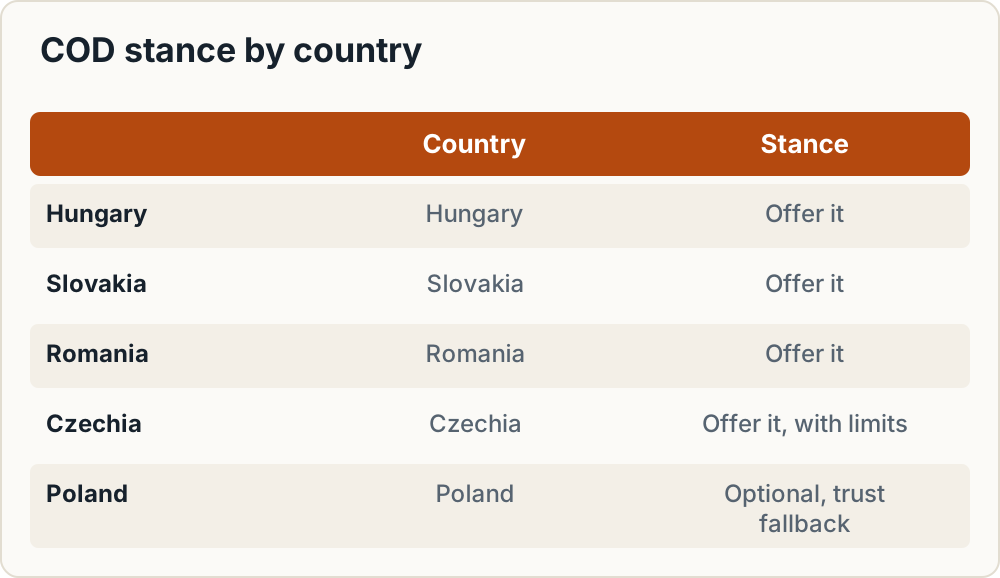
Your own margin matters more than any market average. If a COD order costs you more than it earns once refusals are counted, cap it by basket value, add a surcharge within legal limits (see the compliance section), or limit it to pickup points.
COD share of online orders by country: what the numbers really say
The figures that circulate for cash on delivery in Eastern Europe (about 72% for CZ/SK, 54% for Hungary, about 51% for Romania) appear in vendor blogs such as Elogy, and none of them cite named research. They should not be read as hard facts.
Part of the confusion comes from what is being measured. A survey asking "which payment methods do you use?" lets each respondent pick several, so the shares add up to more than 100%. A figure for "share of orders" counts transactions, often on one shop platform only. A figure for "share of shops offering COD" only tells you how common the option is. All three get quoted as "COD share".
| Country | Figure | What it measures | Year | Source | Source quality |
|---|---|---|---|---|---|
| PL | 41% (another summary: 29%) | Respondents who use COD (multi-choice) | 2025 | Gemius, E-commerce w Polsce 2025, via secondary summaries | Primary report, figures not confirmed against the PDF |
| CZ | 13% | Share of payment methods used | 2025 | APEK data via Česká e-commerce | Industry association data |
| CZ | 31.6% | Share of orders (Shoptet shops) | 2024 | TASR / teraz.sk | Provider data via news agency |
| SK | over 43% | Share of orders (Shoptet, 7,600+ shops) | Published May 2025 | TASR / teraz.sk | Provider data via news agency |
| SK | 25–30%, up to 40% for cheaper goods | Share of orders (Upgates) | Published June 2026 | TASR / teraz.sk | Provider data via news agency |
| HU | over 74% paid on delivery, about 55% in cash | Share of orders, 3,200 merchants | 2019 | GKI Digital via HWSW | Research survey, outdated |
| RO | about 51% | Share of orders, 2025 peak season | 2025 | WAPI | Unsourced blog |
| CZ/SK, HU, RO | 72%, 54%, 51% | Not stated | Not stated | Elogy | Unsourced blog |
Poland
In Poland, COD is a fallback rather than the default. Secondary summaries of the Gemius 2025 report put BLIK at 72%, instant bank transfer at 64% and cards at 43% of respondents who use each method. For COD, one summary gives 41% and another gives 29%, the latter tied to shoppers aged 50 and over. These may answer different questions in the survey, so check the report itself before you quote either number. The same summaries report that 30% of respondents see COD as a sign that a shop is credible, which is the main reason to keep it.
Czechia and Slovakia
The two Czech figures measure different things. APEK data gives dobírka (COD) 13% of payment methods used, behind online card payments (42%) and Google Pay/Apple Pay (23%), and close to bank transfer (12%). Shoptet data reported by TASR puts COD at 31.6% of orders in Czech shops on its platform in 2024. A market-wide survey and the order mix of one shop platform will not give the same number.
Slovakia relies on COD more than Czechia in every source found. In the same TASR report, Shoptet data covering more than 7,600 Slovak shops shows more than 43% of online orders paid by COD. Upgates, also quoted by TASR in June 2026, gives a lower 25–30% of orders, and says it can reach 40% for cheaper goods.
Hungary
Hungary has the best-documented COD market, but the data is old. A GKI Digital survey of 3,200 merchants, published in June 2019, found that more than 74% of online orders were paid on delivery and about 55% in cash. The survey predates Hungary's instant payment system. More recent figures circulate without a named source, so they are left out here. Treat 74% as a 2019 figure, not a current share.
Romania
The roughly 51% COD share for the 2025 peak season appears on WAPI and other logistics blogs without a primary source. Use it as an indication only. What is not in doubt is that COD is standard: the main couriers, including FAN Courier, Sameday, Cargus and DPD, all offer it.
Carrier COD fees by country (2026)
The table below uses each country's local currency. Where a figure comes from a comparison site rather than the carrier's own price list, it is marked as indicative. The carrier's official price list always takes precedence. Contract rates for volume senders are usually lower than list prices.
| Country | Carrier | COD fee | Net/gross | COD limit | Payout | Source quality |
|---|---|---|---|---|---|---|
| PL | InPost Kurier | 1.99 PLN (0–1,000 PLN), 2.99 PLN (1,000–2,000), 3.95 PLN (2,000–5,000) | Net | Higher bands cost more | Not stated | Secondary, check the official PDF |
| CZ | Packeta | 1%, min. 29 CZK | Not stated | Not stated | Weekly | Indicative |
| CZ | DPD | 2%, min. 35 CZK | Not stated | Not stated | 5 days | Indicative |
| CZ | PPL | 1.5%, min. 39 CZK | Not stated | Not stated | 2 days | Indicative |
| CZ | Czech Post | 1.5%, min. 45 CZK, max. 500 CZK | Not stated | Not stated | 14 days | Indicative |
| SK | Packeta | 1%, min. 1.10 EUR | Not stated | Not stated | Weekly | Indicative |
| HU | Foxpost | 300 HUF per parcel up to 15,000 HUF COD, 2% above; plus 0.45% transaction fee on remitted COD (cap 20,000 HUF) | Not stated | Not stated | Not stated | Official price page |
| HU | GLS / Packeta / DPD / Magyar Posta | 490–590 / 390–490 / 500–700 / 700–1,000 HUF | Not stated | Not stated | Not stated | Indicative ranges |
| RO | FAN Courier | 14.00 RON + 2% of amount, plus fuel surcharge | Net (16.94 RON gross) | 5,000 RON | 2 working days | Official |
Worked example: fee on a typical basket
| Basket | Carrier | Calculation | COD fee |
|---|---|---|---|
| 300 PLN | InPost Kurier | Band 0–1,000 PLN | 1.99 PLN net (unconfirmed) |
| 1,500 CZK | Packeta | 1% = 15 CZK, below the 29 CZK minimum | 29 CZK |
| 1,500 CZK | PPL | 1.5% = 22.50 CZK, below 39 CZK | 39 CZK |
| 1,500 CZK | Czech Post | 1.5% = 22.50 CZK, below 45 CZK | 45 CZK |
| 60 EUR | Packeta SK | 1% = 0.60 EUR, below the minimum | 1.10 EUR |
| 25,000 HUF | Foxpost | 2% × 25,000 + 0.45% × 25,000 | 500 HUF + about 113 HUF transaction fee |
| 300 RON | FAN Courier | 14.00 + 2% × 300 | 20.00 RON net before fuel surcharge |
In most of these examples the fixed minimum sets the price, not the percentage. For a small shop with mid-range baskets, the minimum fee is the number to compare between carriers.
Poland: InPost and others
InPost publishes its COD (pobranie) tariff in the InPost Kurier price list valid from 1 March 2026. The net bands above come from secondary sources and have not been checked against the PDF. Tables circulating online show much higher fees for COD amounts above 5,000 PLN, and different amounts for other InPost products. Read the price list for the service you actually use before you price COD.
Czechia and Slovakia: Packeta, PPL, DPD, Czech Post
The Czech comparison data on preprava-baliku.cz lists each carrier's COD fee as a percentage with a minimum. At typical basket values that means you pay the minimum. Payout speed differs more than the fee: PPL pays every 2 days, DPD after 5 days, Packeta weekly and Czech Post after 14 days. At least one other source describes Packeta's fee as 29 CZK plus 1%, which would add 15 CZK on a 1,500 CZK basket, so check Packeta's own price list.
In Slovakia, Packeta published a new delivery price list from 31 March 2026 and has announced a further change from 1 September 2026. The 1%/1.10 EUR figure comes from a comparison site. Confirm the current COD line in Packeta's own price list.
Hungary: GLS, Foxpost, Packeta, MPL
Foxpost's business price page lists a COD handling fee of 300 HUF per parcel up to a COD amount of 15,000 HUF, and 2% above that. It also lists a transaction fee of 0.45% on remitted COD, capped at 20,000 HUF. The page does not say whether these amounts are net or gross, so confirm that in your contract.
The transaction fee shows that COD costs in Hungary can change mid-contract. From 1 August 2024, Foxpost raised it from 0.3% to 0.45% and lifted the cap from 10,000 to 20,000 HUF net, citing a government regulation on bank transaction fees. The indicative ranges for other carriers are rough guides only, and shops set their own customer-facing fee.
Romania: FAN Courier, Sameday
FAN Courier charges 14.00 lei net (16.94 lei with VAT) plus 2% of the reimbursed amount, plus a fuel surcharge. The cap is 5,000 lei per shipment, and the money reaches the sender within 2 working days of delivery. The page also says returning the cash is a separate shipment, charged at 14.00 lei net plus 2%. For that line it shows 16.66 lei with VAT, which implies 19% VAT, while 16.94 lei implies the current 21%. The page appears to mix old and new rates. For Sameday, the public tariff information we found did not clearly state a COD fee, so check Sameday's own price list before you compare.
Refusal and return rates: what is known and what is not
No regulator or carrier publishes COD refusal rates by country. Every figure in circulation comes from operators with something to sell:
- Elogy: between a third and half of orders in COD-heavy markets may be rejected at the door. No source is given.
- BigArena, from its own fulfilment experience: delivery success of 85–92% for PL, CZ, SK and HU. Romania: 90–95% for supplements, 86–92% for fashion and 80–88% for electronics over 200 EUR. That implies failure rates of roughly 5–20% depending on category.
These are ranges from fulfilment practice, not statistics. The gap between "8–15% fail" and "33–50% rejected" shows why your own data is the only number worth using.
Track three outcomes separately, because they cost different amounts and follow different rules:
- Refused at the door: the courier returns the parcel and you pay outbound and return shipping.
- Not collected at a pickup point: the parcel waits for the storage period, then comes back.
- Statutory withdrawal: the customer accepts and pays, then withdraws within 14 days (see the compliance section).
Break-even maths: when COD stops paying
The following assumes the customer pays shipping when the parcel is delivered, and the shop absorbs the COD fee. Expected profit per COD order placed:
Profit = (1 − r) × M − F − r × (S_out + S_ret + H)
where r is the refusal rate, M the gross margin per delivered order, F the COD fee, S_out and S_ret the outbound and return shipping you absorb on a refusal, and H the handling cost of a return. If your carrier charges F only on delivered parcels, replace F with (1 − r) × F. If extra charges apply to the remittance, such as FAN Courier's separately charged cash return or Foxpost's transaction fee, add them to F.
Setting profit to zero gives the break-even refusal rate:
r* = (M − F) / (M + S_out + S_ret + H)
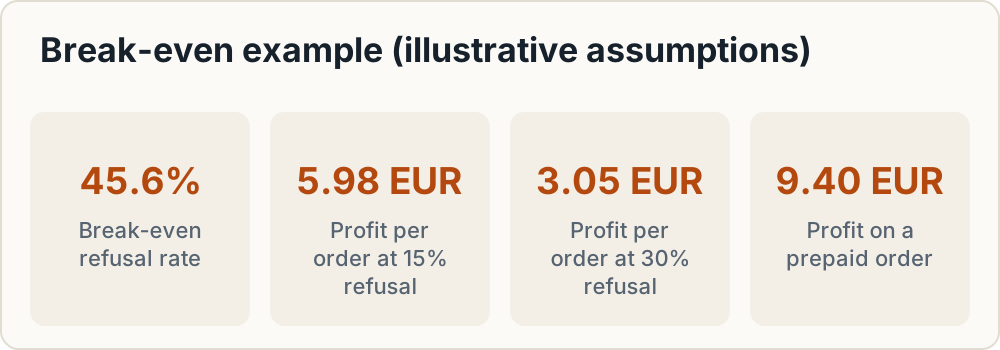
Worked example with illustrative assumptions (not market data): a 40 EUR basket at 25% gross margin (M = 10 EUR), a COD fee of 1.10 EUR, 4 EUR each way for shipping and 1.50 EUR handling.
| Item | Value |
|---|---|
| Break-even refusal rate | (10 − 1.10) / (10 + 4 + 4 + 1.50) = 8.90 / 19.50 ≈ 45.6% |
| Profit at 15% refusal | 0.85 × 10 − 1.10 − 0.15 × 9.50 ≈ 5.98 EUR |
| Profit at 30% refusal | 0.70 × 10 − 1.10 − 0.30 × 9.50 ≈ 3.05 EUR |
| Prepaid order, assuming 0.60 EUR payment fee | 9.40 EUR |
Breaking even is not the same as being worth it. At a 15% refusal rate, each COD order earns about 3.40 EUR less than a prepaid one. COD pays off only if it brings in orders that would not otherwise happen, or if it brings in customers who later buy prepaid. Run the formula on your own figures, by country and by product category.
How to cut COD refusals without losing the order
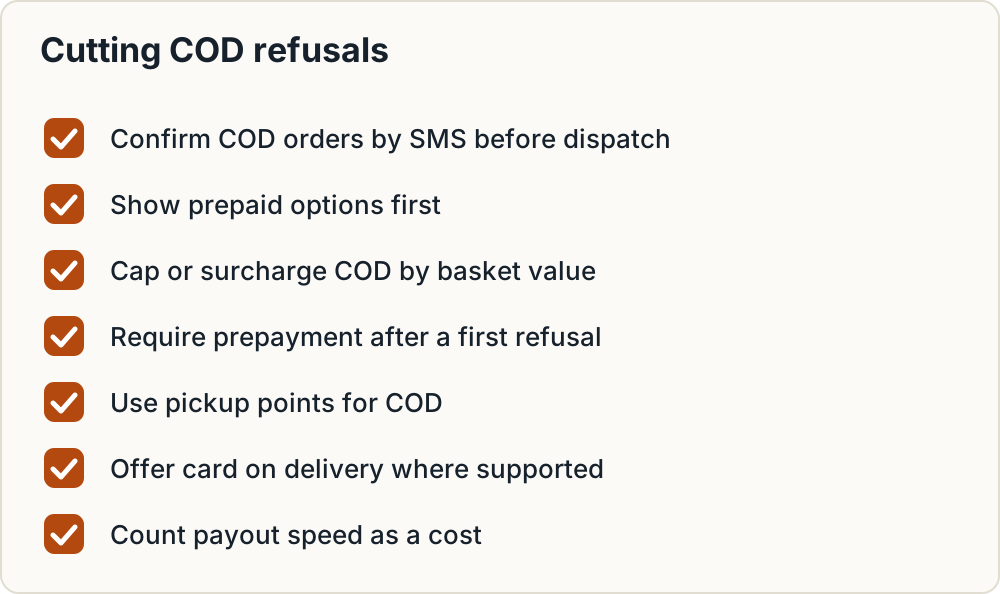
- Confirm before dispatch. Send an SMS or messaging-app confirmation for COD orders, and hold the order until the customer confirms.
- Show prepaid options first. In Poland, put BLIK and instant transfer at the top. Elsewhere, put card and instant payment first.
- Cap or surcharge by basket value. Limit COD above a value where one refusal wipes out several orders' margin, within the surcharge rules below.
- Require prepayment after a first refusal. Flag the customer account and the delivery address.
- Use pickup points for COD. This avoids the cost of failed doorstep deliveries. Uncollected parcels still come back, so track them.
- Offer card payment on delivery where your carrier supports it. It removes the "no cash on me" excuse. Check which services offer it in your contract.
- Count payout speed as a cost. FAN Courier pays within 2 working days. In Czechia, comparison data shows PPL paying every 2 days, Packeta weekly and Czech Post after 14 days. Slow payout ties up working capital.
Shared customer-reputation or blacklist services exist in some of these markets. Sharing data about customers' refusals is processing of personal data under the GDPR, so check the legal basis and the provider's documentation before connecting one.
Legal and compliance notes
Right of withdrawal. Under the Consumer Rights Directive 2011/83/EU, consumers can withdraw from a distance contract within 14 days of delivery without giving a reason. The trader must refund within 14 days of being told. The consumer bears the direct cost of the return only if they were properly informed beforehand. Refusing a COD parcel at the door is not the same as a withdrawal notice. How a refusal is treated depends on national law and the carrier's terms, so check this in each country.
Payment surcharges. Article 19 of the same Directive requires member states to stop traders from charging consumers fees for a given means of payment that exceed the cost the trader bears for it. A COD surcharge therefore cannot exceed your actual cost of offering COD. Article 22 also requires the consumer's express consent to any extra payment, so a pre-ticked option does not count. Check how PL, CZ, SK, HU and RO have written this into national law before you set a surcharge.
VAT on carrier fees. Price lists mix net and gross amounts. FAN Courier's 16.94 lei gross on 14.00 lei net reflects 21% VAT, while its 16.66 lei line implies 19%. Confirm the rate on your invoice. The InPost figures above are net, and Foxpost's page does not say which basis it uses.
Frequently asked questions
Which CEE country relies on cash on delivery the most?
Hungary has the strongest record: a 2019 GKI Digital survey of 3,200 merchants found more than 74% of online orders paid on delivery. Among recent sourced figures, Slovakia stands out, with Shoptet reporting more than 43% of orders paid by COD. Poland relies on it least, because BLIK and instant transfers dominate.
How fast do couriers pay out collected COD money?
FAN Courier in Romania pays the sender within 2 working days of delivery, according to its own service page. Czech comparison data shows PPL paying every 2 days, DPD after 5 days, Packeta weekly and Czech Post after 14 days. Check the payout schedule in your contract, because it determines how much cash COD ties up.
Can a webshop charge customers extra for cash on delivery?
Under Article 19 of Directive 2011/83/EU, a fee for a payment method must not exceed the trader's own cost of that method. Under Article 22, the customer must expressly agree to it. Check the national rules in each country before adding a COD surcharge.
Is a refused COD parcel the same as a withdrawal from the contract?
No. A withdrawal under Directive 2011/83/EU is a decision the consumer communicates within 14 days of delivery, and it comes with refund and return-cost rules. A doorstep refusal is a failed delivery, and its consequences depend on national law and the carrier's terms. Treat the two separately in your terms and in your reporting.
What is a normal COD refusal rate?
No official figure exists for any CEE country. Fulfilment operators quote anything from roughly 8–15% failed deliveries to "a third to half" of orders, without independent sources. Measure your own rate per country and per category, and compare it with your break-even rate.
Checklist: COD setup by country
| Country | Main COD carrier (examples) | Indicative fee | Payout | Stance |
|---|---|---|---|---|
| PL | InPost | 1.99–3.95 PLN net up to 5,000 PLN (unconfirmed) | Check contract | Optional, trust fallback |
| CZ | Packeta, PPL, DPD, Czech Post | 29–45 CZK minimum (indicative) | 2 to 14 days | Offer, with value cap |
| SK | Packeta | 1%, min. 1.10 EUR (indicative) | Weekly (indicative) | Offer |
| HU | Foxpost, GLS, Packeta | Foxpost 300 HUF up to 15,000 HUF COD; others indicative 390–590 HUF | Check contract | Offer, with card on delivery where available |
| RO | FAN Courier | 14.00 RON + 2% net, plus fuel | 2 working days | Offer, with confirmation step |
Before you switch COD on:
- Read the carrier's official price list for the COD line, the VAT basis, any remittance or transaction fee, and whether the fee applies to refused parcels.
- Calculate your break-even refusal rate per country with the formula above.
- Add order confirmation for COD orders and a prepayment rule for repeat refusers.
- Keep any COD surcharge at or below your real cost and get express consent for it.
- Track refusals, uncollected parcels and withdrawals as separate metrics, and recheck fees every quarter.
Sources
What this guide relies on, in the order cited.
- Elogy · elogy.io
- Gemius, E-commerce w Polsce 2025 · gemius.com
- APEK data via Česká e-commerce · ceska-ecommerce.cz
- TASR / teraz.sk · teraz.sk
- TASR / teraz.sk · teraz.sk
- GKI Digital via HWSW · hwsw.hu
- WAPI · wapi.com
- official PDF · inpost.pl
- Indicative · preprava-baliku.cz
- Indicative · posielanie-balikov.sk
- Official price page · foxpost.hu
- Indicative ranges · hello-life.eu
- Official · fancourier.ro
- published a new delivery price list from 31 March 2026 · packeta.sk
- raised it · foxpost.hu
- BigArena · bigarena.net
- Consumer Rights Directive 2011/83/EU · eur-lex.europa.eu