
On this page
- What COD really costs per order (and why the carrier fee is the smallest part)
- The formula
- Worked example with real inputs (all assumptions labelled)
- Copy-ready COD calculator table
- What carrier fees look like: verified figures and what to ask for
- Refusal rates: what data exists and how to treat it
- Decision table: keep, restrict, surcharge or drop COD
- How to reduce COD refusals and returns
- Compliance notes
- Frequently asked questions
- Next steps
This guide explains how the rules work in practice. It is not legal or tax advice; check the linked official sources or ask an adviser for your specific case.
The carrier's COD fee rarely decides whether cash on delivery pays off. Refused parcels do. On each refusal you pay outbound and return shipping, handle the parcel and get no sale. So the useful question for cash on delivery cost calculation in e-commerce is how many extra orders COD has to bring to beat a prepaid checkout at your refusal rate. In our worked example, a shop with a 15% refusal rate needs about 1.34 COD orders for every prepaid order it would otherwise get. Cross-border home delivery to Romania pushes that to roughly 2x.
This article is the calculator. For a country-by-country overview of fees, see COD fees and refusal risk by country.
What COD really costs per order (and why the carrier fee is the smallest part)
A COD order has four cost layers:
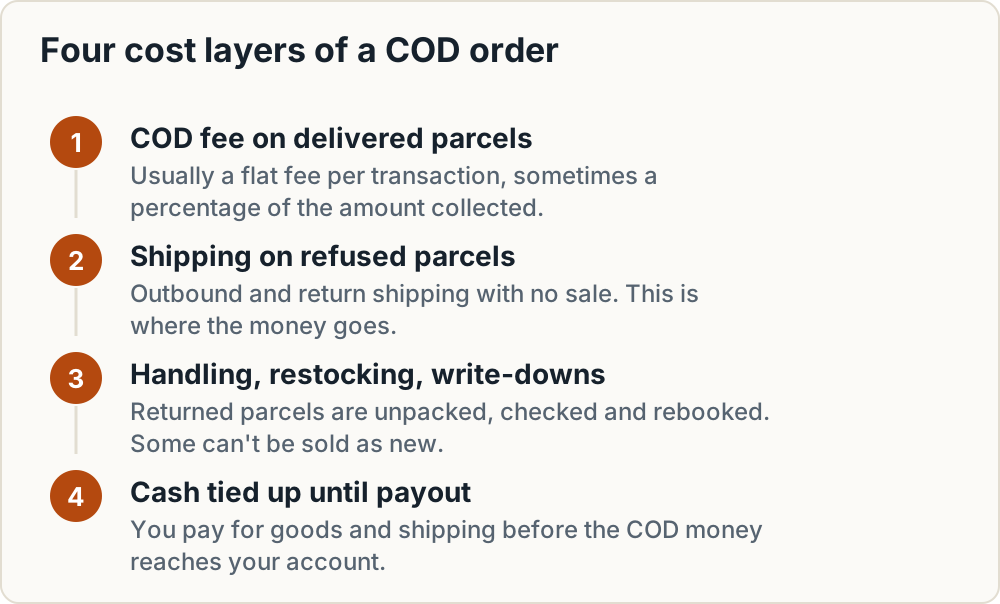
- COD fee on delivered parcels. Usually a flat fee per transaction, sometimes a percentage of the amount collected.
- Outbound and return shipping on refused or uncollected parcels. This is where the money goes. In our base case below, one refusal wipes out about two-thirds of the profit from a delivered order.
- Handling, restocking and write-downs. Someone has to unpack, check and rebook every returned parcel. Some come back damaged or can no longer be sold as new.
- Cash tied up until payout. You pay for the goods and the shipping before the money reaches your account. DPD CZ, for example, pays standard COD on the 3rd working day after delivery and express COD on the next working day.
Layer 1 shows up on every carrier invoice. Layers 2 and 3 are spread across returns reports and staff time, so they are easy to miss.
The formula
Use these definitions:
- r = refusal or non-pickup rate for COD parcels
- CM = contribution margin before shipping: price minus product cost, packaging and any other variable costs that don't depend on the payment method
- S_out = outbound shipping, S_ret = return shipping
- F_cod = COD fee, H = handling per return, W = average write-down per return (the value lost on unsellable items)
Expected profit per COD order = (1 − r) × (CM − S_out − F_cod) − r × (S_out + S_ret + H + W)
Prepaid profit per order = CM − S_out − gateway fee
For gateway fee inputs, see payment gateway fees in Poland and Czechia and HU and RO gateway fees.
Break-even uplift = prepaid profit per order ÷ COD profit per order
The break-even uplift is the number that decides the question. It tells you how many COD orders you need to match the profit of one prepaid order. If dropping COD would lose you fewer orders than that, prepaid wins.
Break-even refusal rate for an expected uplift U is the value of r at which U × COD profit = prepaid profit. In practice it is the highest refusal rate you can tolerate, given how many extra orders you think COD really brings.
Worked example with real inputs (all assumptions labelled)
These inputs describe a Czech shop sending to Packeta pick-up points:
| Input | Value | Source or status |
|---|---|---|
| Order value | 1,200 CZK | Assumption |
| Contribution margin before shipping | 420 CZK (35%) | Assumption |
| Outbound shipping, pick-up point CZ | 89 CZK | Packeta Between Us price list, valid from 1 June 2026, VAT incl. |
| COD fee | 26 CZK | Same price list |
| Return shipping | 89 CZK | Assumption (equal to outbound) |
| Handling per return | 20 CZK | Assumption |
| Write-down | 0 CZK | Assumption (all returns resold) |
| Prepaid gateway cost | 24 CZK (2%) | Assumption |
The Packeta figures come from the consumer "Between Us" price list. E-shop contract rates are not published there and will usually be different. The figures also include VAT. A VAT-registered shop should use net amounts in its own model.
Per-order outcomes:
- Delivered COD order: 420 − 89 − 26 = 305 CZK
- Refused COD order: −(89 + 89 + 20) = −198 CZK
- Delivered prepaid order: 420 − 89 − 24 = 307 CZK
So COD profit per order = 305 − 503 × r.
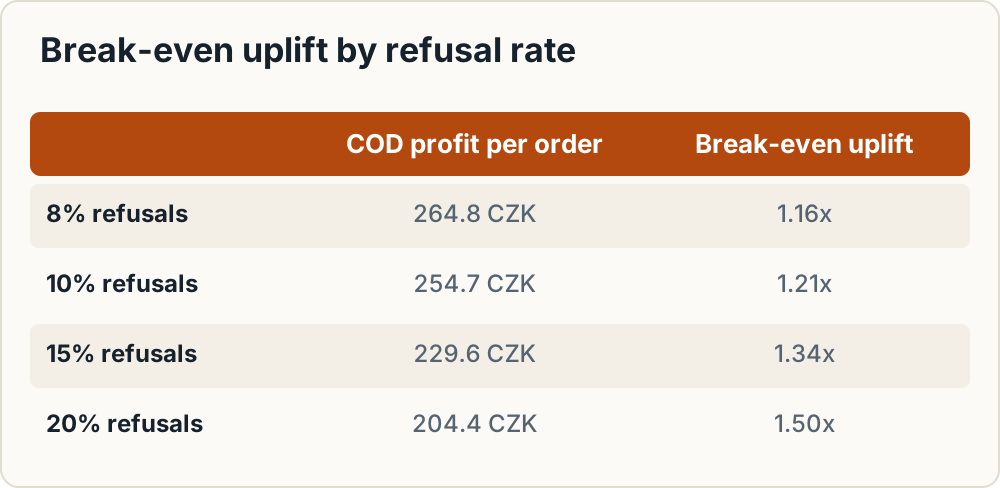
| Refusal rate r | COD profit per order | Break-even uplift (307 ÷ COD profit) |
|---|---|---|
| 8% | 264.8 CZK | 1.16x |
| 10% | 254.7 CZK | 1.21x |
| 15% | 229.6 CZK | 1.34x |
| 20% | 204.4 CZK | 1.50x |
In this example COD only makes a loss once r passes about 60.6% (305 ÷ 503). Even so, it falls behind prepaid much earlier. At a 15% refusal rate, COD has to bring about 34% more orders than a prepaid-only checkout just to break even. And if you expect COD to lift orders by 30% (U = 1.3), the highest refusal rate you can afford is (305 − 307 ÷ 1.3) ÷ 503 ≈ 13.7%.
Sensitivity: home delivery and cross-border
The same formula and margin, with return shipping still assumed equal to outbound and the COD fee still assumed to be 26 CZK. Check the COD fee for cross-border parcels in your own contract. Delivery prices are from the same Packeta Between Us list.
| Scenario | Delivered COD | Refused | Prepaid | Uplift at r = 10% | Uplift at r = 15% |
|---|---|---|---|---|---|
| CZ pick-up point (89 CZK) | 305 | −198 | 307 | 1.21x | 1.34x |
| CZ home delivery (129 CZK) | 265 | −278 | 267 | 1.27x | 1.45x |
| RO pick-up point (119 CZK) | 275 | −258 | 277 | 1.25x | 1.42x |
| RO home delivery (209 CZK) | 185 | −438 | 187 | 1.52x | 2.04x |
Shipping costs hit COD twice, because every refused parcel pays for both legs. In the RO home-delivery case, COD makes a loss at about 29.7% refusals. A 15% refusal rate already means you need about twice the orders.
Expensive items make this worse. BigArena, a fulfilment company, reports lower COD success for electronics over 200 EUR in Romania (80–88%). That implies a refusal rate of 12–20%. Take the RO pick-up point row at r = 20%: COD profit drops to 168.4 CZK and the break-even uplift rises to 1.64x. That is before any write-down on returned electronics.
Copy-ready COD calculator table
Copy this into a spreadsheet, one column per country, carrier and delivery type.
| Row | Input or formula | Your value |
|---|---|---|
| A | Average order value | |
| B | Product cost + packaging + other variable costs | |
| C | Contribution margin = A − B | |
| D | Outbound shipping (net of VAT if you reclaim it, incl. fuel/toll surcharges) | |
| E | COD fee (flat, or % × A) | |
| F | Return shipping for refused parcel | |
| G | Handling per return | |
| H | Share of returns resold as new (%) | |
| I | Write-down = (1 − H) × B × your loss rate on unsellable items | |
| J | Refusal rate r | |
| K | Gateway fee for prepaid = % × A + fixed fee | |
| L | Expected order uplift from offering COD | |
| Out 1 | COD profit = (1 − J) × (C − D − E) − J × (D + F + G + I) | |
| Out 2 | Prepaid profit = C − D − K | |
| Out 3 | Break-even uplift = Out 2 ÷ Out 1 | |
| Out 4 | Break-even refusal rate = (C − D − E − Out 2 ÷ L) ÷ (C − E + F + G + I) |
Out 4 is the formula above rearranged: COD profit = (C − D − E) − r × (C − E + F + G + I).
How to get r from your own data. Take the number of refused plus uncollected parcels and divide it by the COD parcels shipped over the last 90 days. Split the result by country, carrier and order value band. Don't use a blended average across countries. A low Czech rate can hide a high rate on Romanian home deliveries.
What carrier fees look like: verified figures and what to ask for
Most carriers don't publish COD fees or return fees for e-shop contracts. Those are negotiated. The public figures below are reference points, not your rates.
| Carrier | Figure | Source |
|---|---|---|
| Packeta (Between Us, from 1 June 2026, VAT incl.) | COD 26 CZK per transaction, max COD value 10,000 CZK; pick-up point CZ 89, SK 99, HU 109, RO 119 CZK; home delivery CZ 129, SK 169, HU 199, RO 209 CZK; storage 15 CZK per day | Packeta price list |
| Zásilkovna | Fuel surcharge 19.5% from 1 October 2026 on transport fees excl. VAT, reset monthly from the EU Oil Bulletin diesel price; toll surcharge 1.10 CZK per commenced kg (excl. VAT) from 1 February 2026 | Zásilkovna pricing |
| DPD CZ | COD limits: domestic 50,000 CZK cash, 200,000 CZK by card, international equivalent of 2,500 EUR; payout on 3rd working day (standard) or next working day (express) | DPD CZ additional services |
| DPD CZ | COD to CZ, SK, PL, HU, SI, HR, BG, RO; card payment at the door by CZ and SK recipients costs an extra 1% of the COD amount | DPD CZ COD FAQ |
| InPost PL | From 1 March 2026, business return via Paczkomat 12.84 zł (A), 14.55 zł (B), 18.55 zł (C) | chip.pl |
The InPost source doesn't give a COD fee, so we haven't stated one. Check your InPost contract. BigArena, a fulfilment company, puts courier COD fees at about 0.30–0.60 EUR per parcel on top of shipping. That is a vendor figure, not a price list.
The Zásilkovna pricing page doesn't say whether the fuel surcharge also applies to the COD fee or to return legs. Ask your account manager. At 19.5%, it changes rows D and F noticeably.
Numbers to pull from your own contract
- COD fee: flat or percentage, and whether it changes with order value
- Return fee for refused or uncollected parcels
- Whether the COD fee is charged or refunded when a parcel is refused
- Free pickup days at the pick-up point and the storage fee after that
- Payout day and payout frequency
- Currency conversion rate and fee for cross-border COD
- Whether fuel and toll surcharges apply to return legs
- Maximum COD value per parcel
To compare carriers, see carriers for small CEE shops, Romania couriers compared and shipping CZ/PL to Romania and Hungary.
Refusal rates: what data exists and how to treat it
We found no regulator or carrier that publishes refusal rates by country. The only figures we found come from BigArena, a fulfilment company, and they haven't been audited:
| Market | Reported COD delivery success | Implied refusal rate |
|---|---|---|
| Serbia, Slovakia, Czechia, Hungary, Poland | 85–92% | 8–15% |
| Romania, supplements | 90–95% | 5–10% |
| Romania, fashion | 86–92% | 8–14% |
| Romania, electronics over 200 EUR | 80–88% | 12–20% |
| Bulgaria (by category) | 88–97% | 3–12% |
We've taken the implied refusal rate as 100% minus the success rate. BigArena's definitions may count things differently. Running our base case across the 8–20% range gives a break-even uplift of 1.16x to 1.50x. Your own 90-day data overrides these figures.
Decision table: keep, restrict, surcharge or drop COD
| Situation | Recommended action |
|---|---|
| Break-even uplift under about 1.1x, low refusal rate | Keep COD as is; review the numbers every quarter |
| Break-even uplift 1.1–1.4x | Keep COD, but only for pick-up points; add phone or SMS confirmation |
| Break-even uplift above 1.4x, or above the uplift you can realistically expect | Restrict hard or drop COD in that country or channel |
| High-value orders | Require prepayment above a set order value; never go above the carrier's maximum (Packeta: 10,000 CZK) |
| First-time customers | Require confirmation before dispatch; consider prepayment above a lower threshold |
| Repeat customers with successful COD history | Keep COD available |
| Customers with a refusal history | Remove COD for them in the shop |
| Home delivery or remote areas | Offer COD only at pick-up points or lockers |
A COD order-value cap interacts with your free shipping threshold. Work through both together with the per-country free shipping threshold worksheet.
How to reduce COD refusals and returns
- Confirm orders before dispatch. BigArena reports a 4–7 percentage-point improvement in delivery success on supplements campaigns with confirmation enabled. This is a vendor claim from one product category. In our base case, going from 15% to 10% refusals cuts the break-even uplift from 1.34x to 1.21x.
- Send SMS notifications in the local language with the delivery date and pickup deadline.
- Validate addresses before printing labels. Wrong addresses lead to uncollected parcels.
- Steer COD buyers to pick-up points or lockers. In Packeta's public list, pick-up point delivery costs less than home delivery, so a refusal costs less if return legs are priced the same way. Check your return pricing. See parcel locker delivery setup.
- Offer a small prepaid discount instead of a COD surcharge. Check the legal position first (see below).
- Flag repeat refusers in your shop system and hide COD for them.
- Get returns back into sellable stock fast, and check their condition on arrival, so fewer items end up written down (row I).
For the wider setup, see shipping setup for a small CEE webshop.
Compliance notes
A customer refusing a parcel at the door does not automatically count as exercising the 14-day withdrawal right. You still need a working withdrawal process and correct refund timing. See 14-day withdrawal right.
Who bears the return shipping after a refusal, and whether you may pass a COD fee on to the customer, depends on EU consumer law and how each country has implemented it. We haven't verified the national rules for this article. Check them with the consumer authority in each target country, or with an adviser, before you add a COD surcharge or bill customers for refused parcels. The same applies to cash handling limits and to VAT or invoicing for COD orders. These vary by carrier and country.
Frequently asked questions
Does the Packeta 26 CZK COD fee apply to my e-shop contract?
Not necessarily. The 26 CZK figure is from Packeta's consumer "Between Us" price list valid from 1 June 2026, and it includes VAT. E-shop contract rates are negotiated and not published there, so use the rate on your own invoice.
Should I use published refusal rates or my own?
Use your own. The only refusal figures we found come from a fulfilment company and haven't been audited. Your own 90-day data, split by country, carrier and order value band, describes your customers far better.
Why does COD look worse for cross-border home delivery?
Every refused parcel pays for both shipping legs, so higher shipping prices count twice. In our example, Romanian home delivery at 209 CZK pushes the break-even uplift to about 2x at a 15% refusal rate. The same rate gives 1.34x for Czech pick-up points.
Does a confirmation call pay for itself?
Work it out per order. BigArena, a fulfilment company, reports a 4–7 percentage-point improvement in delivery success on supplements campaigns. In our base case, 5 points less refusal is worth about 25 CZK per COD order (503 CZK × 0.05). If a call costs you less than that in staff time, and your refusals fall by a similar amount, it pays.
How long until the carrier pays out the COD money?
It depends on the carrier and your contract. DPD CZ usually issues the payment order on the 3rd working day after delivery for standard COD, and on the next working day for express COD. For other carriers, check the payout terms in your contract.
Next steps
- Export 90 days of COD shipments and outcomes, split by country, carrier, delivery type and order value band.
- Fill in the calculator table with your contract rates, net of VAT if you reclaim it, including fuel and toll surcharges.
- Compare the break-even uplift with a realistic estimate of the orders COD brings. Then set rules per country using the decision table.
- Ask your carrier the contract questions from the checklist, especially about return fees and surcharges on returns.
- Review the alternatives: COD fees and refusal risk by country and gateway payouts and reserves.
- Rerun the numbers every quarter, or whenever a carrier changes its price list.
Sources
What this guide relies on, in the order cited.
- on the 3rd working day after delivery and express COD on the next working day · dpd.com
- Packeta Between Us price list · packeta.com
- reports lower COD success for electronics over 200 EUR in Romania · bigarena.net
- Zásilkovna pricing · zasilkovna.cz
- DPD CZ COD FAQ · dpd.com
- chip.pl · chip.pl