
On this page
- Can a non-Romanian seller sell on eMAG? Short answer and who it suits
- Registration step by step for a foreign EU company
- eMAG Marketplace fees and commission categories
- Fulfilment: own shipping vs Fulfilment by eMAG (FBE)
- Hungary and Bulgaria through Cross-Border
- VAT, OSS and the Romanian warehouse trap
- Frequently asked questions
- Pre-launch checklist
This guide explains how the rules work in practice. It is not legal or tax advice; check the linked official sources or ask an adviser for your specific case.
Yes, a company from another EU country can sell on eMAG Marketplace without setting up a Romanian entity. Commission runs from 7% to 25% depending on category, and there is no subscription fee. Three questions decide whether the channel works for you. First, what you will actually pay in your categories, because eMAG only shows that grid in the contract. Second, whether you ship your own stock or use Fulfilment by eMAG (FBE). Third, whether holding stock in Romania creates VAT obligations there.
Can a non-Romanian seller sell on eMAG? Short answer and who it suits
eMAG's partner registration page asks for your country of registration in the first step. It refers to VAT registration for selling in the EU and has a section for international sellers. The page does not spell out which countries are eligible. The Harta agency guide, a third-party source, is more explicit: you need an EU company with an active EU VAT number, and you do not need a Romanian entity.
One seller relationship can reach three markets through eMAG's Cross-Border programme: Romania, Bulgaria and Hungary. When eMAG launched cross-border FBE in 2023, it cited more than 9 million customers across the three countries, as reported by Wall-Street.ro. That is eMAG's own figure, not an independent audit.
eMAG is likely to work for you if:
- you run an EU-registered company with an EU VAT number
- your products can legally be sold in Romania, Hungary and Bulgaria
- you can supply product safety data (see our guide to GPSR fields on Allegro, Kaufland and eMAG)
- you can meet packaging obligations in the destination countries (see packaging EPR in Poland, Czech Republic, Romania, Slovakia and Hungary)
Skip it for now if you have no VAT registration, your margins cannot absorb a commission at the upper end of the 7–25% range, or you are not willing to settle VAT questions with an accountant before stock goes to Romania.
Registration step by step for a foreign EU company
eMAG's registration page describes the process as follows:
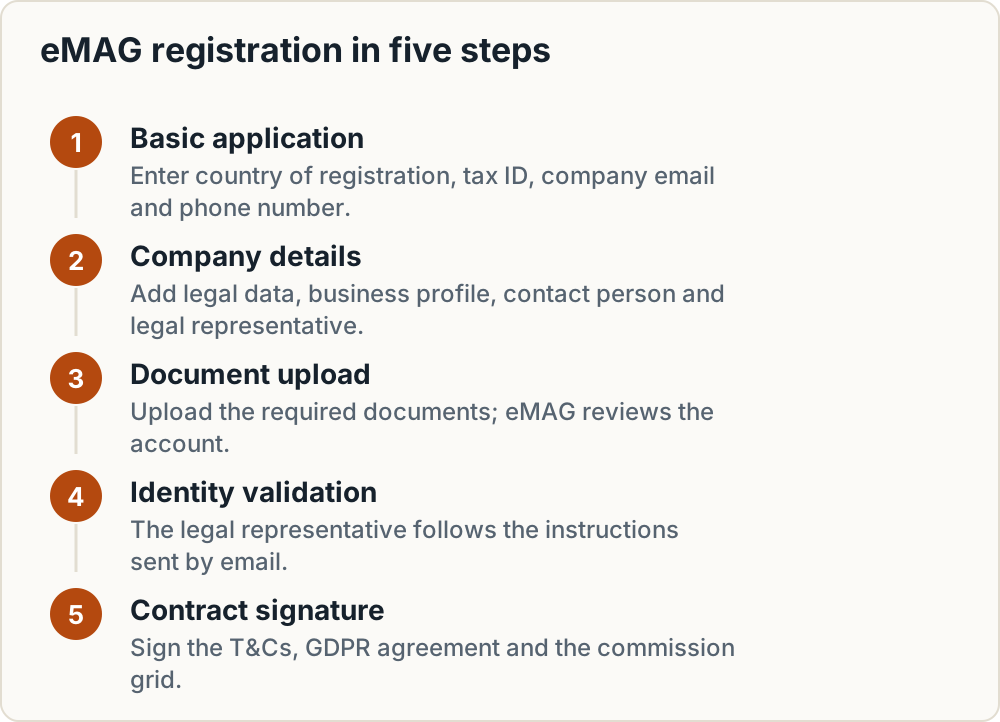
- Basic application. Enter your country of registration, tax ID, company email and phone number.
- Company details. Add legal company data, your business profile, a contact person and the legal representative.
- Document upload and verification. Upload the documents listed below. eMAG then reviews the account.
- Identity validation. The legal representative completes an identity check by following the instructions eMAG sends by email.
- Contract signature. Once approved, you sign the Terms & Conditions with their annexes, a GDPR agreement and the commission grid for the categories you have access to.
Documents to prepare
| Document | Notes |
|---|---|
| ID card or passport of the legal representative | Should match the person named in step 2 |
| Articles of association | Updated version |
| Trade register certificate | From your national register |
| VAT certificate | "If applicable", per eMAG. Harta says an active EU VAT number is needed |
| Bank statement | Must show the company name or tax code |
| Utility bill or similar document | Must prove ownership or existence of the registered office |
Files must be PNG, JPG or PDF, and no larger than 15 MB each. Harta lists inconsistent company data, illegible documents and missing information as common reasons for rejection. Check that names and addresses match across every document before you upload.
The Romanian pickup point for lockers
In the locker-delivery section of the same page, eMAG says international sellers must provide a pickup point in Romania. eMAG recommends agreeing a drop-off point in Romania with your couriers. Once parcels reach that point, eMAG takes over delivery to the locker. eMAG states that locker delivery within Romania costs nothing, and cross-border locker delivery from Romania to Bulgaria and Hungary costs 5 RON. Because the rule sits in the locker section, ask your onboarding contact whether it applies to your setup before you arrange a Romanian address.
eMAG Marketplace fees and commission categories
eMAG's taxes and commissions page publishes the following:
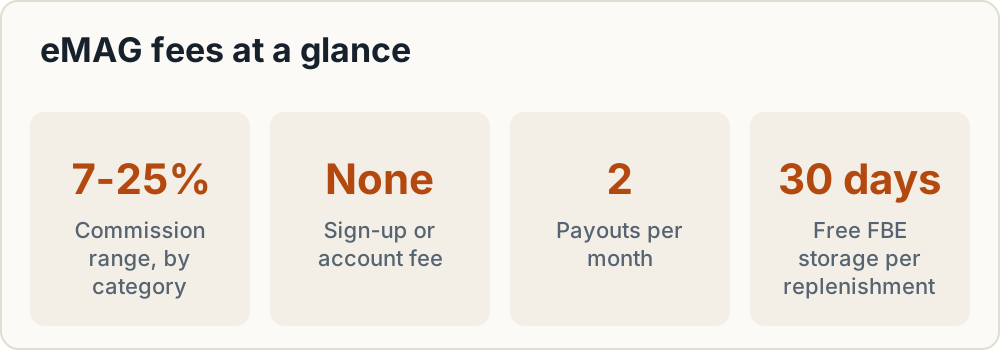
- Commission of 7% to 25%, depending on product category
- No sign-up fee, account management fee or customer support fee
- Payouts twice a month, with commission already deducted
- The fee grid is shown in the contract, before you sign
eMAG does not publish category-by-category rates. You only see the exact rate for your products at the contract stage.
About third-party commission tables
Several sites publish eMAG commission tables. Marqetir's fee page, updated July 2026, lists:
| Category (Marqetir) | Commission (unverified) |
|---|---|
| Electronics | 7% |
| Home & Garden, Automotive | 8% |
| Sports & Outdoor, Toys & Baby | 9% |
| Fashion, Beauty & Health, Food & Grocery | 10% |
| Books & Media | 12% |
| Jewellery & Accessories | 15% |
Treat these figures as unverified. eMAG's official range goes up to 25%, and Marqetir's own text cites that range, yet its table stops at 15%. Some categories must therefore cost more than any table shows. Do not build a business case on these numbers. Ask for the grid for your exact categories.
Building a margin check
According to eMAG, commissions are the same in all three countries. For each product, your margin model should include:
- Selling price including destination-country VAT
- Minus VAT (Romanian, Hungarian or Bulgarian rate, depending on your VAT setup)
- Minus eMAG commission from your contract grid
- Minus courier cost (own shipping) or FBE processing and storage
- Minus an allowance for returns and damaged items
- Minus product cost and inbound freight
Cash on delivery is still widely used in the region. eMAG's public fee pages do not explain how it is handled for marketplace sellers, so ask about it during onboarding. For background, see cash on delivery in Eastern Europe and payment methods for CEE e-commerce.
Fulfilment: own shipping vs Fulfilment by eMAG (FBE)
Option A: own stock and integrated couriers
Under Cross-Border, integrated couriers pick up from your warehouse in Romania and deliver to Bulgaria and Hungary. You must sign a transport contract with at least one courier company. eMAG's Bulgarian Cross-Border page names Sameday and Fan Courier as the eligible couriers. Confirm the current list when you sign up.
This route assumes your stock is in Romania. eMAG Hungary's FAQ also describes courier pickup from warehouses in Hungary for delivery to Romania. Harta says foreign sellers can also ship from their own EU warehouse. If your stock is elsewhere in the EU, ask eMAG which routes and couriers are supported for your location.
Option B: Fulfilment by eMAG
Under FBE, eMAG handles storage, order processing, pickup, packing, delivery, customer care and returns for Romania, Bulgaria and Hungary. eMAG says its warehouse covers more than 240,000 sqm.
FBE costs, as published:
- The first 30 days of storage are free for each replenishment.
- After that, the storage fee depends on the age of the stock.
- The processing fee is "from 3.40 RON" per unit on the FBE page but "starting at 3.99 RON" on the taxes page. eMAG's own pages disagree, so treat roughly 3.40–3.99 RON per unit as the floor. The actual fee depends on dimensions, weight and category.
- eMAG offers a downloadable cost simulator on the taxes page. Run your real SKUs through it rather than relying on the minimum fee.
Cross-border FBE launched in May 2023. At launch, eMAG described it as carrying no additional costs for sellers. Orders for Bulgaria and Hungary ship from its logistics hubs in Joița, Giurgiu County. That was a 2023 press statement, so confirm the current terms in your contract.
Compliance: goods sent to FBE must meet the legal requirements of national and European legislation. You must also supply product, volume, storage and handling data before the first shipment.
Decision table
| Own stock + couriers | FBE | Independent 3PL in Romania | |
|---|---|---|---|
| Stock location | Your warehouse (RO, or as eMAG supports) | eMAG warehouse in Romania | 3PL warehouse in Romania |
| Courier contract | You sign at least one | Handled by eMAG | Usually via the 3PL |
| Customer care and returns | You | eMAG | You or the 3PL |
| Main cost lines | Courier rates, your labour | Processing + storage after 30 days | 3PL fees + courier |
| Romanian VAT exposure | Possible if stock is in RO; confirm with an accountant | Possible, stock is in RO; confirm with an accountant | Possible, stock is in RO; confirm with an accountant |
| Suits | Sellers already set up in Romania | Sellers who want eMAG to handle logistics and returns | Sellers using several channels in Romania |
Independent fulfilment providers in Romania, such as Fast FulFill, offer a third route. Treat any provider's comparison with FBE as that provider's own view.
Hungary and Bulgaria through Cross-Border
Enrolment
According to the Cross-Border page, you sign the legal documents separately on each platform (marketplace.emag.ro, .bg and .hu) and then sign a transport contract with at least one courier.
Turn on automatic export. With it on, eMAG translates your products into Hungarian and Bulgarian free of charge and lists them with synchronised price and stock. If you transfer products manually, they get different identifiers and you lose price and stock synchronisation, which risks overselling.
Automatic translation will not catch everything. Have a native speaker review your top sellers, especially safety warnings and size information.
Currency
eMAG converts prices to the local currency automatically and pays you in the local currency.
- Bulgaria adopted the euro on 1 January 2026 at 1 EUR = 1.95583 BGN. eMAG's euro transition notice says BGN is no longer an option in publishing templates, so prices are submitted in EUR. Bulgarian payouts are processed in EUR. Bulgaria's mandatory dual BGN/EUR price display period ended on 8 August 2026.
- Hungary still uses the forint. Your margin model needs to cover exchange-rate movements against HUF.
eMAG Hungary for foreign sellers
For a non-Hungarian company, the usual route to becoming an eMAG Hungary seller is Cross-Border. The lower-commission Open Hungary scheme is not open to foreign resellers (see the FAQ below). For extra Hungarian traffic outside eMAG, see Árukereső and Compari feed requirements.
VAT, OSS and the Romanian warehouse trap
The EU-wide distance-sales threshold is EUR 10,000 per year. Above it, you charge VAT at the destination country's rate, either through OSS or by registering locally. eMAG's Cross-Border page and Hungary FAQ tell sellers above EUR 10,000 in EU remote sales to declare VAT through the OSS portal.
Stock held in Romania changes this. The Harta agency guide warns that a warehouse in Romania may create Romanian tax obligations regardless of the threshold. It also notes that OSS is an optional procedure, not an obligation. That is a third-party view, but it matters most for FBE, where your stock sits in Romania by design. Moving your own goods from another EU country into Romanian stock can also have its own VAT treatment.
Settle these questions with an accountant who knows Romanian VAT before your first shipment:
- Does storing stock in Romania (FBE or 3PL) require Romanian VAT registration for your company?
- How are sales from Romanian stock to Hungarian and Bulgarian customers treated, and how do they interact with OSS?
- Who issues invoices, and in which language and currency?
VAT is not the only obligation. Product safety and packaging rules apply too: see our guides on GPSR fields and packaging EPR in Romania and Hungary.
Frequently asked questions
Do I need a Romanian company to sell on eMAG?
No. Harta says an EU company with an active EU VAT number is enough. eMAG's registration page has a section for international sellers. Expect to need a pickup point in Romania if you use locker delivery.
What is the commission on eMAG Marketplace?
Between 7% and 25%, depending on category, per eMAG. The rate for your categories appears only in the contract grid before you sign. The commission is the same in Romania, Bulgaria and Hungary.
Is there a registration or monthly fee on eMAG?
eMAG states that there are no sign-up, account management or customer support fees. You pay commission on sales, plus logistics costs if you use FBE.
How much does Fulfilment by eMAG cost?
Storage is free for the first 30 days of each replenishment. After that, it is charged by stock age. Processing starts from 3.40 RON or 3.99 RON per unit, depending on which eMAG page you read, and rises with size and weight. Use eMAG's cost simulator for real figures.
Can I sell in Hungary and Bulgaria with one eMAG account?
Yes, through Cross-Border, which lets you manage stock and prices from one marketplace. You still sign the legal documents on each country platform and a courier contract.
Do I have to register for VAT in Romania if I use FBE?
Possibly. A third-party guide warns that stock in Romania may create Romanian tax obligations regardless of the EUR 10,000 threshold. Get an accountant's answer for your case before shipping stock.
Is the Open Hungary programme open to foreign sellers?
No. Open Hungary is limited to Hungarian-nationality legal entities and sole traders with turnover up to HUF 150,000,000 in the previous financial year, selling products manufactured exclusively in Hungary. Eligible sellers pay 5–10% commission depending on category, or 0% for NGOs and social businesses. Foreign resellers sell in Hungary on standard terms.
How long does eMAG seller verification take?
eMAG does not publish a verification time on its registration page. Harta describes it as usually a few days and notes that eMAG does not guarantee timelines. Build a buffer into your launch plan.
Is the eMAG seller interface available in English?
Yes. eMAG lists English, Romanian, German, Greek, Polish, Chinese (Simplified), Bulgarian and Hungarian. Listings still need to be in each market's language, and automatic export covers this for Hungary and Bulgaria.
Pre-launch checklist
Go / no-go:
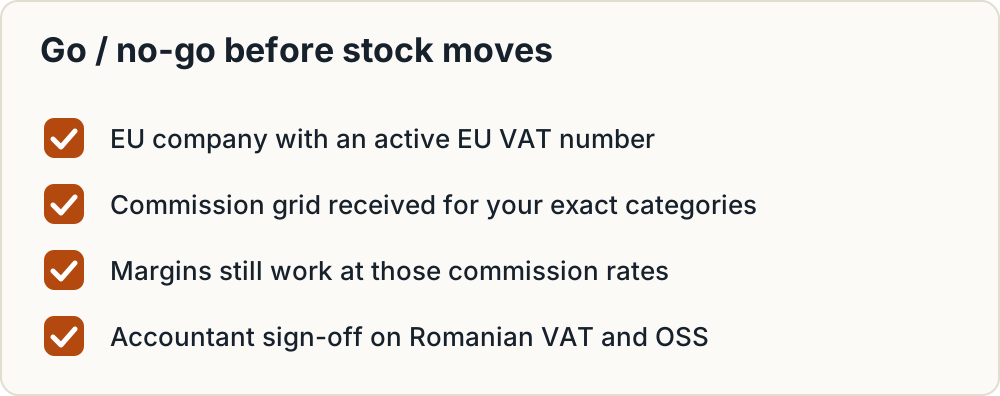
- EU-registered company with an active EU VAT number
- Commission grid received for your exact categories, and margins still work at those rates
- Accountant sign-off on Romanian VAT exposure and OSS before any stock goes to Romania
Before launch:
- Prepare the documents as PDF, JPG or PNG, each under 15 MB, with consistent company data.
- Confirm with onboarding whether and where you need a Romanian pickup point.
- Choose own shipping or FBE. Run your SKUs through the eMAG cost simulator.
- If shipping yourself, sign a courier contract (check the current eligible couriers).
- Prepare GPSR product safety data and register for packaging EPR where required.
- Sign the legal documents on emag.ro, .bg and .hu, and turn on automatic export.
- Review the Hungarian and Bulgarian translations of your best-selling listings.
- Set Bulgarian prices in EUR and plan for HUF exchange-rate movements.
- Ask how cash on delivery and payouts work for your account.
Sources
What this guide relies on, in the order cited.
- partner registration page · marketplace.emag.ro
- Harta agency guide · harta.agency
- Cross-Border programme · marketplace.emag.ro
- as reported by Wall-Street.ro · wall-street.ro
- taxes and commissions page · marketplace.emag.ro
- Marqetir's fee page · marqetir.com
- Bulgarian Cross-Border page · marketplace.emag.bg
- eMAG Hungary's FAQ · marketplace.emag.hu
- FBE · marketplace.emag.ro
- 1 January 2026 · trade.ec.europa.eu
- euro transition notice · marketplace.emag.ro
- Open Hungary · marketplace.emag.hu