On this page
- Short answer: three setups, three different VAT bills
- The four criteria that decide your setup
- Amazon.pl and Amazon.de for a CEE seller: what you are signing up for
- Seller account registration and verification
- Selling plans and referral fees
- Fulfilment options compared
- VAT registrations by setup: Germany, Poland, Czechia
- Costs in 2026: what changed this year
- Worked example: is the Central Europe Programme worth it?
- Other obligations before launch
- Frequently asked questions
- Next steps
This guide explains how the rules work in practice. It is not legal or tax advice; check the linked official sources or ask an adviser for your specific case.
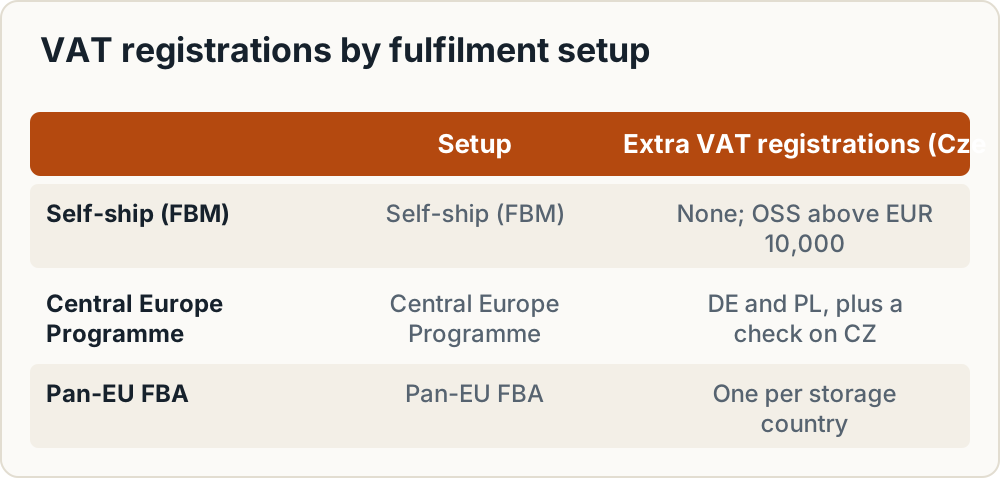
If you sell on Amazon.pl from the Czech Republic or another CEE country, how you fulfil orders decides how many VAT registrations you need, and that is the biggest fixed cost of the channel. Self-shipping keeps you on your home VAT number plus OSS. The Central Europe Programme (CEP) needs registrations in Germany and Poland, plus Czechia if you are based elsewhere. Pan-EU FBA needs a VAT number in every country where Amazon stores your goods.
This guide is for owners of small shops in CZ, SK, PL, HU and RO who already handle VAT and OSS at home. It covers Amazon.de and Amazon.pl together, because most CEE sellers end up listing on both.
Short answer: three setups, three different VAT bills
| Setup | Where your stock sits | Extra VAT registrations (Czech seller) | Best for |
|---|---|---|---|
| Self-ship (FBM) | Your own warehouse in CZ | None. OSS once EU-wide B2C distance sales pass EUR 10,000 | Testing demand, bulky or slow items, low volume |
| EFN (European Fulfilment Network) | Amazon centres in one marketplace country | The storage country (DE or PL) | Moderate volume from a single stock pool |
| FBA in Germany only | Amazon centres in DE | DE | Sellers focused on Amazon.de |
| Central Europe Programme | Amazon centres in DE, PL and CZ | DE and PL, plus a check on Czech obligations | Steady volume on Amazon.de |
| Pan-EU FBA | Amazon centres in several countries | One per storage country | High volume across many EU marketplaces |
One rule drives the whole table: the VAT trigger is the storage of your own goods in a country. Amazon simply having a warehouse there doesn't create an obligation. Where your company is established doesn't settle it either.
The four criteria that decide your setup
- Monthly units on Amazon. This decides whether per-unit FBA savings can cover the fixed cost of extra VAT registrations.
- How many VAT registrations you can run. Each one means returns, bookkeeping and often Intrastat or recapitulative statements. That cost is fixed, not per unit.
- Product size and price. The 2026 fee changes favour cheap, small items (Low-Price FBA now covers items up to EUR 20). Bulky items often do better with self-shipping.
- Which marketplaces you need. Amazon.de and Amazon.pl alone rarely justify Pan-EU FBA. Selling across many EU marketplaces might.
Amazon.pl and Amazon.de for a CEE seller: what you are signing up for
Amazon runs a European seller account that can list on several EU marketplaces. Before relying on it, check the current marketplace list in Seller Central help. Amazon.pl has its own seller page with registration in Polish and its own fulfilment centres in Poland.
There is no Amazon marketplace in Czechia, Slovakia, Hungary or Romania, so sellers from those countries reach Amazon customers through other countries' stores. Amazon is only one channel, though. For comparison, see our map of marketplaces in Central and Eastern Europe and Allegro vs Kaufland vs eMAG fees. If Poland is your main target, also read our guide on selling on Allegro from another EU country.
Seller account registration and verification
According to Amazon.pl, you need:
- a business email address or an existing Amazon customer account
- an active credit card
- a passport or national ID
- your business registration details, including your VAT number
- a phone number
- a bank account
Amazon verifies identity, address, bank account and business. Under Amazon's verification rules, this covers everyone on the account: the contact person, the legal representative and the beneficial owners.
Verification commonly fails on these points:
- ID: it must be valid and show full name, date of birth, place of birth and citizenship.
- Proof of address: it must be issued by a company or an authority and dated within the last 180 days. Handwritten documents and screenshots are rejected.
- Re-verification: after account changes, Amazon allows up to 60 days. If you miss that window, the account is restricted.
Prepare the documents for every beneficial owner before you start. A co-owner with an expired ID is enough to stall the process.
Selling plans and referral fees
| Amazon.de | Amazon.pl | |
|---|---|---|
| Professional plan | EUR 39/month excl. VAT | PLN 165.91/month excl. VAT |
| Individual plan | EUR 0.99 per item sold | PLN 4 per item sold |
| Minimum referral fee | EUR 0.30 in most categories | See the Amazon.pl fee page |
Sources: Amazon.de pricing, Amazon.pl.
On Amazon.de, referral fees in most categories are 8–15%, with reduced rates down to 5% on some low-price bands since the 2026 cuts. Books are a flat 15% with no minimum fee. Some categories, such as clothing, are tiered by price.
In its 2026 update, Amazon cut several referral fees:
| Category and price band | Before | After | Effective |
|---|---|---|---|
| Clothing up to EUR 15 | 8% | 5% | 15 Dec 2025 |
| Clothing EUR 15–20 | 15% | 10% | 15 Dec 2025 |
| Home Products up to EUR 20 | 15% | 8% | 5 Jan 2026 |
| Pet clothing and food up to EUR 10 | 15% | 5% | 5 Jan 2026 |
| Grocery and Vitamins up to EUR 10 | 8% | 5% | 5 Jan 2026 |
On Amazon.de, the Individual plan only makes sense below roughly 40 sales a month (EUR 39 ÷ EUR 0.99 ≈ 39 items). Above that, Professional is cheaper and unlocks the tools most sellers need.
Fulfilment options compared
Self-ship (FBM) from CZ, PL or SK
Your stock stays in your own warehouse, and the delivery promise and shipping cost are entirely yours. For orders to Germany and Poland, carrier choice drives both margin and delivery time. See our comparison of carriers for small CEE shops.
For VAT, these are ordinary B2C distance sales. The EUR 10,000 threshold is a single EU-wide total covering all your cross-border B2C sales, not a limit per country. Most active sellers pass it, so you will likely use OSS. Our guide to OSS VAT registration for a webshop explains how.
EFN (European Fulfilment Network)
Your stock sits in Amazon centres in one marketplace country, and Amazon fulfils orders from other marketplaces across borders at cross-border rates. According to amzbase's comparison, EFN generally needs no VAT number in the destination countries. Sales to them are distance sales handled through OSS.
You still need a VAT number in the country where the stock is stored. A Polish seller storing in Poland stays on its home registration. A Czech, Slovak, Hungarian or Romanian seller has no Amazon marketplace at home, so EFN stock sits in DE or PL, and that country's VAT registration applies.
Central Europe Programme (CEP)
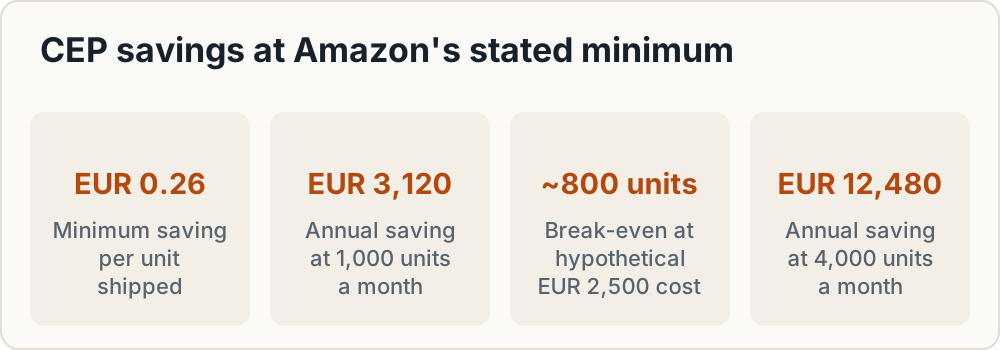
With CEP, your German FBA inventory is stored in Germany, Poland and Czechia. You send stock to one German centre, and Amazon distributes it from there. Amazon says CEP reduces FBA fees by at least EUR 0.26 per unit shipped.
Amazon also states that taking part creates additional VAT obligations and Intrastat reporting, and that its savings figures don't include those costs.
Pan-EU FBA
Pan-European FBA is available in the Amazon stores of DE, FR, IT, ES, NL, PL, SE, BE and IE. You must enable storage in at least two countries and hold a VAT number in each storage country. You then pay local fulfilment rates. In its own marketing, Amazon claims savings of up to 53% compared with EFN fees.
VAT registrations by setup: Germany, Poland, Czechia
Poland
Poland has no VAT registration threshold for businesses not established there. According to Avalara's country summary, you must register on form VAT-R before your first taxable transaction. Applications typically include:
- proof of your home-country VAT registration
- a company register extract with a sworn Polish translation
- details of your activity and where goods are stored
This is a third-party summary. Check the current requirements on the official Polish tax portal (podatki.gov.pl) before you file.
Germany
Storing your goods in Germany requires German VAT registration. This applies to German-only FBA, CEP and Pan-EU alike. Third-party advisers commonly report that a foreign applicant waits about 2.5 to 5 months for the tax number (Steuernummer). We could not confirm this against an official source. After that, you request the VAT ID (USt-IdNr.) from the Federal Central Tax Office (BZSt) and file monthly preliminary returns through ELSTER. Leave a buffer in your launch plan.
Czechia
Amazon states that CEP brings additional VAT obligations in the storage countries, including Czechia. A Czech VAT payer already holds a Czech VAT number. What changes is that stock now moves into and out of Czechia as intra-EU transfers of your own goods, and you have to report those transfers.
Whether that needs anything beyond your existing registration and returns is a question for the Finanční správa (the Czech tax administration) or your tax adviser. Settle it before you enable CEP. For sellers from SK, HU or RO, Czech registration is an extra one, just like the Polish one.
Stock movements and reconciliation
When Amazon moves your goods between countries, those movements are transfers of your own goods. Depending on the flows, you may need to report them in VAT returns, recapitulative statements or Intrastat.
Every month, reconcile Amazon's VAT Transactions Report against the Inventory Event Detail report before passing the figures to your accountant.
Costs in 2026: what changed this year
According to Amazon's 2026 European fee update:
- fees fall by an average of EUR 0.17 per unit sold across Europe
- parcel fulfilment fees fell by an average of EUR 0.32 in UK, DE, FR, IT and ES (from 15 December 2025)
- Low-Price FBA was extended to items priced at or below EUR 20, with an average saving of about EUR 0.45 per unit on newly eligible items (from 5 January 2026)
Some fees went up. Storage, return-to-seller and liquidation fees rose, and FBA fees in PL, NL, SE, BE and IE rose by about EUR 0.02 per unit on average. Since 17 April 2026, a 1.5% fuel and logistics surcharge has also applied to FBA fulfilment fees on European marketplaces, including Germany.
We don't reproduce per-weight fee bands here. Take exact DE and PL fulfilment fees from the current FBA rate card in Seller Central, and run each SKU through Amazon's revenue calculator with the 1.5% surcharge added.
Worked example: is the Central Europe Programme worth it?
Amazon's CEP page shows annual savings of EUR 3,120 for 1,000 units a month and EUR 12,480 for 4,000 units a month. Both match the minimum saving: 1,000 × 12 × EUR 0.26 = EUR 3,120.
Break-even formula:
Annual CEP saving = units per month × 12 × EUR 0.26 Break-even when that saving = annual cost of the extra registrations
For a Czech seller, the extra costs are Polish VAT registration and filing, any Intrastat reporting, the added Czech transfer reporting, and the accountant's time to reconcile all of it. You would need German VAT registration for German FBA anyway, so it doesn't count as a CEP cost.
Illustration only, with hypothetical costs. Suppose your written quotes add up to EUR 2,500 a year for Polish VAT compliance, Intrastat and extra accounting.
| Units per month | Annual CEP saving | Hypothetical extra cost | Net |
|---|---|---|---|
| 300 | EUR 936 | EUR 2,500 | −EUR 1,564 |
| 800 | EUR 2,496 | EUR 2,500 | about zero |
| 1,500 | EUR 4,680 | EUR 2,500 | +EUR 2,180 |
| 4,000 | EUR 12,480 | EUR 2,500 | +EUR 9,980 |
At EUR 2,500 a year, break-even is about 800 units a month (2,500 ÷ 3.12). Because EUR 0.26 is Amazon's stated minimum, your actual saving per unit may be higher. Amazon offers its own VAT services, and one third party reported a price of about EUR 400 per country per year, which we could not verify. Treat every VAT-service price here, including the EUR 2,500, as an example only, and get written quotes before deciding.
A seller from SK, HU or RO also has to add the cost of the Czech registration, which pushes the break-even volume up accordingly.
Recommendations by scenario:
- Testing Amazon, under about 100 orders a month: self-ship from your own warehouse and use OSS.
- Steady sales on Amazon.de, below your break-even volume: use German-only FBA or EFN. That means one foreign VAT number.
- Above break-even on Amazon.de: join CEP once your PL (and, if needed, CZ) VAT numbers are active.
- High volume across several EU marketplaces: price Pan-EU FBA, including the Netherlands requirement and every registration it brings.
Other obligations before launch
Selling on Amazon doesn't change your product obligations. It just makes gaps easier for Amazon and the authorities to spot.
- Packaging EPR: see packaging EPR in Poland, Czechia, Slovakia, Hungary and Romania and BDO registration for foreign online sellers.
- Product safety: labels and listing details must meet GPSR. Use our GPSR checklist.
- Invoicing: your invoicing tool must handle OSS rates and, under FBA, the local VAT of each storage country. Compare options in e-shop invoicing software for CEE.
- Everything else: go through the EU compliance checklist for an online shop.
Since 1 July 2026, a flat EUR 3 customs duty has applied to low-value parcels (under EUR 150) imported into the EU. It affects goods coming from outside the EU, not stock moving within the EU from CZ, PL or SK.
Frequently asked questions
Do I need a Polish VAT number to sell on Amazon.pl from Czechia?
Not if you self-ship from Czechia or keep your stock only outside Poland. Sales to Polish customers are then B2C distance sales, which you report through OSS once your EU-wide cross-border sales pass EUR 10,000. You need a Polish VAT number once your goods are stored in Poland, for example through CEP, Pan-EU FBA or EFN based in Poland.
Can I sell on Amazon.de and Amazon.pl with one account?
Yes. Amazon's European seller account lets you list on several EU marketplaces, including Germany and Poland, from one registration. Check the current marketplace list in Seller Central help. Referral and fulfilment fees follow each marketplace's own rate card, so check Amazon.pl and Amazon.de pricing separately.
How long does German VAT registration take for a foreign seller?
Third-party advisers commonly estimate 2.5 to 5 months for a foreign applicant to receive a German tax number. This is not an official figure. After that, you request the VAT ID from the Federal Central Tax Office (BZSt), and monthly preliminary returns through ELSTER usually follow. Don't plan German FBA storage until the number has arrived.
What is the difference between EFN and Pan-European FBA?
With EFN, your stock sits in one country and Amazon ships cross-border to other marketplaces at cross-border rates. You need VAT registration only in the storage country. With Pan-EU FBA, Amazon spreads your stock across several countries and charges local fulfilment rates. In exchange, you need a VAT number in every country where stock is stored.
Next steps
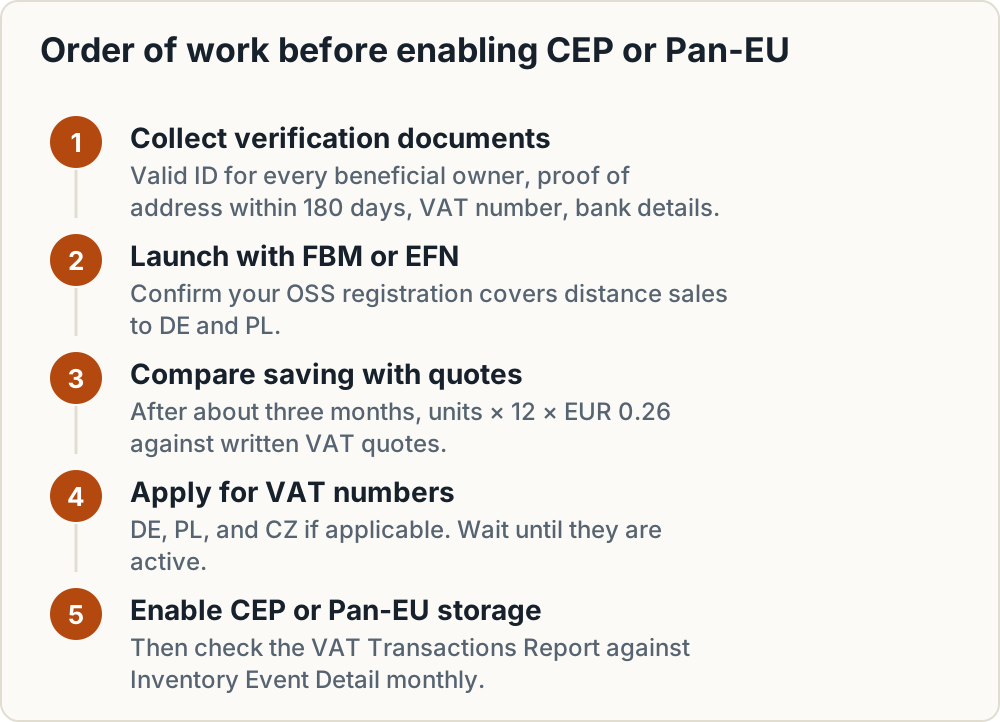
- Collect your verification documents: a valid ID for every beneficial owner, proof of address dated within 180 days, your VAT number and your bank details.
- Register one European seller account. Pick the Professional plan if you expect more than about 40 sales a month on Amazon.de.
- Launch with FBM or EFN. Confirm whether your OSS registration already covers distance sales to DE and PL.
- Price each SKU in Amazon's revenue calculator, using the current rate card and the 1.5% surcharge.
- After about three months of data, calculate monthly units × 12 × EUR 0.26 and compare the result with written quotes for your extra VAT registrations.
- Apply for the VAT numbers you will need (DE, PL, and CZ if applicable) and wait until they are active.
- Only then enable CEP or Pan-EU storage, and set up a monthly check of the VAT Transactions Report against Inventory Event Detail.
- Before the first shipment to Amazon, confirm EPR, BDO and GPSR compliance.
Sources
What this guide relies on, in the order cited.
- the VAT trigger is the storage of your own goods in a country · eurofiscalis.com
- its own seller page with registration in Polish · sell.amazon.pl
- Amazon's verification rules · sell.amazon.de
- Amazon.de pricing · sell.amazon.de
- Amazon cut several referral fees · aboutamazon.eu
- EUR 10,000 threshold · amzbase.com
- CEP · sell.amazon.de
- Pan-European FBA · sell.amazon.es
- Avalara's country summary · avalara.com