
On this page
- Quick answer: the compliance order of priority
- What applies now: dated status table (October 2026)
- Which seller type are you? (decision table)
- What legal requirements must an online shop meet in the EU?
- Step 1: Business and VAT status at home
- Step 2: Consumer law and the legal pages every e-shop needs
- Step 3: GPSR product information and EU responsible person
- Step 4: VAT across borders with OSS
- Step 5: Packaging EPR (PPWR) per destination country
- Step 6: Does the European Accessibility Act apply to a small webshop?
- Step 7: Customs, only if you import from outside the EU
- Country-by-country first steps (CZ, SK, PL, HU, RO)
- Worked example: a Czech own-brand shop adding Poland and Hungary
- Mistakes that block listings or trigger checks
- Frequently asked questions
- Copy-ready EU compliance checklist
This guide explains how the rules work in practice. It is not legal or tax advice; check the linked official sources or ask an adviser for your specific case.
Before your first sale, a small online shop needs three things in place: a clear business and VAT status at home, consumer-law pages and a compliant checkout, and GPSR product information backed by an EU responsible person. The first cross-border sale then brings in destination-country VAT (usually handled through OSS) and packaging EPR in each destination country. Accessibility depends on how big the shop is, and customs only matters if you import from outside the EU. This EU compliance checklist for online shops puts those obligations in the order you act on them, splits them by seller type, and points to the country-level guides for Czechia, Slovakia, Poland, Hungary and Romania.
Quick answer: the compliance order of priority
- Trader identity and domestic VAT status. Know who the legal seller is and whether you must register for VAT at home.
- Consumer-law pages and checkout flow. This includes the online withdrawal button, which has been mandatory since 19 June 2026.
- GPSR product information and an EU responsible person for every product you list.
- Destination-country VAT, usually through OSS, once your B2C sales to consumers in other EU countries pass EUR 10,000 a year.
- Packaging EPR in each destination country where you ship packaged goods to end users.
- Accessibility (European Accessibility Act), unless the shop meets the microenterprise test.
- Customs, only if you import goods from outside the EU.
Why this order: steps 1–3 must be done before the first sale. Steps 4–5 are triggered by the first cross-border sale. Step 6 depends on company size, and step 7 on where your stock comes from. This page gives the overview. The national details (registration portals, fees, forms) are in the linked cluster articles.
Who this applies to
This guide is for shops with 1–10 staff that sell to consumers (B2C) in or into CZ, SK, PL, HU or RO and have no in-house lawyer. It suits shops that are starting to sell cross-border. It also suits shops that have only just found out that GPSR, EPR or accessibility rules now cover them. EU consumer rules also apply to sellers based outside the EU when they sell to EU consumers, as the Your Europe guidance on consumer contracts explains.
What applies now: dated status table (October 2026)
| Rule | Applies since | Status as of October 2026 | Who it hits |
|---|---|---|---|
| OSS VAT scheme and EUR 10,000 EU-wide threshold | 1 July 2021 | In force | B2C sellers shipping to other EU states |
| GPSR, Regulation (EU) 2023/988 | 13 December 2024 | In force | Anyone placing consumer products on the EU market |
| European Accessibility Act (Directive 2019/882) | 28 June 2025 | In force; microenterprises exempt for services | E-commerce services to consumers |
| EU Online Dispute Resolution platform | Closed 20 July 2025 | Discontinued; remove links | Every B2C shop with an old ODR link |
| Online withdrawal button (Directive (EU) 2023/2673) | 19 June 2026 | In force | Online distance contracts with a statutory withdrawal right |
| EUR 3 flat customs duty on low-value parcels | 1 July 2026 | Interim measure until the EU customs data hub | Imports from outside the EU under EUR 150 |
| PPWR, Regulation (EU) 2025/40 | 12 August 2026 | In force; the proposed suspension of the authorised-representative rule has not been adopted (see Step 5) | Producers of packaged goods, marketplaces |
Which seller type are you? (decision table)
Most flat checklists skip this step. What you owe depends on your role in the supply chain, not just on what you sell.
| Obligation | Own brand / manufacturer | Reseller (buys from EU supplier) | Importer (buys outside EU) | Marketplace-only seller |
|---|---|---|---|---|
| GPSR | Full manufacturer duties: risk analysis, traceability, complaint records kept 10 years | Distributor duties: check that suppliers upstream meet the rules; show the manufacturer's data in offers | Check compliance before placing goods on the market; refuse non-compliant goods | The same duties as your role above; the marketplace does not take them over |
| Consumer law | Yes | Yes | Yes | Yes, plus the platform's own rules |
| Destination VAT / OSS | Above EUR 10,000 cross-border B2C | Above EUR 10,000 cross-border B2C | Above EUR 10,000 cross-border B2C | Same as own shop if you are EU-established; the marketplace becomes the deemed supplier only for non-EU sellers and for imported consignments up to EUR 150 |
| Packaging EPR | Yes, per destination country | Yes, if you pack or ship packaged goods to end users in that country | Yes, per destination country | Yes; marketplaces must collect proof before letting you sell |
| Accessibility (EAA) | Yes unless microenterprise | Yes unless microenterprise | Yes unless microenterprise | Your own shop site is covered unless you are a microenterprise; check with each platform how its listing pages are handled |
| Customs | Only if production or stock is outside the EU | No (EU-to-EU) | Yes | Only for non-EU stock |
GPSR roles in detail
The EUR-Lex summary of the GPSR says every covered product needs a responsible economic operator established in the EU. That can be the manufacturer, the importer, an authorised representative or a fulfilment service provider. Manufacturers must carry out a risk analysis, provide traceability information, and keep complaint records and contact details for 10 years. Importers must check that a product complies before placing it on the market. Distributors must check that their upstream suppliers meet the rules.
Selling under your own label? A reseller who puts its own brand on a product, or substantially modifies it, may be treated as the manufacturer. Check this against Article 13 of the GPSR text, or with an adviser, before you decide which role you hold. White-label sellers are the ones most often caught by this.
Selling only on marketplaces? The marketplace's duties sit next to yours, not instead of them. You still need to supply the manufacturer and responsible-person data. For where each platform wants that data, see our guide to GPSR fields on Allegro, Kaufland and eMAG.
What legal requirements must an online shop meet in the EU?
There are six areas. This is who each one hits, and when.
- Tax (VAT and OSS). Domestic VAT thresholds decide whether you register at home. The EU-wide EUR 10,000 threshold decides when you start charging destination-country VAT.
- Product safety (GPSR). Applies to consumer products from the first listing. Offers must carry manufacturer and safety information.
- Packaging and waste (EPR, PPWR). Applies per country wherever you deliver packaged goods to end users. It now also blocks marketplace onboarding.
- Consumer contract law. Applies from the first B2C sale: pre-contract information, withdrawal rights, the legal guarantee, delivery terms and the withdrawal button.
- Accessibility (EAA). Applies to e-commerce services aimed at consumers, unless the business is a microenterprise.
- Customs. Applies only to goods brought in from outside the EU.
Step 1: Business and VAT status at home
Domestic VAT registration thresholds apply only to businesses established in that country. They say nothing about selling abroad. Figures from Tax Foundation data dated 15 June 2026:
| Country | Domestic VAT registration threshold |
|---|---|
| Czechia | CZK 2,000,000 |
| Poland | PLN 240,000 (from 1 January 2026) |
| Hungary | HUF 20,000,000 |
| Slovakia | Sources disagree; check the current figure with Finančná správa SR |
| Romania | Sources disagree; check the current figure with ANAF |
We have left out the Slovak and Romanian figures on purpose. Published sources give different numbers for both. Use the figure on the national tax authority's own site.
Many cross-border sellers register for VAT voluntarily below the threshold, for example to reclaim input VAT or because B2B customers expect it. The rules and effects of voluntary registration differ by country. Check them with your local tax authority or accountant before you file.
Step 2: Consumer law and the legal pages every e-shop needs
These baseline rules apply across the EU, per Your Europe:
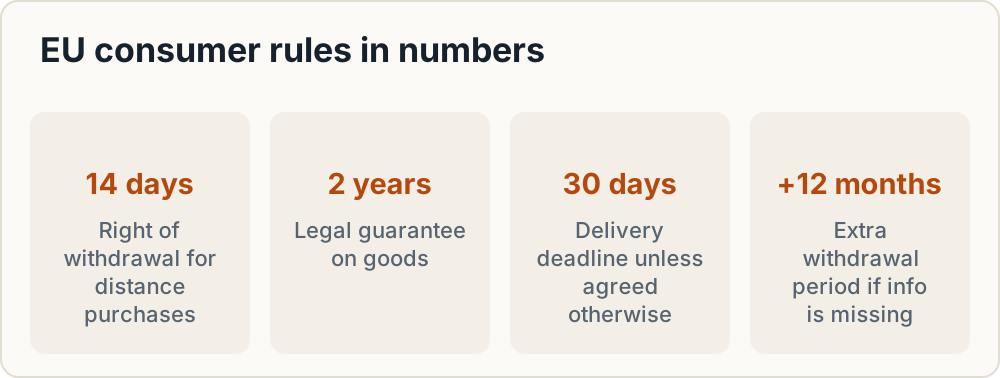
- consumers have a 14-day right of withdrawal for distance purchases
- goods carry a 2-year legal guarantee
- delivery must happen within 30 days unless you agreed otherwise
- you must give pre-contractual information before the order is placed
Under the Consumer Rights Directive (2011/83/EU, Article 10), if you fail to tell consumers about the withdrawal right, the period can extend by up to 12 months beyond the normal 14 days. Leaving out the withdrawal information exposes you to returns for over a year rather than two weeks.
The legal pages to publish
- Trader identity and contact: legal name, address, company ID, VAT ID, email and phone
- Terms and conditions
- Withdrawal information and the model withdrawal form
- Returns and complaints page: how withdrawal differs from a guarantee claim
- Privacy policy and cookie notice: follow the guidance of the national data-protection authority in each market
- Accessibility statement, where the EAA applies (Step 6)
- Price, delivery and payment information shown before the customer commits
The withdrawal button
According to Hogan Lovells' summary of Directive (EU) 2023/2673, from 19 June 2026 traders must offer a withdrawal function:
- labelled "withdraw from contract here" or an unambiguous equivalent
- available for the whole withdrawal period
- followed by a "confirm withdrawal" step
- triggering an automatic acknowledgement on a durable medium, such as email
Customers must be able to use it as guests, without logging in. It applies to distance contracts concluded online that carry a statutory withdrawal right.
In practice, check whether your shop platform (Shopify, WooCommerce, Shoptet, PrestaShop or another) has released an update or app for this. Then test it as a guest customer on mobile. Translate the label properly for each market. Don't rely on an English label on Polish or Hungarian storefronts.
Note: The withdrawal button deadline passed on 19 June 2026. A shop without a working, guest-accessible withdrawal function is out of compliance now, not at some future date.
Remove the ODR link
The EU Online Dispute Resolution platform was discontinued on 20 July 2025 under Regulation (EU) 2024/3228 (Taylor Wessing). Many terms pages and imprints still link to it. Delete the link and the related wording. Keep any information on national alternative dispute resolution bodies that your country requires.
Step 3: GPSR product information and EU responsible person
The GPSR has applied since 13 December 2024 (EUR-Lex summary). Under Article 19, as summarised by CMS, every distance-sales offer must show:
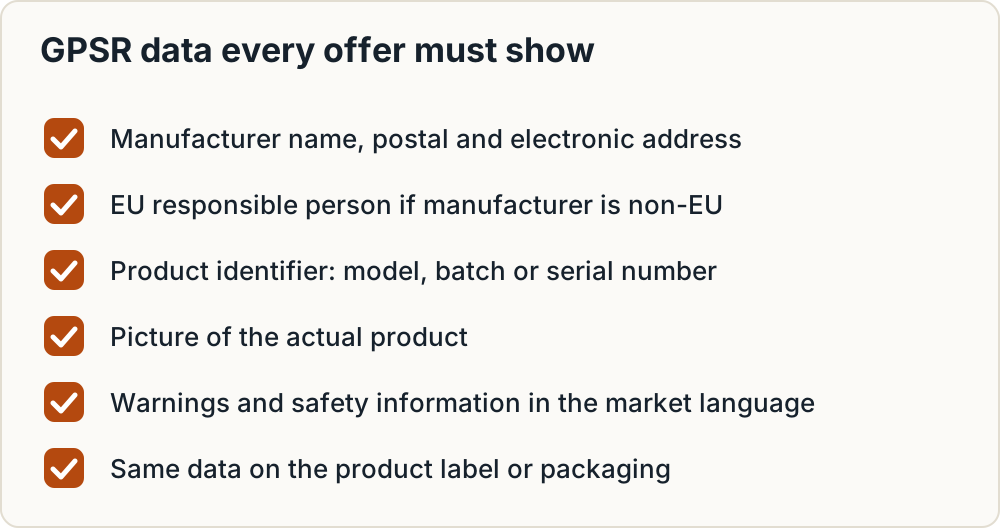
- the manufacturer's name and postal and electronic address
- if the manufacturer is outside the EU, the name and contact details of the EU responsible person
- information that identifies the product, including a picture and its type or other identifier
- warnings or safety information in a language consumers can easily understand
Per-SKU checklist
| Field | What to enter | Typical gap |
|---|---|---|
| Manufacturer | Registered name, postal address, email or web contact | Brand name instead of the legal entity |
| EU responsible person | Name and contact, if the manufacturer is outside the EU | Missing for dropshipped goods |
| Product identifier | Model, batch or serial number, matching the product | Generic photo without a model number |
| Image | Picture of the actual product | Stock image of a different variant |
| Safety information | Warnings and instructions from the label or manual | Only in English on CEE storefronts |
| Language | Language of each destination market | One language for all markets |
| Physical label | Same data on the product or packaging | Data online but not on the item |
Store this data in your product information system or as custom fields in the shop platform. Then every channel (own shop, Allegro, Kaufland, eMAG, price comparison feeds) pulls from one source.
Step 4: VAT across borders with OSS
The European Commission's OSS page sets a single EU-wide threshold of EUR 10,000 a year for cross-border B2C distance sales of goods and certain services. It is not a per-country threshold:
- Below it, supplies stay taxed in your home Member State.
- Above it, the destination country's VAT rules apply.
- It only applies to suppliers established in a single Member State.
Once you are above the threshold, you can either register for VAT in each destination country or use the Union OSS. The Union OSS lets you register in one Member State of identification and report VAT due in every consumption country through one portal, with quarterly returns. Returns and payment are generally due by the end of the month after the quarter: 30 April, 31 July, 31 October and 31 January. Confirm the deadlines with your own tax authority's OSS guidance.
Selling to only two countries doesn't exempt you. The EUR 10,000 test is on your combined cross-border B2C sales across all EU destinations. Selling EUR 6,000 to Poland and EUR 5,000 to Hungary means EUR 11,000, which is over the threshold. From the sale that takes you over it, you charge Polish and Hungarian VAT rates.
For registration steps, return filing and record-keeping in Czechia and Poland, see OSS VAT registration steps for CZ and PL.
Step 5: Packaging EPR (PPWR) per destination country
The Packaging and Packaging Waste Regulation (EU) 2025/40 has applied generally since 12 August 2026 (PPC Land; Dreyfus). As reported by PPC Land, Article 45(3) requires producers who sell to end users in a Member State where they are not established to appoint an authorised representative for EPR in that country. Neither source mentions a small-volume exemption.
The contested part: is the representative rule suspended?
On 10 December 2025 the Commission proposed (COM(2025) 982, procedure 2025/0395(COD)) to suspend the authorised-representative requirement until 1 January 2035. The suspension would cover only producers established in the EU. Sources describe its status differently:
- PPC Land and other trackers report that the Council discontinued negotiations on 24 June 2026, as most Member States opposed the suspension.
- Dreyfus, writing on 20 August 2026, still calls it legislative work in progress.
Both agree on the practical point: no amending regulation has been published, so the rule applies. Before relying on any suspension, check procedure 2025/0395(COD) on EUR-Lex or the Council's site. Shops established outside the EU would not be covered by the proposal in any case.
Marketplaces now check EPR before you can sell
Dreyfus reports that under Article 45, online platforms must get proof of EPR registration in the consumer's Member State, plus a self-certification, before letting a producer use their services. A missing registration therefore means a blocked listing, not just a possible fine.
Action point: Build an EPR evidence file per country now: registration numbers, certificates from your producer responsibility organisation, and your signed self-certification. Platforms can ask for it during onboarding or later.
The country-level steps and fees are in packaging EPR in Poland, Czechia, Slovakia, Hungary and Romania. Hungary runs its own system, covered in Hungary EPR registration for foreign online sellers. If you sell electronics or batteries, check WEEE and battery EPR separately. Those are separate regimes and are not covered here.
Step 6: Does the European Accessibility Act apply to a small webshop?
Yes, unless the shop is a microenterprise. The EAA has applied since 28 June 2025, and e-commerce services to consumers are expressly in scope (Grant Thornton CZ). The technical benchmark is the harmonised standard EN 301 549, which for websites largely follows WCAG 2.1 level AA.
The microenterprise test
Under Directive 2019/882 (Article 4(5)), microenterprises providing services are exempt. A microenterprise has:
- fewer than 10 staff, and
- annual turnover or annual balance sheet total of no more than EUR 2 million.
Both conditions must hold: the headcount test plus at least one of the two financial tests. A shop with 12 staff is covered even with EUR 800,000 turnover. A shop with 8 staff is also covered if both its turnover and its balance sheet total exceed EUR 2 million. The exemption covers services only. It doesn't exempt products the EAA lists separately, such as e-readers or computers, if you make or import them.
National implementation
- Czechia: Act 424/2023, supervised by the Czech Trade Inspection Authority, with fines up to CZK 10 million (Grant Thornton CZ).
- Poland: the Polish Accessibility Act covers e-commerce services from 28 June 2025. It excludes services from microenterprises, puts the Minister of Digitization in charge of e-commerce supervision, and requires accessibility information (gov.pl).
- Romania: transposed by Law 232/2022. Confirm the supervising authority before relying on it.
- Hungary: reported as transposed by Act LXVIII of 2022 on accessibility requirements for products and services. Confirm the details with the national authority.
- Slovakia: transposition details are not covered here. Check the Slovak implementing law before assuming anything.
Grant Thornton CZ notes that services under existing contracts may continue until 28 June 2030. Read this as a transition for contracts already running, not a delay for new customer-facing shop features.
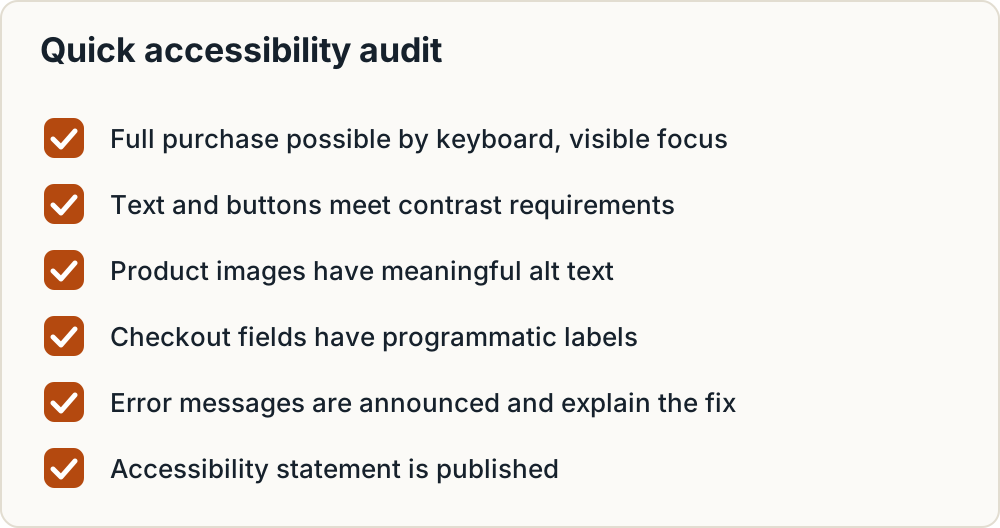
Quick accessibility audit
- The whole purchase can be completed using only the keyboard, with a visible focus indicator
- Text and buttons meet contrast requirements
- Product images have meaningful alt text
- Checkout form fields have programmatic labels, not just placeholder text
- Error messages are announced and explain how to fix the problem
- An accessibility statement is published (required in Poland for covered services)
Step 7: Customs, only if you import from outside the EU
Council decisions from December 2025 and February 2026 set a flat customs duty of EUR 3 per item on parcels valued under EUR 150 from 1 July 2026. "Per item" means per distinct tariff heading in the parcel, so two different product types in one parcel cost EUR 6. It is an interim measure, planned to run until 1 July 2028, when the permanent arrangement linked to the EU customs data hub is expected. It matters if you dropship or import from China or other non-EU suppliers and ship directly to consumers in CEE. It doesn't affect EU-to-EU sellers. For how the duty is calculated and how it changes your pricing, see EU EUR 3 customs duty on small parcels.
Country-by-country first steps (CZ, SK, PL, HU, RO)
| Country | Accessibility law and regulator | EPR entry point | Domestic VAT threshold | After compliance: go-to-market |
|---|---|---|---|---|
| Czechia | Act 424/2023; Czech Trade Inspection Authority | EPR country guide | CZK 2,000,000 | Heureka and Zboží feeds |
| Slovakia | See country article | EPR country guide | Check with Finančná správa SR | Heureka.sk feed |
| Poland | Polish Accessibility Act; Minister of Digitization | EPR country guide | PLN 240,000 | Allegro, parcel lockers |
| Hungary | Act LXVIII of 2022 (reported) | Hungary EPR registration | HUF 20,000,000 | Árukereső feed |
| Romania | Law 232/2022 | EPR country guide | Check with ANAF | eMAG, Compari feed |
Once the compliance basics are done, these guides cover going to market:
- price comparison feed requirements
- selling on eMAG as a foreign seller
- payment methods for CEE e-commerce
- parcel locker delivery setup
- cash on delivery in Eastern Europe
Worked example: a Czech own-brand shop adding Poland and Hungary
The figures here are illustrative, not taken from a source. The shop is a Czech company with 6 staff and EUR 400,000 annual turnover. It sells own-brand cosmetic accessories (brushes, cases, organisers) packed in cardboard. It ships to consumers in CZ, PL and HU from a warehouse near Brno.
1. Home status. EUR 400,000 is far above CZK 2,000,000 at any recent exchange rate, so the company must be VAT-registered in Czechia.
2. Consumer pages. The shop translates its terms, withdrawal information and model form into Polish and Hungarian. It adds a guest-accessible withdrawal button with local-language labels and an automatic confirmation email. It also removes the old ODR link from its terms.
3. GPSR. The shop is the manufacturer, because the products carry its brand. It needs a risk analysis per product line and batch or model identifiers. It must show its own name, address and email on every listing and on each label, keep complaint records for 10 years, and translate warnings into Polish and Hungarian. No separate responsible person is needed, because the manufacturer is established in the EU.
4. VAT. Suppose cross-border sales are EUR 90,000 to Poland and EUR 40,000 to Hungary. That is EUR 130,000 combined, well past EUR 10,000, so Polish and Hungarian VAT apply. Rather than registering for VAT in both countries, the shop registers for Union OSS in Czechia and files one quarterly return there.
5. Packaging EPR. The shop places packaged goods on the market for end users in Poland and Hungary. It needs EPR compliance in both countries and, under Article 45(3), an authorised representative in each. The suspension proposal would cover this shop, as it is EU-established, but it has not been adopted. So the shop sets up representation and keeps the evidence file. Hungary follows its own procedure (see the Hungary guide).
6. Accessibility. 6 staff is fewer than 10, and EUR 400,000 is below EUR 2 million. The shop is a microenterprise and exempt from the EAA for its e-commerce service. If it hires its 10th employee, the exemption ends regardless of turnover. The same happens if both turnover and balance sheet total pass EUR 2 million. Building accessibility into routine site updates now spares the shop an urgent overhaul later, when it outgrows the exemption.
7. Customs. Production is in the EU, so customs does not apply.
Mistakes that block listings or trigger checks
- Missing GPSR data in offers. Marketplaces can suppress listings without manufacturer or responsible-person fields.
- A stale ODR link. It signals terms that haven't been updated since before July 2025.
- No withdrawal button after 19 June 2026, or one that needs a login.
- Selling packaged goods abroad without EPR evidence, then losing marketplace access when the platform asks for registration proof.
- Assuming the EAA exemption without testing both criteria. Headcount and financial limits are separate tests.
- Treating the OSS threshold as per country. EUR 10,000 is the combined EU total.
- Copying VAT thresholds from a blog instead of the tax authority, especially for Slovakia and Romania.
- Relying on the proposed PPWR suspension before it is published as law.
Frequently asked questions
Does a marketplace seller still need an EU responsible person?
Yes. The GPSR requires every covered product to have a responsible economic operator established in the EU, whether it is sold on your own site or on Allegro, Kaufland or eMAG. If you or your manufacturer are established in the EU, that operator can be you or the manufacturer. If the manufacturer is outside the EU, you need an importer, authorised representative or fulfilment service provider in the EU.
Is the "withdraw from contract" button mandatory for every shop?
It is mandatory from 19 June 2026 for distance contracts concluded online where the consumer has a statutory right of withdrawal. Shops that sell only to businesses, or only goods excluded from the withdrawal right (such as made-to-order items), may fall outside it for those contracts. Most B2C shops with a normal 14-day return right need it.
Do I need GPSR, EPR and OSS if I only sell in two countries?
Usually yes. GPSR applies from the first consumer product you list. EPR applies in each country where you deliver packaged goods to end users. Destination-country VAT applies once your combined cross-border B2C sales across all EU countries pass EUR 10,000 a year, however few countries that covers. OSS is the optional scheme most small shops use to declare it.
Do these EU rules apply to shops based outside the EU?
Yes, when they sell to EU consumers. Non-EU shops must follow EU consumer law and need an EU-based responsible operator under the GPSR. They also face EPR duties in each destination country and customs on imports, including the EUR 3 flat duty on low-value parcels from 1 July 2026.
Does the EAA microenterprise exemption cover the products I sell?
No. The exemption covers services, such as your e-commerce site. Products covered by the EAA, such as e-readers, computers and smartphones, follow separate product rules, which fall mainly on manufacturers and importers. A shop that simply resells ordinary goods like clothing or cosmetics is not affected by the product part of the EAA.
Copy-ready EU compliance checklist
Before the first sale
- Legal seller entity, company ID and VAT ID confirmed
- Domestic VAT status checked against the national authority's current threshold
- Trader identity and contact page published
- Terms and conditions in each market's language
- Withdrawal information and model form published
- Withdrawal button live, guest-accessible, with confirm step and automatic email
- Returns and complaints page separates withdrawal from guarantee claims
- Old ODR link removed
- Privacy policy and cookie notice in place
- Seller type identified (manufacturer, distributor, importer), including any own-brand check
- GPSR data per SKU: manufacturer, EU responsible person, identifier, image, warnings in each language
- Same GPSR data on product labels or packaging
At the first cross-border sale
- Combined cross-border B2C sales tracked against EUR 10,000
- Once over the threshold: Union OSS registration (or VAT registration in each destination country), with returns in the calendar
- Packaging EPR registration per destination country
- Authorised representative appointed where Article 45(3) applies
- EPR evidence file ready: registration numbers, PRO certificates, self-certification
- WEEE and battery obligations checked if relevant
Size and sourcing checks
- EAA microenterprise test run: staff under 10 AND turnover or balance sheet total of EUR 2 million or less
- If not exempt: accessibility audit done and accessibility statement published
- If importing from outside the EU: EUR 3 per-item customs duty included in pricing
Every six months
- Re-check SK and RO VAT thresholds and the PPWR Article 45(3) suspension status
- Re-run the EAA size test after hiring or a strong sales year
- Spot-check GPSR fields on all marketplace listings
Sources
What this guide relies on, in the order cited.
- Your Europe guidance on consumer contracts · europa.eu
- EUR-Lex summary of the GPSR · eur-lex.europa.eu
- Tax Foundation data dated 15 June 2026 · taxfoundation.org
- Hogan Lovells' summary of Directive (EU) 2023/2673 · hlc.com
- Taylor Wessing · taylorwessing.com
- CMS · cms.law
- European Commission's OSS page · vat-one-stop-shop.ec.europa.eu
- PPC Land · ppc.land
- Dreyfus · dreyfus.fr
- Grant Thornton CZ · grantthornton.cz
- gov.pl · gov.pl
- Law 232/2022 · accessible-eu-centre.ec.europa.eu