
On this page
- Short answer: what a webshop must issue and report in each country
- Hungary: NAV Online Számla and receipt data reporting
- Poland: KSeF, and why most webshops need no cash register
- Romania: RO e-Factura and the B2C/CNP rule
- Czech Republic: no EET for online-paid orders today, EET 2.0 from 2027
- Slovakia: eKasa and e-invoicing via Peppol from 2027
- Decision table: which document and channel for which order
- Worked example: one shop, five countries, one week of orders
- Tool requirements checklist and vendor examples
- What to do before 1 January 2027
- Frequently asked questions
- Decision summary
This guide explains how the rules work in practice. It is not legal or tax advice; check the linked official sources or ask an adviser for your specific case.
Choosing e-shop invoicing software for CEE starts with one question: where does each invoice have to be reported? If you invoice under Hungarian VAT, pick a tool with a NAV technical-user connection. For Polish B2B you need a KSeF-capable tool, for Romania a tool that routes invoices to RO e-Factura by customer type, and for Slovak B2B from 2027 a Peppol Access Point connection. In Czechia, a standard invoicing tool covers online-paid orders.
Your software does three separate jobs, and they are easy to confuse:
- Invoice content and numbering. This applies in every country.
- Structured e-invoice reporting to the state. Hungary requires it for every invoice. Poland and Romania require it for B2B, and Slovakia does from 2027.
- Fiscal receipts or sales recording. This applies mainly when a customer pays you in person.
This guide reflects our research as of 21 October 2026. Several regimes change on 1 January 2027.
Short answer: what a webshop must issue and report in each country
| Country | B2C order paid online | Cash on delivery via courier | B2B invoice | Reporting channel | Status, Oct 2026 |
|---|---|---|---|---|---|
| CZ | No EET record for gateway payments | Outside EET 2.0 | Invoice, no state clearance | EET 2.0 for in-person payments only | EET 2.0 signed 17 Sept 2026; recording from 1 Jan 2027 |
| SK | No eKasa | No eKasa (courier collects) | Peppol e-invoice from 1 Jan 2027 | eKasa for cash at point of sale; Peppol via Access Point | 2026 is a voluntary Peppol year |
| PL | No register if mail-order exemption met; KSeF optional for consumers | Check with your accountant | KSeF | KSeF | Mandatory for all since 1 Apr 2026; fines from 1 Jan 2027 |
| HU | Invoice data to NAV | Invoice data to NAV | Invoice data to NAV | NAV Online Számla; receipt reporting | Receipt reporting since 1 Sept 2026, with fines for it from 1 Jan 2027 |
| RO | Generally not sent to e-Factura | Generally not sent to e-Factura | e-Factura within 5 working days | RO e-Factura | B2C scope narrowed by Law 88/2026 |
Invoices are needed everywhere. Most online-paid mail-order sales need no fiscal receipt. The exceptions are payments taken at your own pickup point and certain product categories.
Hungary: NAV Online Számla and receipt data reporting
Hungary has the widest rule of the five. NAV's guidance says every invoice, amending invoice and cancelling invoice issued under the VAT invoicing rules must be reported through Online Számla. Since 1 January 2021 this has covered B2B and B2C invoices regardless of amount.
The customer can still receive a PDF or paper invoice. NAV receives the structured data in its XML v3.0 schema. NAV does not approve each invoice before it is issued; it checks the data afterwards.
What the software must do
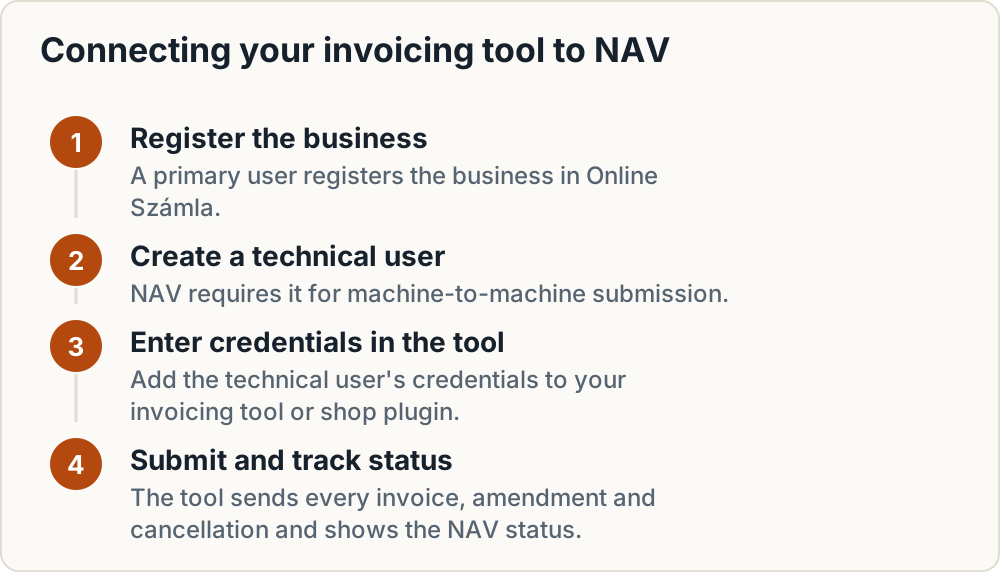
- A primary user registers the business in Online Számla.
- The primary user creates a technical user, which NAV requires for machine-to-machine submission.
- You enter the technical user's credentials in your invoicing tool or shop plugin.
- The tool submits every invoice, amendment and cancellation and shows the NAV status.
NAV also runs a test environment for developers. Ask your vendor or plugin developer whether they have tested against it.
Penalties: NAV can fine per invoice for missing or wrong data. In 2018, under the earlier threshold-based regime, the Hungarian business press reported fines of up to HUF 500,000 per invoice. We could not confirm the current maximum from a statutory source, so check it with your accountant.
Receipt data reporting since 1 September 2026
Since 1 September 2026, data on receipts (nyugta) issued by hand or by computer must be reported to NAV within 3 calendar days, aggregated daily by tax rate. Webshops and other online sellers can submit from their own system through the machine interface. NAV treats September to December 2026 as a transition period without fines. From 1 January 2027 it fines missing or faulty receipt reports.
Many webshops issue an invoice for every order and no receipts. If that is your setup, confirm with NAV or your accountant that receipt reporting does not apply to you.
Poland: KSeF, and why most webshops need no cash register
KSeF (Krajowy System e-Faktur) became mandatory on 1 February 2026 for taxpayers with sales above PLN 200 million, and on 1 April 2026 for everyone else. Penalties start on 1 January 2027.
Two points matter for small shops:
- PLN 10,000 relief: a business whose invoiced B2B sales stay at or below PLN 10,000 gross in a month can issue those invoices outside KSeF until the end of 2026. The test is applied month by month.
- Consumer invoices: invoices to consumers stay voluntary in KSeF.
The rules for receipts that show the buyer's NIP also change in 2027. If your checkout lets buyers add a NIP to a receipt, check the Ministry of Finance's KSeF guidance before 1 January 2027.
Cash register exemption for mail-order sales
Most Polish webshops do not need a cash register. The exemption regulation (positions 36–37 of the annex) covers mail-order sales when three conditions are met:
- Payment is non-cash (transfer, card terminal, payment platform) and reaches the business bank account.
- Goods are delivered by post or courier.
- Your records link each payment to the transaction and the customer.
Some goods need a register whatever the payment method, including tobacco, spirits above 50% alcohol and coal. Check cash payments, including cash on delivery, against the regulation, and check the end date of the exemption there too. Our guide to KSeF for your online shop covers the B2B flow step by step.
Romania: RO e-Factura and the B2C/CNP rule
B2B invoices go through RO e-Factura. Since 1 January 2026 they must be transmitted within 5 working days of the issue date or the legal invoicing deadline.
Law 88/2026, published on 29 May 2026, treats a transaction as B2C when the customer gives no tax ID or is identified by a CNP (personal numeric code). Such invoices are generally not sent to e-Factura unless the individual has voluntarily registered. An invoice with no identifier uses 13 zeros as a placeholder. Sources differ on whether the change applied from 1 June or 1 July 2026. If your June 2026 invoices are affected, confirm the date with ANAF or your accountant.
Fines reported by Fiscal Requirements:
| Case | Fine |
|---|---|
| Late submission, large taxpayer | RON 5,000–10,000 |
| Late submission, medium taxpayer | RON 2,500–5,000 |
| Late submission, other taxpayers | RON 1,000–2,500 |
| Mandatory B2B invoice issued outside the system | 15% of invoice value |
Your tool must route each invoice based on the customer data. With a tax ID, the invoice goes to e-Factura. With a CNP only, or no identifier, it is B2C and stays out, unless the buyer has opted in. Our article RO e-Factura for webshops: B2C vs B2B and the CNP case goes through the checkout fields.
Czech Republic: no EET for online-paid orders today, EET 2.0 from 2027
The original EET was abolished in 2023. According to the Financial Administration's EET site, the President signed the EET 2.0 law on 17 September 2026. Recording starts on 1 January 2027, and January runs as a voluntary pilot. Fakturoid's explainer dates full operation from 1 February 2027.
EET 2.0 covers contact payments: cash, card, QR and vouchers taken in person. It excludes bank transfers, payment-gateway payments and cash on delivery collected by a courier and passed on to the shop. Dauc.cz confirms that a card payment through a gateway the customer is redirected to needs no record.
Pickup points are the catch. If a customer pays when collecting the order at your shop or pickup point, that is a contact payment, and EET 2.0 applies to it. Fakturoid lists fines of up to CZK 500,000 for obstruction or failing to submit data. It also describes an "EET OFF" option of CZK 1,400 a month for self-employed people (OSVČ) in the first flat-tax bracket with annual income under CZK 1 million.
Slovakia: eKasa and e-invoicing via Peppol from 2027
According to Podnikajte.sk, an e-shop needs eKasa only when it receives cash or a cash substitute at the point of sale itself. Cash or a card payment at your own pickup counter therefore triggers it. Bank transfer, online card payment and courier-collected cash on delivery do not. Where eKasa applies, you issue a receipt (pokladničný doklad). This is a secondary source. Check it against Act 289/2008 or Finančná správa guidance, and ask your accountant whether newer sales-records legislation affects your setup.
The bigger change is B2B. From 1 January 2027, domestic B2B and B2G e-invoicing becomes mandatory through Peppol (EN 16931, Peppol BIS Billing 3.0). 2026 is a voluntary transition year. Access Points send the tax data to Finančná správa, so your tool must connect to a certified Access Point. An extension to intra-EU cross-border invoices is planned for 1 July 2030.
Decision table: which document and channel for which order
The table assumes a VAT-registered shop that issues invoices under each country's rules. A shop selling to consumers abroad under OSS may face different rules. "Check" means our sources did not settle the case, so confirm it with your accountant.
| Scenario | CZ | SK | PL | HU | RO |
|---|---|---|---|---|---|
| B2C, card via online gateway | No EET 2.0 record | No eKasa | No register if exemption met; KSeF optional | Invoice data to NAV | Not sent unless buyer opted in |
| B2C, cash on delivery via courier | Outside EET 2.0 | No eKasa | Check | Invoice data to NAV | Not sent unless buyer opted in |
| B2C, pickup paid in person | EET 2.0 from 2027 | eKasa | Check: outside mail-order exemption | Invoice data to NAV; receipt reporting if a receipt is issued | Check |
| B2B, buyer gives VAT ID at checkout | Invoice | Peppol from 1 Jan 2027 (domestic) | KSeF | Invoice data to NAV | e-Factura within 5 working days |
| B2B, EU reverse charge | Invoice | Outside Peppol until planned 2030 extension | Check | Invoice data to NAV (all invoices) | Check |
Worked example: one shop, five countries, one week of orders
This shop is hypothetical. It sells home goods online, has no physical store, and holds the VAT registrations it needs to invoice under each country's rules. In one week it receives:
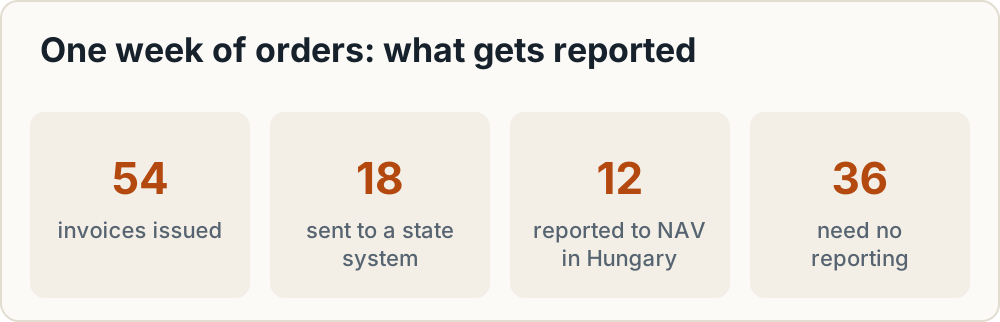
- 40 B2C orders prepaid by card through a gateway (8 per country)
- 5 cash-on-delivery orders collected by couriers (1 per country)
- 9 B2B orders (3 each in PL, RO and HU)
That is 54 orders and 54 invoices.
| Country | Orders | What the tool must send, and where |
|---|---|---|
| CZ | 8 prepaid + 1 COD | Invoices only. No EET 2.0 records, because gateway and courier COD payments are excluded. |
| SK | 8 prepaid + 1 COD | Invoices only, no eKasa. From 2027, a domestic B2B order would go via Peppol. |
| PL | 8 prepaid + 1 COD + 3 B2B | 3 B2B invoices to KSeF. Consumer invoices are optional in KSeF. Confirm the register exemption for the COD order. |
| HU | 8 prepaid + 1 COD + 3 B2B | All 12 invoices reported to NAV through the technical user. |
| RO | 8 prepaid + 1 COD + 3 B2B | 3 B2B invoices to e-Factura within 5 working days. The 9 B2C invoices stay out unless a buyer opted in. |
Result: 18 of the 54 invoices must go to a state system: 12 in Hungary, 3 in Poland and 3 in Romania. The other 36 need correct content and numbering but no reporting. If the shop opened a paid pickup counter in Prague or Bratislava, payments taken there would also fall under EET 2.0 or eKasa.
Cost illustration, using prices checked on 21 October 2026. This covers only the CZ and HU invoicing tools:
- Fakturoid "Na každý den": 256 Kč a month at the standard price, or 211 Kč a month at the discounted price. VAT is included.
- Számlázz.hu "#start": 1,990 Ft net a month on monthly billing, or 1,690 Ft net a month on the annual package (20,280 Ft net a year). The Számla Agent API for automatic invoicing costs extra.
We did not price the Polish, Romanian or Slovak connections.
Tool requirements checklist and vendor examples
Run this list against any vendor demo:
- Hungary: submits invoices, amendments and cancellations to NAV through a technical user, and shows the submission status.
- Hungary: handles receipt data reporting, if you issue receipts.
- Poland: sends structured invoices to KSeF by API and has a documented offline or failure mode.
- Romania: routes by customer type (tax ID, CNP or none), supports the 13-zero placeholder, and tracks the 5-working-day deadline.
- Slovakia: connects to a certified Peppol Access Point and produces Peppol BIS 3.0 invoices.
- Credit notes and cancellations go through the same channel as the original invoice.
- Shop integration with Shoptet, WooCommerce or Shopify, or a usable API. See Shoptet vs Shopify vs WooCommerce in CEE.
- Numbering series per country and document type.
- VAT and OSS: correct rates for each destination country. See OSS VAT registration for a webshop.
- Archiving of invoices and reporting confirmations.
Fakturoid (CZ)
These prices come from the Fakturoid pricing page, checked on 21 October 2026. The page states that prices include VAT. It shows a discounted and a standard price for each plan, so confirm on the page which billing terms the discount needs.
| Plan | Discounted | Standard | API requests/month |
|---|---|---|---|
| Zdarma | 0 Kč (up to 5 clients) | 0 Kč | 1,500 |
| Na lehko | 151 Kč/month | 182 Kč/month | not stated |
| Na každý den | 211 Kč/month | 256 Kč/month | 3,000 |
| Na maximum | 393 Kč/month | 476 Kč/month | 20,000 |
There is a 30-day trial. Before you subscribe, check whether Fakturoid or your shop platform offers an integration for Shoptet, WooCommerce, Shopify or PrestaShop, and on what terms. Strength: a simple Czech tool with clear API quotas. Limit: we found no support for the HU, PL, RO or SK reporting channels.
Számlázz.hu (HU)
These prices come from the Számlázz.hu packages page, checked in October 2026.
| Package | Monthly billing, net | Annual package, net per month (gross) |
|---|---|---|
| #free | 0 Ft | 0 Ft |
| #start | 1,990 Ft | 1,690 Ft (2,146 Ft) |
| #digital | 2,890 Ft | 2,490 Ft (3,162 Ft) |
| #profi | 3,790 Ft | 3,290 Ft (4,178 Ft) |
Every package is listed as prepared for NAV online invoicing. As with any tool, submission runs through your NAV technical user. The Számla Agent API, which handles automatic invoicing from a shop, is a paid add-on on every package. Strength: built around the NAV workflow. Limit: the API add-on is an extra cost.
We did not price or verify any vendor for Poland, Romania or Slovakia for this article. For those countries, judge tools against the checklist above rather than against claims of compliance.
What to do before 1 January 2027
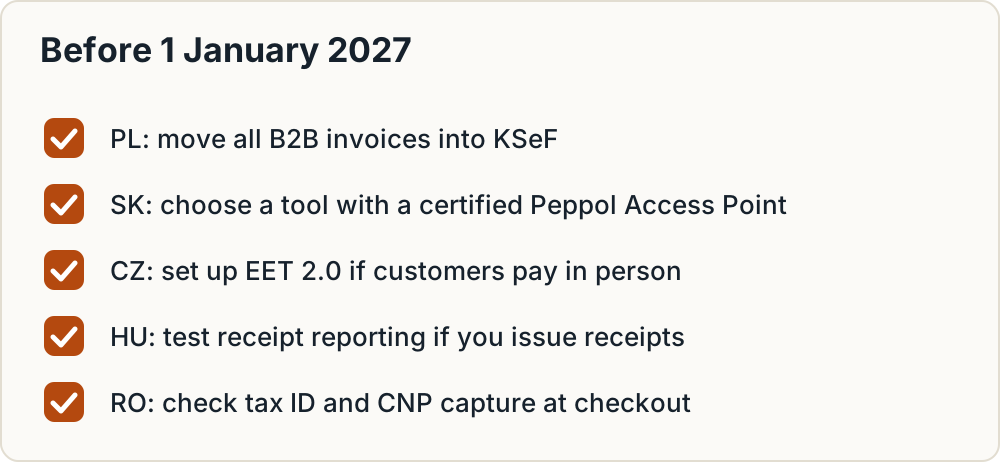
- Poland: move all B2B invoices into KSeF. Penalties start on 1 January 2027, and the PLN 10,000 relief ends with 2026.
- Slovakia: choose a tool connected to a certified Peppol Access Point, and test domestic B2B invoices during the voluntary 2026 period.
- Czechia: if customers pay at a shop or pickup point, set up EET 2.0 recording. January 2027 is a voluntary pilot.
- Hungary: if you issue receipts, test receipt reporting now, because fines can apply from 1 January 2027.
- Romania: check that your checkout captures tax ID and CNP correctly under Law 88/2026.
- Work through the EU compliance checklist for an online shop, and review cash on delivery in Eastern Europe and the Barion and SimplePay gateway guide for HU and RO.
Frequently asked questions
Do all Hungarian webshop invoices have to be reported to NAV?
Yes, if you invoice under Hungarian VAT. Every invoice, amendment and cancellation goes to NAV through Online Számla, B2B and B2C, regardless of amount. The customer can still receive a PDF or paper invoice.
Which invoicing tools connect directly to NAV Online Számla?
Any tool can submit invoice data to NAV if it uses a technical user created by the business's primary user in Online Számla. Számlázz.hu is one Hungarian example, and automatic invoicing from a webshop needs its paid Számla Agent API. Ask any other vendor whether they use NAV's machine interface and have tested in NAV's test environment.
Does a Polish webshop need a fiscal cash register?
Usually not, for mail-order sales paid by transfer, card or payment platform into the business bank account, delivered by post or courier, and documented per customer. Some goods, such as tobacco, spirits above 50% alcohol and coal, need a register anyway. Cash payments need checking against the exemption regulation.
Is KSeF mandatory for invoices to consumers in Poland?
No. Invoices to consumers remain voluntary in KSeF. B2B invoices must go through KSeF, which has been mandatory for all taxpayers since 1 April 2026, with penalties from 1 January 2027.
Does a Slovak e-shop need eKasa for cash on delivery?
Not when a courier collects the cash and passes it on, according to Podnikajte.sk. eKasa applies when the shop itself receives cash or a cash substitute at the point of sale, such as its own pickup counter. Confirm this against Act 289/2008 before relying on it.
Must a Romanian webshop send B2C invoices to RO e-Factura?
Generally no, under Law 88/2026. A customer with no tax ID, or identified only by CNP, is treated as B2C, and the invoice stays out of e-Factura unless the individual registered voluntarily. Invoices with no identifier use 13 zeros.
Do Czech e-shops have to report sales under EET 2.0?
Only payments taken in person, such as cash or card at a shop or pickup point. Gateway payments, bank transfers and courier-collected cash on delivery are excluded. The law was signed on 17 September 2026, and recording starts on 1 January 2027 with a voluntary January pilot.
Decision summary
- Invoicing under Hungarian VAT: you need a NAV-connected tool. Every invoice is reported, and receipts too if you issue them.
- Polish B2B customers: you need KSeF, with penalties from 1 January 2027. Consumer invoices are optional, and mail-order sales paid to your bank account usually need no register.
- Romanian customers: you need e-Factura for B2B within 5 working days, and tax ID/CNP routing for B2C.
- Slovak B2B customers: you need a Peppol Access Point connection by 1 January 2027. eKasa applies only to cash or cash substitutes taken at your own point of sale.
- Czech online-only shop: a standard invoicing tool such as Fakturoid is enough. EET 2.0 applies only if customers pay you in person.
- Selling in several countries: we found no single verified tool covering all five channels. Plan on one local tool or connector per country, and test each one against the checklist.
Sources
What this guide relies on, in the order cited.
- NAV's guidance · nav.gov.hu
- B2B and B2C invoices regardless of amount · econnect.eu
- up to HUF 500,000 per invoice · vg.hu
- reported to NAV within 3 calendar days · nav.gov.hu
- mandatory on 1 February 2026 · ifirma.pl
- three conditions are met · ifirma.pl
- within 5 working days · fiscal-requirements.com
- gives no tax ID or is identified by a CNP · kpmg.com
- Financial Administration's EET site · eet.gov.cz
- Fakturoid's explainer · fakturoid.cz
- covers contact payments · pruvodcepodnikanim.cz
- Dauc.cz · dauc.cz
- Podnikajte.sk · podnikajte.sk
- domestic B2B and B2G e-invoicing becomes mandatory · econnect.eu
- Fakturoid pricing page · fakturoid.cz
- Számlázz.hu packages page · szamlazz.hu