On this page
- GPSR in one minute: who it hits and since when
- Step 1: Work out your role for each product
- Step 2: Make sure an EU responsible person exists
- Step 3: Labels on the product and packaging
- Step 4: Technical documentation and retention
- Step 5: Product page requirements (Article 19)
- Worked example: one Czech shop, three products
- What shops get wrong
- CEE enforcement: what changed in 2026
- Printable checklist and 30-day plan
- Frequently asked questions
- Key takeaways
This guide explains how the rules work in practice. It is not legal or tax advice; check the linked official sources or ask an adviser for your specific case.
Under the General Product Safety Regulation (GPSR), every consumer product you sell needs an identifiable manufacturer, an EU-based responsible person, a traceable label and safety information on the product page. This GPSR checklist for a webshop puts those duties in the order a small shop works: first decide your role for each product, then check the product and its label, the file you keep and the product page.
It is written for shops selling in or into Czechia, Slovakia, Poland, Hungary and Romania without compliance staff. You will find a role decision table, a per-SKU data template for your feed or PIM, and a path for products with no EU manufacturer.
GPSR in one minute: who it hits and since when
Regulation (EU) 2023/988 has applied since 13 December 2024 to nearly all consumer products sold in the EU, including distance sales. An online shop shipping to customers in another member state is covered in the same way as a shop with a counter.
GPSR is the general safety net. Where EU sector rules (toys, electrical equipment, cosmetics and so on) set specific safety requirements, GPSR covers only the aspects and risks those rules leave open. Article 2(2) excludes some categories, among them human and veterinary medicines, food, feed, living plants and animals, plant protection products and antiques. Read the full list in Article 2 before you treat a product line as exempt.
The regulation does not set a single EU-wide fine. Each member state sets its own penalties, so enforcement differs between CZ, PL and the other CEE markets (see below).
Step 1: Work out your role for each product
Your duties depend on your role. A shop can hold different roles for different SKUs, so decide product by product, not once for the whole business.
| Situation | Your role | Main duties | What the product page must show |
|---|---|---|---|
| You resell another brand bought from an EU manufacturer or wholesaler | Distributor | Before selling, check that the manufacturer's and importer's identifier, contact details and instructions are present. Keep the product safe in storage and transport. Do not supply products you suspect are non-compliant | Manufacturer details, product image and identifiers, warnings in the customer's language |
| You sell under your own shop name or trademark (private label) | Manufacturer | Risk analysis, technical documentation, labelling, instructions, 10-year retention | As above, with your own business as the manufacturer |
| You change a product in a way that affects its safety | Manufacturer of the modified product | Full manufacturer duties for the modified version | As above |
| You buy directly from a non-EU supplier and bring the goods into the EU | Importer | Check the manufacturer met its duties, put your own name and contact details on the product, keep a copy of the technical documentation for 10 years | Non-EU manufacturer's details plus your details as responsible person |
| You dropship or list a non-EU brand with no EU presence | Depends on setup. Someone in the EU must be the responsible person | Do not sell until an EU responsible person exists | Manufacturer and EU responsible person details |
Sources for the duties: Articles 11 (importers) and 12 (distributors) of the regulation, and Ecommerce Germany on own-brand sellers.
The private-label row catches many small shops. A retailer that sells under its own name or trademark is treated as the manufacturer. This applies even if a factory in Shenzhen or Łódź made the goods.
Step 2: Make sure an EU responsible person exists
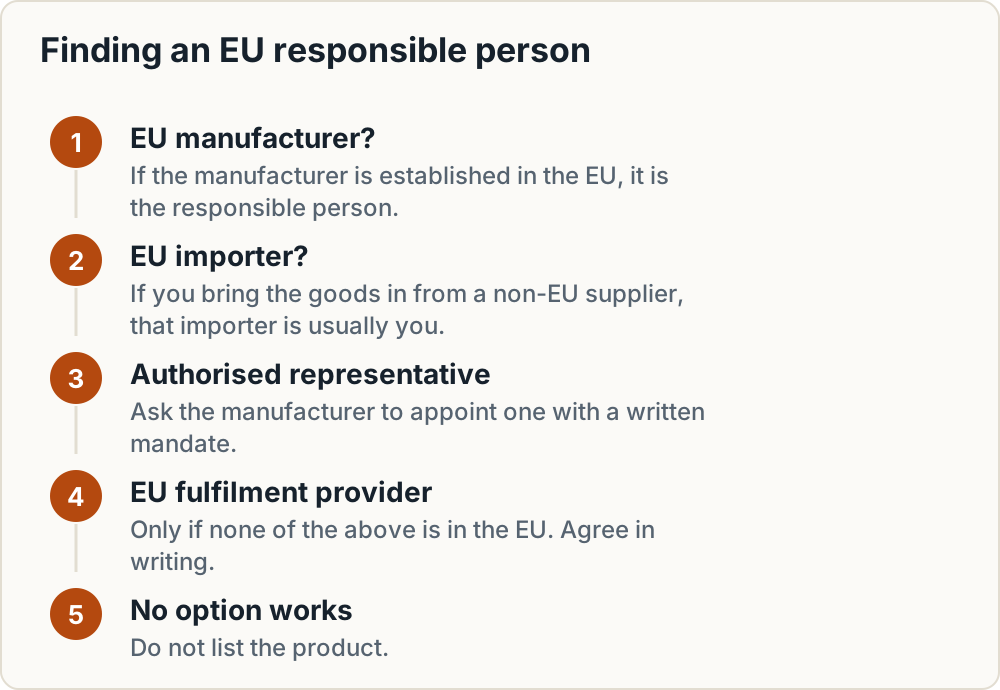
A product covered by GPSR may only be placed on the EU market if an economic operator established in the EU is responsible for it. The Commission's guidelines, published on 19 November 2025, list who can take that role: an EU manufacturer, the importer, an authorised representative, or an EU fulfilment service provider, the last only if none of the others is established in the EU. An authorised representative acts under a written mandate.
The responsible person must actually do the job. They need access to the compliance information and must cooperate with authorities. A mailbox address is not enough.
Decision path if you have no EU manufacturer
- Is the manufacturer established in the EU? If yes, it is the responsible person. Record its details and move on.
- Is there an EU importer? If you buy from a non-EU supplier and bring the goods into the EU yourself, that importer is usually you. Take on the importer duties knowingly.
- Neither? Ask the manufacturer to appoint an EU authorised representative with a written mandate. Some suppliers already have one. Ask before you order.
- Still nothing? Only then can an EU fulfilment service provider take the role. Agree this in writing and check they hold the file.
- No option works? Do not list the product.
The same logic of naming an EU-based party shows up in other regimes. Our articles on GPSR fields on Allegro, Kaufland and eMAG and Hungary EPR registration cover the marketplace and EPR versions.
Step 3: Labels on the product and packaging
Article 9 sets the manufacturer's labelling duties (text of Article 9):
- Identifier: a type, batch or serial number or another element that consumers can easily see and read. If the product's size or nature prevents this, put it on the packaging or in an accompanying document.
- Manufacturer contact: name, registered trade name or trademark, postal address and electronic address. These go on the product itself. Only where that is not possible may they go on the packaging or in an accompanying document.
- Instructions and safety information: in a language consumers can easily understand, as decided by the member state where the product is sold.
Importers must add their own name, registered trade name or trademark, postal and electronic address in the same way: on the product, or on the packaging or an accompanying document if that is not possible. The responsible person's name and contact details must appear on the product or its packaging, the parcel or an accompanying document.
Label template (one per SKU)
| Field | Example entry |
|---|---|
| Product name and type/model | Ceramic mug, model M-350 |
| Batch or serial | LOT 2025-11-A |
| Manufacturer | Name, postal address, email or web form |
| Importer (if any) | Name, postal address, email |
| EU responsible person | Name, postal address, email (if manufacturer is outside the EU) |
| Warnings | Local language for each target market |
| Instructions reference | "See enclosed leaflet" or QR to manual, plus printed leaflet where needed |
Relabelling stock from non-EU suppliers
A sticker or insert can add missing EU details to stock already in your warehouse. Two rules of good practice apply. The data must be correct and must match your file. The sticker must not cover markings already on the product, such as the CE mark, the identifier or existing warnings. If you would have to cover something to make room, use a hang tag or an insert instead.
Step 4: Technical documentation and retention
Before placing a product on the market, the manufacturer carries out an internal risk analysis and draws up technical documentation. ComplianceGate lists the usual contents: a general product description, risk analysis and mitigation, test reports and the European standards applied. Under Article 9, the file must be kept up to date and kept for 10 years after the product is placed on the market. It must be available to market surveillance authorities on request.
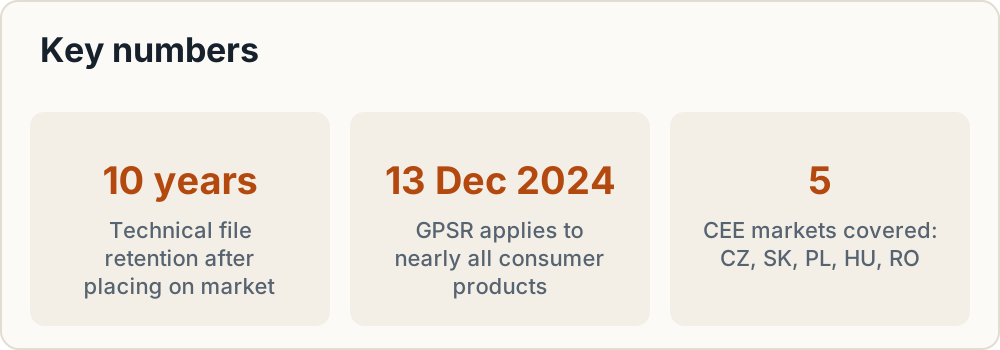
Importers keep a copy for 10 years. Distributors have no explicit duty to hold the file. They should still be able to get the documents from their supplier quickly, so ask for them at onboarding. Authorities may request the file during import or sector checks or after a complaint, and marketplaces may ask for it too.
One folder per SKU
/GPSR/SKU-10432-mug-M350/
  01-product-description.pdf
  02-manufacturer-and-supplier-contacts.txt
  03-responsible-person-mandate.pdf
  04-risk-notes.pdf
  05-test-reports/
  06-standards-applied.txt
  07-label-artwork.pdf
  08-manual-and-warnings-CZ-SK-PL-HU-RO.pdf
  09-supplier-declaration.pdf
  10-placed-on-market-date.txt   (and review date = +10 years)
Incident procedure in five lines
- Log every safety complaint with SKU, batch, date and description.
- Stop sales of the affected batch while you check.
- Contact the manufacturer and responsible person the same day.
- If an accident happened: the manufacturer (or the responsible person, if the manufacturer is outside the EU) must report it to the authorities without delay through the Safety Business Gateway. As an importer or distributor, inform the manufacturer at once. File the report yourself if the manufacturer tells you to, or if you are the manufacturer.
- Save all correspondence in the SKU folder.
Step 5: Product page requirements (Article 19)
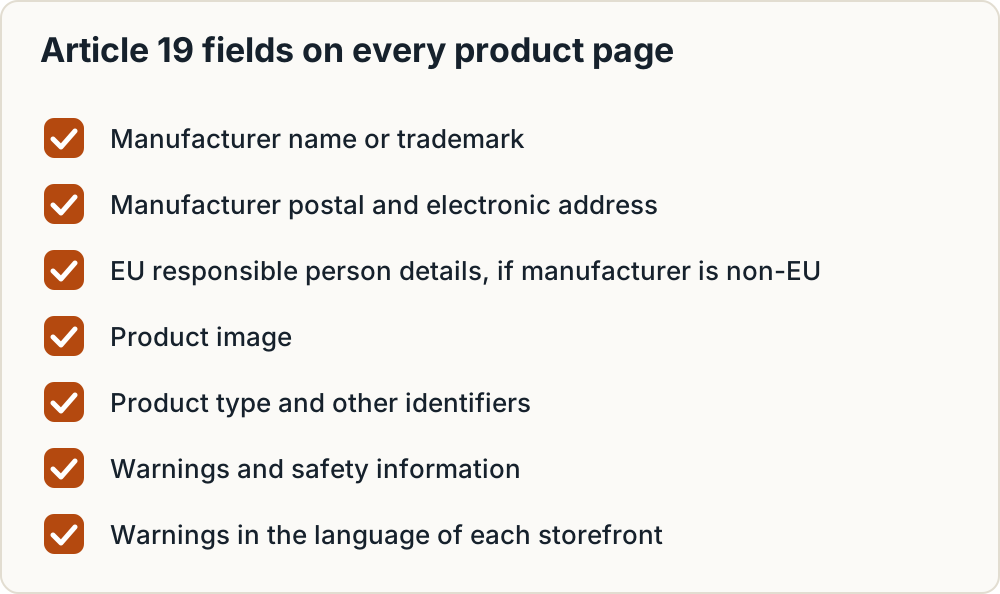
Article 19 lists what an online offer must show clearly and visibly. That means the manufacturer's name, registered trade name or trademark, with postal and electronic address. If the manufacturer is outside the EU, add the responsible person's name, postal address and electronic address. The offer also needs information that identifies the product, including an image, its type and any other product identifier. Finally, it needs any warnings or safety information, in a language consumers easily understand as decided by the member state. As VIMM notes, the image is part of the product identification.
Copy-ready field template for your feed or PIM
| Field key | Content | Required when |
|---|---|---|
gpsr_manufacturer_name |
Name or trademark | Always |
gpsr_manufacturer_address |
Postal address | Always |
gpsr_manufacturer_email |
Email or web contact | Always |
gpsr_rp_name |
EU responsible person | Manufacturer outside the EU |
gpsr_rp_address |
Postal address | Manufacturer outside the EU |
gpsr_rp_email |
Manufacturer outside the EU | |
gpsr_type |
Type or model | Always |
gpsr_identifier |
Other identifiers, such as batch, serial or EAN | Where the product has them |
image_main |
Product image | Always |
gpsr_warnings_cs / _sk / _pl / _hu / _ro |
Warnings per language | For each storefront you run |
Put the data in a "Product safety" block in the same position on every product page. Article 19 requires the information in the offer itself, so a footer or terms page alone does not do the job. Map the fields once and every channel benefits; see our product feed checklist and multi-channel product feed mapping.
On language, a Czech law firm states that warnings and safety information in online offers aimed at Czech consumers must be in Czech. In practice, show warnings in the language of each storefront: Czech on .cz, Slovak on .sk, Polish on .pl, Hungarian on .hu and Romanian on .ro.
Worked example: one Czech shop, three products
A Brno shop selling home goods in CZ and SK stocks three products:
| Product | Source | Role | Responsible person | File duty |
|---|---|---|---|---|
| German-brand kettle | EU wholesaler | Distributor | German manufacturer | Get documents on request from the supplier |
| Mugs under the shop's own brand | Factory in China | Manufacturer (own brand) and importer | The shop | Full file, 10 years |
| LED lamp, Chinese brand | Dropshipped from China | Unclear until an EU party exists | Missing | Do not list until an EU party exists |
The mugs were first placed on the market on 3 March 2025. The file must be kept until at least 3 March 2035. If a new batch or design change follows, update the file and keep the original date log.
The stakes in Czechia are real. Act No. 387/2024 Coll., the Czech GPSR act, sets fine ceilings of up to CZK 20 million for distributors. For manufacturers and importers the ceiling is up to CZK 50 million, the top tier being for placing dangerous products on the market. A Czech law firm also reports up to CZK 5 million for online shop violations. For the mugs, the shop sits in the manufacturer and importer tier.
The lamp shows the most common gap. A cheap product with no EU responsible person cannot legally be listed, however good the product page looks.
What shops get wrong
Warning: Putting your own logo on a supplier's product makes you its manufacturer. That brings the full risk analysis, technical file and 10-year retention duties. A "white label" invoice from the factory does not move those duties back to the factory.
- Treating role as a company-wide setting. Roles differ per SKU. Store the role as a field in the PIM.
- Using a virtual office as responsible person. A mailbox with no access to the file does not meet the requirement.
- English-only warnings on CEE storefronts. Local-language safety information is expected for each market.
- Forgetting the image. Article 19 includes an image in the product identification, so use a real photo of the product.
- Hiding the data in the footer. Keep it in a product safety block on each product page.
- Covering markings with stickers. Relabel next to existing markings, never over them.
CEE enforcement: what changed in 2026
Czech Republic. Act No. 387/2024 Coll. on general product safety sits alongside the regulation. The Czech Trade Inspection Authority (ČOI) is the main supervisor, with other bodies covering specific product groups. The fine ceilings are set out in the worked example above. Check the current consolidated text before relying on any number.
Poland. The Act of 7 November 2025 on the supervision of general product safety (Dz.U. 2025 poz. 1826) was published on 19 December 2025 and has applied since 3 January 2026. It sets the national supervision framework involving UOKiK and the Trade Inspection (Inspekcja Handlowa). We have not verified the fine amounts against the act's text, so read the penalty provisions there before relying on any figure.
Slovakia, Hungary, Romania. We found no verified national sources on GPSR penalties. Contact the national market surveillance authority in each country, and do not assume their rules match the Czech or Polish ones.
Printable checklist and 30-day plan
"Once" means a one-time setup. "Per SKU" means repeat it for every new product.
| Area | Item | Frequency |
|---|---|---|
| Role | Role recorded for each SKU in the PIM | Per SKU |
| Responsible person | EU responsible person named, written mandate on file if not manufacturer or importer | Per SKU |
| Product | Sector rules checked (toys, electrical, cosmetics) | Per SKU |
| Label | Identifier, manufacturer and importer contact, responsible person, local-language warnings | Per SKU |
| File | SKU folder created, placed-on-market date and 10-year review date logged | Per SKU |
| Page | Product safety block template built into the theme | Once |
| Page | All Article 19 fields filled and visible | Per SKU |
| Feed | GPSR fields mapped to every channel | Once, then check per SKU |
| Incidents | Complaint log and five-line procedure in place, contact route to each manufacturer agreed | Once |
30-day plan: Week 1, assign roles and find gaps in the responsible person field across all SKUs. Week 2, request missing documents and mandates from suppliers. Week 3, build the product safety block and feed fields, then fill the bestsellers first. Week 4, relabel stock, delist products with no EU responsible person and set up the incident log.
For the obligations outside GPSR, see our EU compliance checklist for an online shop, packaging EPR in CEE and the EU 14-day withdrawal right.
Frequently asked questions
Does GPSR apply to a small webshop with only a few products?
Yes. GPSR applies to nearly all consumer products sold in the EU, including distance sales, and there is no exemption based on shop size or number of products. A shop with five SKUs needs the same label, page and responsible person data as a large retailer.
Do I need an EU responsible person if I only resell branded goods from an EU wholesaler?
One must exist, but it does not have to be you. If the manufacturer is established in the EU, it is the responsible person. Your job as a distributor is to check that the manufacturer's identifier and contact details are on the product, and to show the Article 19 information on your page.
Can my fulfilment provider be the EU responsible person?
Only as a fallback. Under the Commission's November 2025 guidelines, an EU fulfilment service provider can be the responsible person only if no manufacturer, importer or authorised representative is established in the EU. If you use this route, agree the role in writing and make sure the provider can access the compliance file and respond to authorities.
What language must safety warnings be in on a Czech, Polish or Hungarian product page?
Article 19 requires a language consumers easily understand, as decided by the member state where the product is sold. For Czechia, a Czech law firm states this means Czech. The safe practice is the official language of each storefront's market.
What goes on the product page if the product is too small to label?
Under Article 9, if size or nature prevents marking the product, the identifier and manufacturer details can go on the packaging or in an accompanying document. The online offer still has to show all the Article 19 information. A small item gets the full product safety block on its page.
Do I need to repeat GPSR information on Allegro, Kaufland or eMAG?
Yes. Each online offer must show the Article 19 information, and marketplaces ask for the fields for each product. Holding the data once in a PIM or feed and mapping it to each channel avoids entering it again by hand.
How is a serious accident reported?
The manufacturer, or the EU responsible person if the manufacturer is outside the EU, reports it to the authorities without delay through the EU's Safety Business Gateway. Importers and distributors who learn of an accident must inform the manufacturer at once, and file the report if the manufacturer tells them to. Stop selling the affected batch and keep a record in the SKU's technical file.
Key takeaways
- Decide your GPSR role per SKU. Selling under your own brand makes you the manufacturer.
- No EU-established responsible person means no listing. A mailbox address does not qualify, and a fulfilment provider is only a fallback.
- Labels need an identifier, manufacturer (and importer) contacts and local-language safety information. Relabel without covering existing markings.
- Keep a technical file per SKU for 10 years from placing on the market, and log the date.
- Every product page needs the Article 19 fields, including an image, in a fixed product safety block.
- Penalties are national. Check the Czech and Polish acts in their current versions, and ask the SK, HU and RO authorities directly.
Sources
What this guide relies on, in the order cited.
- applied since 13 December 2024 to nearly all consumer products sold in the EU, including distance sales · vimm.be
- GPSR covers only the aspects and risks those rules leave open · gesetze.legal
- Each member state sets its own penalties · ecommercegermany.com
- 11 (importers) · gesetze.legal
- 12 (distributors) · gesetze.legal
- an economic operator established in the EU is responsible for it · gesetze.legal
- an EU manufacturer, the importer, an authorised representative, or an EU fulfilment service provider, the last only if none of the others is established in the EU · matheson.com
- text of Article 9 · gesetze.legal
- ComplianceGate lists the usual contents · compliancegate.com
- without delay through the Safety Business Gateway · gesetze.legal
- Article 19 · gesetze.legal
- warnings and safety information in online offers aimed at Czech consumers must be in Czech · dostupnyadvokat.cz
- Act No. 387/2024 Coll. · epravo.cz
- Act of 7 November 2025 on the supervision of general product safety · eli.gov.pl