
This guide explains how the rules work in practice. It is not legal or tax advice; check the linked official sources or ask an adviser for your specific case.
From Czechia, Packeta is the obvious first carrier if your customers in Romania or Hungary will collect from pick-up points, because its own network covers both countries. From Poland, InPost International reaches Hungary but not Romania, so Romania needs a courier such as GLS or DPD. This guide compares the carriers a small shop can realistically use on these four lanes, explains why there is no customs step, and shows how to price a delivery before you ask for quotes.
Few public prices exist for these lanes. The most detailed list we could verify is for parcels sent from Slovakia, not from Czechia or Poland. So the article shows you how to compare carriers. It does not name a "cheapest" one, because e-shop contract rates are private and depend on volume.
Do Czech/Polish parcels to Romania or Hungary need customs?
No. Czechia, Poland, Hungary and Romania are all EU member states. A parcel between them is an intra-EU shipment, so there is no customs declaration, no import duty and no clearance.
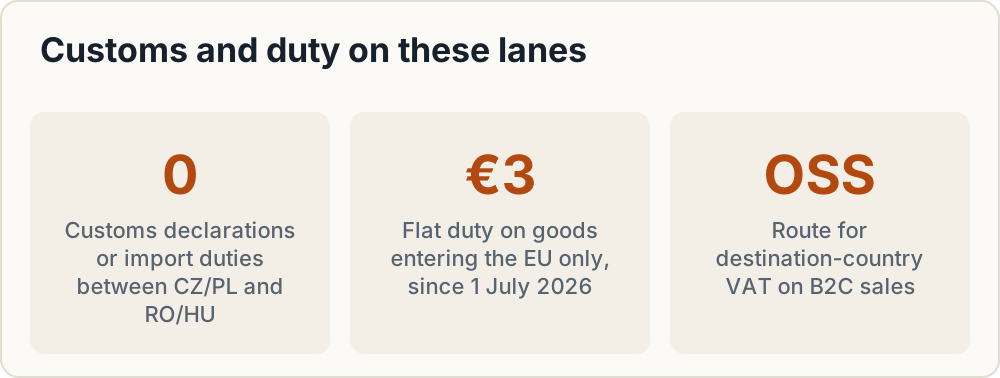
Many articles mix this up with the new EU flat duty. The €3 duty on low-value parcels has applied since 1 July 2026, but only to goods entering the EU from outside it. Shipmondo states that shipping within the EU is not affected. It also says the flat rate is temporary until a new EU customs system takes over, expected from 1 July 2028. KPMG describes the duty as charged per item category (tariff heading) in consignments under €150 entering the EU, aimed at IOSS-registered shipments. Our explainer on the EU €3 customs duty on small parcels covers who it does affect.
Key point: the €3 duty does not apply to a parcel from Prague or Wrocław to Budapest or Bucharest. What does apply is the destination country's VAT on B2C distance sales, usually declared through OSS.
On these routes the tax question is VAT, not customs. See OSS VAT registration for a webshop for the steps from Czechia or Poland.
Carrier options by route
A shop sending 1–20 parcels a day has four realistic carriers for these lanes:
- Packeta (Zásilkovna): pick-up points and parcel machines, strongest from Czechia.
- InPost International: a Polish locker operator with selected foreign lanes.
- GLS: a road courier with business products and an online calculator.
- DPD: a road courier with the DPD Classic export product.
For a general comparison of these four within CEE, see Packeta vs InPost vs GLS vs DPD: carriers for small CEE shops. This article covers only the CZ/PL to RO/HU lanes.
Packeta (Zásilkovna) from Czechia
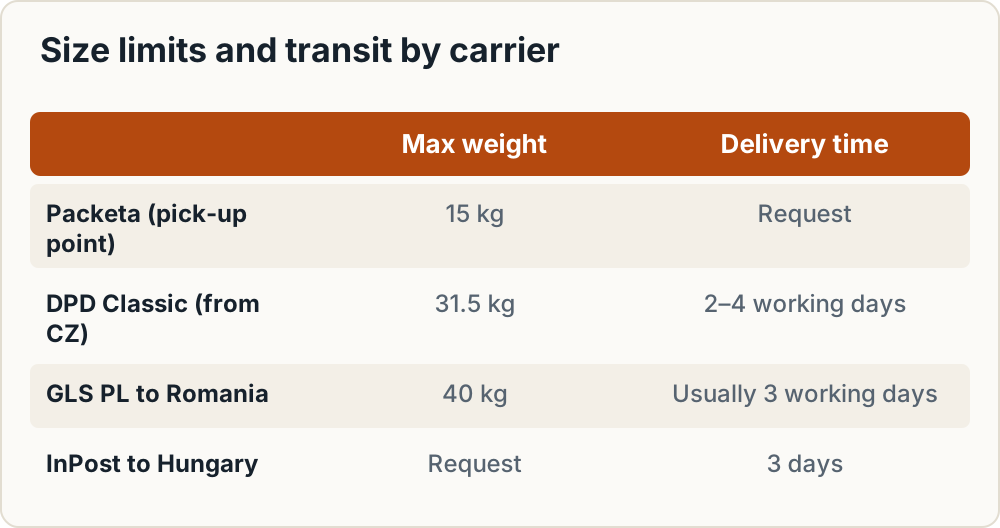
Packeta runs its own pick-up network in Czechia, Slovakia, Hungary and Romania. Its products page says pick-up points accept parcels up to 15 kg, and that home delivery runs through more than 60 partner carriers. It gives no cross-border prices or transit times.
The only public Packeta prices in euros we could verify are on Packeta Slovakia's sender page. They are consumer rates for parcels sent from Slovakia, not Czech-origin prices and not e-shop contract rates. Treat them as a reference point only:
| Destination (from Slovakia, public sender rate) | Pick-up point | Home delivery |
|---|---|---|
| Hungary | from 4.10 EUR | from 7.20 EUR |
| Romania | from 4.70 EUR | from 7.80 EUR |
| Add-on: cash on delivery | 1.40 EUR | 1.40 EUR |
The same page includes insurance up to 15 EUR of parcel value. Above that, each further 5 EUR started costs 0.03 EUR, up to 200 EUR of cover. A standard parcel weighs up to 5 kg; 5–15 kg counts as oversized.
A Czech shop should check Zásilkovna's own CZK sender prices for Hungary and Romania. More important, ask for the e-shop rate card: that is what your checkout fees should be based on.
- Pros: pick-up delivery in both target countries on Packeta's own network; COD available.
- Limits: 15 kg ceiling at pick-up points; home delivery depends on partner carriers; contract rates and transit times must be requested.
InPost, GLS and DPD from Poland (and DPD from Czechia)
InPost International. The business service page lists lockers and points in Italy, France, Belgium, the Netherlands, Luxembourg, Spain and Portugal. Austria and Hungary are served by courier and partner locations via Austrian Post; Czechia and Slovakia via Packeta. The stated delivery time to Hungary is 3 days from posting. Romania is not listed. Business prices are in a separate price list we could not verify, so ask InPost for it.
- Pros: a provider a Polish shop may already use domestically; Hungary covered.
- Limits: Hungary runs through Austrian Post, not InPost lockers; no Romania; prices only on request.
GLS Poland to Romania. The GLS Poland Romania page allows parcels up to 40 kg, with girth plus longest side up to 300 cm. Delivery usually takes 3 working days, and Romania sits in the Euro IV zone. The page points regular shippers to EuroBusinessParcel and occasional senders to the online calculator; business rates must be requested. For returns, the same page lists 58 GLS pick-up points in Romania for parcels sent back to Poland. GLS Hungary is the regional hub for GLS's Eastern European region (HU, CZ, HR, RO, SK, SI and RS), and that page says export parcels within the region can use cash on delivery and FlexDelivery Service. That makes GLS Czech Republic worth a quote for Czech shops too.
- Pros: the highest weight limit on these lanes (40 kg); a published transit time; a defined return route from Romania.
- Limits: no public contract prices; the Polish page does not state COD terms for Romania.
DPD Classic. DPD Czech Republic's export page covers parcels up to 31.5 kg to destinations including Hungary, Poland and Romania. Delivery takes 2–4 working days outside Slovakia, with up to three delivery attempts and basic liability up to CZK 50,000 included. No prices are published. On that page, cash on delivery is listed for DPD Shop2Home, not for DPD Classic, so ask which product supports COD on your lane. We did not verify DPD Poland's export terms, so Polish shops should ask DPD Poland directly.
- Pros: home delivery with repeat attempts; high included liability; both target countries covered.
- Limits: prices only on request; COD not listed for Classic; a wider transit range than GLS's stated 3 days.
We could not verify a Packeta lane from Poland, so it is left out of the table below.
Decision table: which carrier for which route
Only facts from the sources above are used. "Request" means we found no verified public figure.
| Route | Best-fit carrier | Pick-up vs home | Size limit | Delivery time | COD | Price status |
|---|---|---|---|---|---|---|
| CZ to HU | Packeta; DPD Classic for heavier parcels | Packeta: both; DPD: home | Packeta 15 kg; DPD 31.5 kg | Packeta: request; DPD: 2–4 working days | Packeta: available; DPD: Shop2Home only, request | Request quote (SK-origin reference: from 4.10 / 7.20 EUR) |
| CZ to RO | Packeta; DPD Classic | Packeta: both; DPD: home | Packeta 15 kg; DPD 31.5 kg | Packeta: request; DPD: 2–4 working days | Packeta: available; DPD: Shop2Home only, request | Request quote (SK-origin reference: from 4.70 / 7.80 EUR) |
| PL to HU | InPost International (via Austrian Post) | Courier and partner locations | Request | 3 days | Request | Request quote |
| PL to RO | GLS EuroBusinessParcel | Home | 40 kg; girth + longest side 300 cm | Usually 3 working days | Request | Online calculator; business rates on request |
Three rules of thumb follow from the public data:
- Pick-up delivery is cheaper. On Packeta's Slovak list, Hungary costs from 4.10 EUR to a point and from 7.20 EUR to the door, a gap of 3.10 EUR per parcel.
- Romania costs more than Hungary. On the same list, Romanian pick-up starts at 4.70 EUR against 4.10 EUR for Hungary.
- InPost is not an option for Romania. A Polish shop selling there needs a courier contract.
Worked example: landed delivery cost for a 1.5 kg parcel
This example uses Packeta's public Slovak sender rates as reference figures, because they are the only verified public prices for these destinations. A 1.5 kg parcel is standard (up to 5 kg). Your own contract rate will differ, so treat this as a method, not a quote.
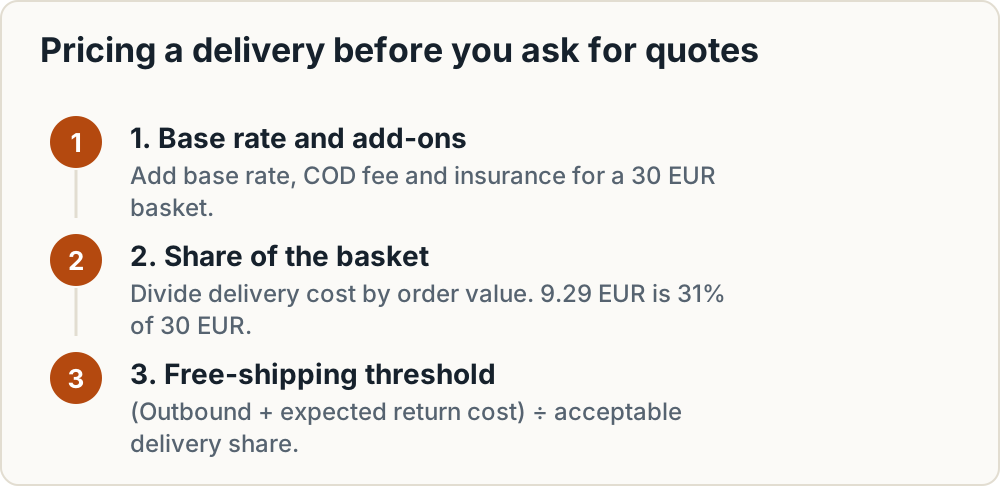
Step 1: base rate and add-ons for a 30 EUR basket
| Scenario (reference rates) | Base | COD | Insurance above 15 EUR | Total |
|---|---|---|---|---|
| To HU, pick-up, prepaid | 4.10 | – | 0.09 | 4.19 EUR |
| To RO, pick-up, prepaid | 4.70 | – | 0.09 | 4.79 EUR |
| To RO, home, COD | 7.80 | 1.40 | 0.09 | 9.29 EUR |
A 30 EUR basket is 15 EUR above the included cover: three started 5 EUR steps at 0.03 EUR, so 0.09 EUR. Without the insurance top-up, Romania home delivery with COD is 7.80 + 1.40 = 9.20 EUR.
Step 2: share of the basket. At 9.29 EUR, delivery takes 31% of a 30 EUR order. Pick-up delivery to Hungary takes 14%. That gap is the case for making pick-up the default and pricing door delivery as an upgrade.
Step 3: free-shipping threshold. Decide what share of order value you can spend on delivery, then divide:
Threshold = (outbound cost + expected return cost) ÷ acceptable delivery share
Expected return cost is the return rate multiplied by the return-leg price. We found no public price for a return from Romania or Hungary to Czechia or Poland, so get it from your carrier. With outbound cost only: 9.29 ÷ 0.10 = 92.90 EUR at a 10% delivery budget. Adding returns raises the threshold.
Who pays for a return depends on your terms and the EU 14-day withdrawal right. Return products also differ between carriers and between Czech and Polish origin, so ask each carrier how a parcel from RO or HU comes back to you.
Your own numbers:
- Contract base rate, HU pick-up: ______ EUR
- Contract base rate, RO pick-up: ______ EUR
- Contract base rate, RO/HU home: ______ EUR
- COD fee: ______ EUR
- Fuel surcharge: ______ %
- Return leg: ______ EUR × return rate ______ % = ______ EUR
- Landed cost per order: ______ EUR
Warning: the packeta.sk prices are public consumer rates for parcels sent from Slovakia. Do not set checkout shipping fees from them without a written e-shop rate card for your own origin country.
Costs beyond the base rate
COD fee and refusal risk. The COD fee is only the visible cost. When a buyer refuses a COD parcel, you pay both legs, get no revenue, and the stock is tied up until it returns. COD demand differs between Romania and Hungary, so check it before you build pricing around it. See cash on delivery fees and refusal risk.
Fuel and remote-area surcharges. Couriers often add these on top of the base rate. Ask Packeta, GLS, DPD and InPost for their current surcharge schedule in writing, for the country your contract is signed in.
Returns. Price the return leg separately, as in the worksheet. A low outbound rate with an expensive return label can cost more overall.
Packaging EPR. Selling packaged goods into another member state can create producer obligations there, and Hungary needs particular attention. Read Hungary EPR registration before your first shipment.
Checklist before choosing a carrier
Work through this list for each lane:
- Parcel profile: typical weight and size. Any parcels over 15 kg (Packeta points), 31.5 kg (DPD Classic) or 40 kg (GLS)?
- COD share: the percentage of RO and HU orders you expect to be COD.
- Delivery mix: pick-up point versus home, per country.
- Tracking language: do notifications reach the recipient in Romanian or Hungarian?
- Claims and liability: the included limit (DPD Czech Republic states CZK 50,000) and the claims process.
- Returns: return label price and the route back to CZ or PL.
- VAT on invoices: destination VAT configured in your shop for OSS sales.
- Last mile in Romania: would a local courier serve buyers better? See Romanian couriers compared.
Questions to send each carrier:
- Contract rate card for CZ or PL to HU and RO, pick-up and home, by weight band.
- Volume tiers and the parcel counts that trigger them.
- Fuel surcharge method and current percentage.
- COD availability on the lane, COD fee, payout timing and the charge for a refused COD parcel.
- Return label price from HU and RO.
- Plugin or API support for Shoptet, Shopify or WooCommerce.
Frequently asked questions
Do I need a customs declaration to ship from Czechia or Poland to Romania or Hungary?
No. All four countries are EU member states, so these are intra-EU shipments with no customs declaration and no import duty.
Does the EU €3 duty apply to my parcels to Romania or Hungary?
No. The flat duty that started on 1 July 2026 covers low-value goods entering the EU from outside it. Parcels shipped within the EU are not affected.
Which carrier is cheapest from Czechia to Hungary and Romania?
Public data cannot answer this, because e-shop contract rates are not published. The only public euro reference we could verify is Packeta's Slovak sender list (from 4.10 EUR to a Hungarian pick-up point, from 4.70 EUR to a Romanian one), and it covers parcels sent from Slovakia. Ask Packeta, DPD and GLS for contract quotes and compare landed cost, not the base rate.
Can InPost deliver from Poland to Romania?
No. InPost International's business page lists Hungary, served via Austrian Post, but not Romania. A Polish shop needs a courier such as GLS or DPD for Romanian customers.
What is the maximum parcel weight at Packeta, GLS and DPD?
Packeta pick-up points accept parcels up to 15 kg, with 5–15 kg counted as oversized. DPD Classic export from Czechia takes up to 31.5 kg. GLS from Poland to Romania accepts up to 40 kg, with girth plus longest side up to 300 cm.
Which VAT do I charge on parcels to Romanian and Hungarian customers?
For B2C distance sales within the EU, the customer's country VAT generally applies once your cross-border EU sales pass the EU distance-selling threshold. Most small shops then declare that VAT through OSS in their home country rather than registering in each destination. Our guide to OSS VAT registration for a webshop explains the threshold and the steps.
Decision summary
- Czech shop, mostly small parcels to RO and HU: start with Packeta pick-up delivery and request its e-shop rate card. Add DPD Classic or GLS for home delivery or parcels over 15 kg.
- Polish shop selling to Hungary: InPost International reaches Hungary via Austrian Post in 3 days. Get its price list and compare it with a courier quote.
- Polish shop selling to Romania: InPost does not cover Romania. Get a GLS EuroBusinessParcel quote (usually 3 working days, up to 40 kg) and consider a local Romanian courier for the last mile.
- Any route: no customs and no €3 duty, but destination VAT through OSS and possible packaging EPR in the destination country.
- Before publishing shipping fees: fill in the worksheet with contract rates, the return leg and surcharges.
For the wider setup, see our guides to shipping setup for a small CEE webshop and parcel locker delivery setup.
Sources
What this guide relies on, in the order cited.
- Shipmondo states · shipmondo.com
- KPMG describes · kpmg.com
- products page · packeta.com
- Packeta Slovakia's sender page · packeta.sk
- business service page · inpost.pl
- GLS Poland Romania page · gls-group.eu
- regional hub for GLS's Eastern European region · gls-group.com
- export page · dpd.com