
On this page
- Shipping setup in one page: the eight steps
- Step 1: Define your parcel profile and destination countries
- Step 2: Carrier contract or aggregator?
- Step 3: Collect the real price lists
- Step 4: Build the shipping rate table by country
- Step 5: Choose delivery options at checkout
- Step 6: Labels, handover and returns
- Step 7: Tracking and delivery notifications
- Step 8: Test, launch and review
- Common mistakes
- Ready-to-use checklist
- Frequently asked questions
- Key takeaways
This guide explains how the rules work in practice. It is not legal or tax advice; check the linked official sources or ask an adviser for your specific case.
Most small shops in CEE can handle shipping setup with one regional carrier or one aggregator, a rate table for each country built from net price lists, and two options at checkout: a locker or pickup point, and a home courier. Do the steps in order. Parcels that lose money, abandoned carts and "where is my parcel" emails usually come from a skipped step.
This guide covers the full setup for a small webshop selling to Czechia, Slovakia, Poland, Hungary and Romania. It is for shops sending fewer than about 100 parcels a day, whether you are launching shipping for the first time or adding a second country.
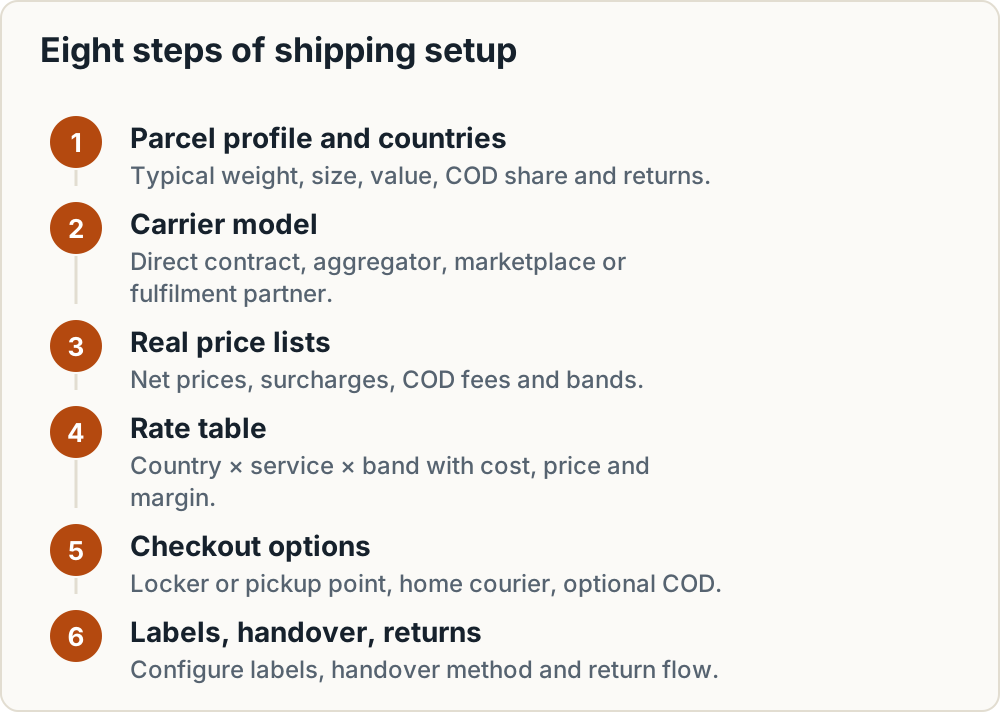
Shipping setup in one page: the eight steps
- Define your parcel profile and destination countries: typical weight, size and value, plus your share of cash on delivery (COD) orders and returns.
- Choose a carrier model: direct contract, aggregator, marketplace shipping or a fulfilment partner.
- Collect the real price lists: net prices, surcharges, COD fees, and the weight or size bands.
- Build the rate table: country × service × band, showing your cost, the customer price and your margin.
- Choose checkout options: locker or pickup point, home courier, and optional COD.
- Configure labels, handover and returns.
- Set up tracking and delivery notifications.
- Test, launch and review every month.
This article covers parcels shipped within the EU. If you ship from outside the EU, or import stock in small parcels, see EU 3 euro customs duty on small parcels.
Prices in this guide: carriers usually quote prices net of VAT and change them regularly. Every figure here is either dated or marked as an assumption. Download the carrier's current PDF before you set your own rates.
Step 1: Define your parcel profile and destination countries
Every later decision depends on what you actually ship. Take your last 50–100 orders, or work from your product range if you have no orders yet. Record:
- Typical weight, and the weight of your heaviest common order
- Box dimensions. Locker networks price by size class and may refuse oversized parcels or charge extra for them.
- Order value, which matters for insurance limits and any free-shipping threshold
- Fragility, which affects packaging cost and damage claims
- Expected COD share and return rate, since both raise your cost per order
Which countries first
Choose launch countries by demand, and by the compliance work you can take on. Selling to consumers in another EU country brings VAT obligations (see OSS VAT registration for a webshop). It can also create packaging obligations in each destination country (see packaging EPR in Poland, Czechia, Slovakia, Hungary and Romania). Each new country brings paperwork as well as a new shipping zone.
Locker or courier, country by country
For each country, estimate how many buyers will expect a locker or pickup point and how many will want a courier to the door. In Poland, InPost Paczkomat lockers are the reference point. In Czechia and Slovakia, Packeta (Zásilkovna) pickup points and Z-BOX lockers are widespread. Packeta also operates in Hungary and Romania, but compare it with local networks there before you commit.
Step 2: Carrier contract or aggregator?
| Model | Best when | Price transparency | Setup effort | COD | Returns |
|---|---|---|---|---|---|
| Direct contract with one regional carrier (e.g. Packeta) | Most orders go to countries that carrier covers well | PDF price list; terms negotiable | Medium | Usually built in, with a payout schedule | Carrier's return services, which vary by country |
| Aggregator (e.g. Furgonetka) | You want several carriers without several contracts | Price per shipment shown in the panel | Low | Depends on the carrier and the aggregator's terms | Managed in the same panel |
| Marketplace shipping | Most sales come through one marketplace | Set by the marketplace | Lowest | Marketplace rules | Marketplace rules |
| Fulfilment partner | Packing in-house no longer works | Bundled fee per order | High at first | Partner's carriers | Partner receives returns |
Direct: Packeta as the regional default
Packeta says it serves more than 62,000 e-shops and that integrations exist for 97% of the e-shop solutions used in Czechia. On most CZ and SK platforms, a plugin already exists. The homepage does not publish contract terms. Ask for the full price list and the list of surcharges before you sign.
Aggregator: one account, many carriers
Furgonetka lists 13 carriers, including DHL, FedEx, GLS, DPD, UPS and InPost. There are no fixed fees and no long-term contract; you pay for what you send. Furgonetka advertises discounts of up to 10% for businesses sending 10 or more parcels a month, and custom quotes for higher volumes. It integrates with Shopify, WooCommerce, PrestaShop, Allegro, Shoper, Base and SkyShop. For a shop based in Poland, or one starting with Poland, this is often the quickest way to launch.
The answer for most small shops
At launch, you usually don't need to negotiate several carrier contracts. One aggregator or one regional carrier is enough. Negotiated rates and volume discounts start to matter once your volume is steady and predictable. Until then, good plugins and a simple setup are worth more than a small saving per parcel.
Contract checklist
Before you sign a contract or accept an aggregator's terms, get written answers on:
- How long prices are valid, and how much notice you get before they change
- The fuel surcharge percentage, and how often it is updated
- Oversize and overweight fees, with the exact size limits
- The COD fee, payout timing and payout currency
- Included insurance, and the cost of extra cover
- Whether return labels are available, and their price
- The deadline for claims on damaged or lost parcels
- Pickup from your premises versus drop-off, and the cost of each
Step 3: Collect the real price lists
Work from the carriers' official documents, not from snippets, comparison blogs or old screenshots.
- Packeta: the full price list is a separate PDF. Its Poland delivery page says prices exclude VAT. In Poland, delivery goes to InPost Paczkomat lockers or to the door via Polish carriers. Parcels larger than InPost's size limits may cost an extra 60 CZK.
- InPost: separate price lists for lockers and for courier. As of October 2026, InPost's site shows a Paczkomat list valid from 1 March 2026, which replaced the list valid from 29 May 2025. The courier list is also dated 1 March 2026. Download the current PDFs from InPost's website and read your size class from them directly. InPost adds a fuel fee as a percentage on top of the net rate, so record that percentage and its date too.
Normalise before you compare
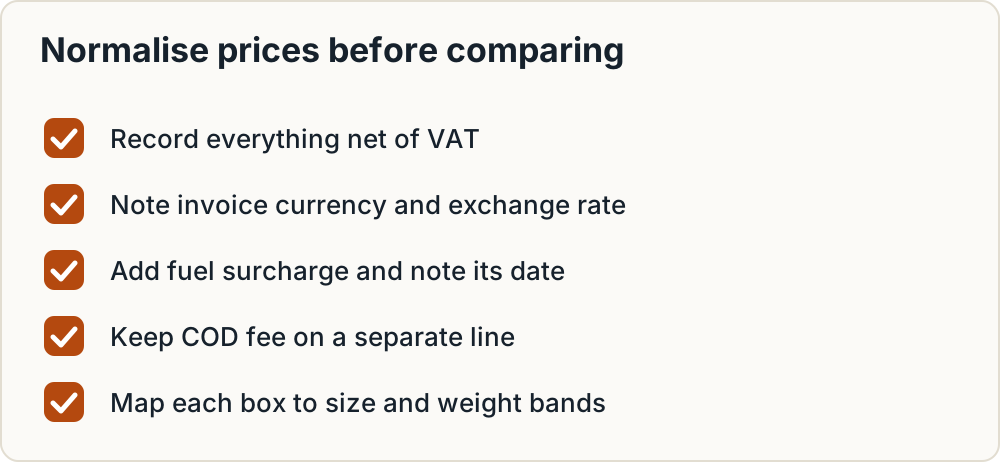
- Net or gross: record everything net of VAT. That is your real cost if you can reclaim input VAT.
- Currency: record the invoice currency and the exchange rate you are using.
- Fuel surcharge: add it to the base price, and note the date.
- COD fee: keep it on a separate line, because it only applies to COD orders.
- Bands: lockers price by size and couriers by weight, so map each of your standard boxes to both.
Check snippets against the source: prices quoted in search snippets and comparison sites go out of date quickly. Before any third-party figure goes into your rate table, check it against the carrier's current official PDF.
Step 4: Build the shipping rate table by country
The rate table is the core of your shipping setup. Use one row for each combination of country, service and band:
| Country | Service | Band | Carrier cost (net) | Packaging + handling | Total cost (net) | Customer price (gross, local) | Customer price (net) | Margin | List date |
|---|---|---|---|---|---|---|---|---|---|
| PL | Locker | Size B | |||||||
| PL | Home courier | up to 5 kg | |||||||
| CZ | Pickup point / Z-BOX | up to 5 kg | |||||||
| CZ | Home courier | up to 5 kg | |||||||
| SK | Pickup point | up to 5 kg | |||||||
| HU | Pickup point | up to 5 kg | |||||||
| RO | Pickup point | up to 5 kg |
Three pricing models
| Model | How it works | Pros | Cons |
|---|---|---|---|
| Flat per country | One price per country and service | Simple, with no surprises at checkout | You lose money on heavy orders and overcharge on light ones |
| Weight bands | The price rises with cart weight | Follows your real cost | Needs accurate product weights |
| Free-shipping threshold | Paid below an order value, free above it | Can lift order value; easy to market | You pay the full cost on every order above the threshold |
A common combination is a flat price per country and service, plus a free-shipping threshold set high enough to protect your margin.
Worked example: a 2 kg parcel to a Polish locker
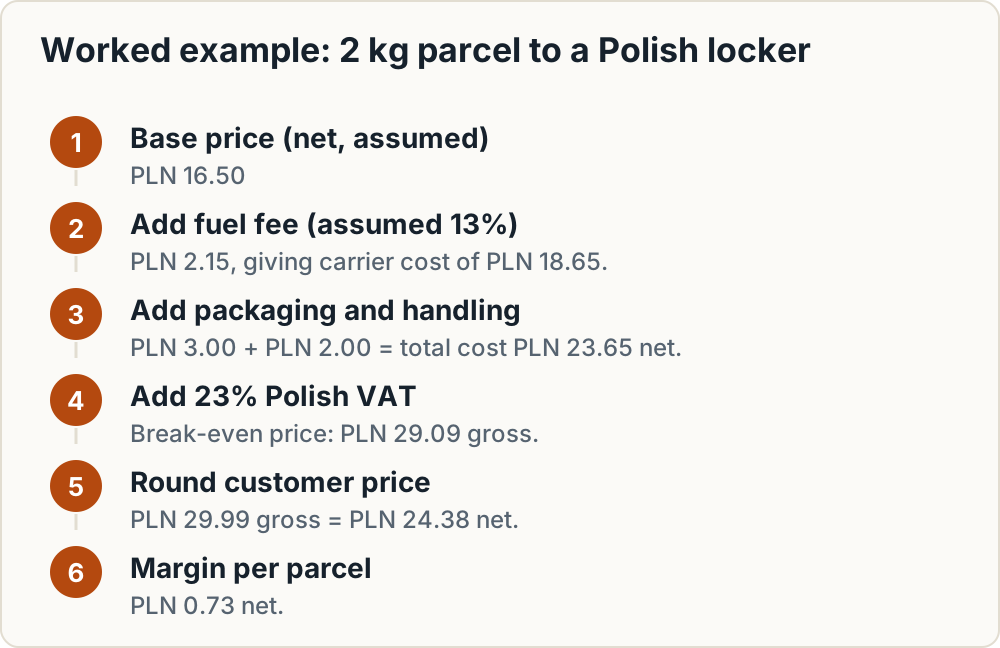
This example shows the method. The PLN 16.50 base price and the 13% fuel fee are assumed illustrative figures, not quotes from the InPost list. Packaging and handling are assumptions too. Replace them all with your own numbers.
Take a 2 kg order that fits a size B locker compartment. Locker prices depend on size, not weight.
- Carrier base price (net, assumed): PLN 16.50
- Fuel fee (assumed 13%; read the actual percentage from the current list): 16.50 × 0.13 = PLN 2.15
- Carrier cost (net): PLN 18.65
- Packaging (assumed): PLN 3.00
- Handling time (assumed): PLN 2.00
- Total cost per parcel (net): PLN 23.65
- Break-even price including 23% Polish VAT: 23.65 × 1.23 = PLN 29.09
- Rounded customer price: PLN 29.99 gross = PLN 24.38 net
- Margin per parcel: PLN 0.73 net
That margin barely covers a damaged-parcel claim. Many shops round up to the next price point, or charge a little more for home delivery.
Now add a free-shipping threshold of PLN 200 gross. An order exactly at the threshold is PLN 162.60 net. Absorbing PLN 23.65 takes about 14.5% of that revenue. If your product margin can't carry that, raise the threshold or limit free shipping to lockers.
Repeat the calculation for the CZ, SK, HU and RO rows using the current Packeta PDF or your other carrier's list. Convert CZK costs into the customer's currency at a rate you update regularly.
Currency, rounding and VAT
- Display each market's currency: CZK, PLN, HUF and RON, and EUR in Slovakia.
- Round to familiar price points, such as PLN 14.99 or CZK 99.
- Consumer prices must include VAT. Delivery is usually taxed like the goods it accompanies. Under OSS, the destination country's rate applies. Confirm your own case with a tax adviser.
What the law says about delivery prices
According to Your Europe, you must show the total price, including delivery costs, before purchase. Paid extras need explicit consent, and a pre-ticked box doesn't count. You may charge different delivery prices for other EU countries, but you must disclose your cross-border delivery options and their cost.
Step 5: Choose delivery options at checkout
Minimum set per country
- One locker or pickup-point option, usually the cheapest
- One home-delivery courier
- COD where buyers expect it
More than three or four options rarely helps a small shop. Each carrier adds another price list to maintain and another integration to test.
Country notes
- Poland: offer Paczkomat first. If you ship from CZ or SK, Packeta can deliver to InPost lockers.
- Czechia and Slovakia: when we checked, Packeta's homepage listed 10,216 pickup points in CZ and 3,868 in SK, plus 9,685 Z-BOXes across its network. Networks grow, so treat these as indicative.
- Hungary: Packeta listed 1,295 pickup points. Compare its coverage with local locker networks in the cities your buyers live in.
- Romania: Packeta listed 1,016 pickup points. Check whether a local network covers your buyers better.
For widgets and pickup-point selectors, see Parcel lockers in Poland, Czechia, Slovakia and Hungary: shop setup.
Cash on delivery
COD costs you a fee on every COD order. When a buyer refuses a parcel, you pay shipping both ways and make no sale. Read cash on delivery in Eastern Europe: fees and refusal risk before you enable it. Then look at prepaid alternatives in payment methods for Poland, Czech and CEE e-commerce.
Delivery time promises
Unless another delivery time was agreed, the trader must deliver within 30 days. Show a realistic range for each option. Packeta says 80% of its parcels to Poland arrive the next day, but it does not guarantee this. "Usually 1–3 working days" is a safer promise than "next day".
Step 6: Labels, handover and returns
Labels and handover
Generate labels from your shop plugin or the aggregator panel. Never retype addresses. Configure:
- A default parcel size and weight for each product or box type
- An automatic COD amount taken from the order total
- A label format that matches your printer (A4 or thermal)
- Your handover method: drop-off at a depot or pickup point, or courier collection
WooCommerce shops can follow WooCommerce Czech Republic and Slovakia setup with Packeta.
Returns: what EU rules require
According to Your Europe's returns guidance, consumers have 14 days to withdraw from an online purchase, counted from delivery for goods. The consumer pays return shipping only if you said so before purchase. If you didn't, or if you offered to pay, the cost is yours. Returns of defective goods are always at the trader's cost.
For each country, write down who pays for returns, how the parcel goes back (prepaid label, return code at a pickup point, or a carrier of the buyer's choice) and the return address. Check return services and their prices during contracting. Packeta, for example, offers two return options from Poland, and Furgonetka includes a returns tool in its panel.
Step 7: Tracking and delivery notifications
How it flows
- You create the shipment in the plugin or panel.
- The carrier assigns a tracking number.
- The plugin writes the tracking number back to the order.
- Your shop sends an email, and optionally an SMS, with a tracking link.
- Carrier status updates trigger further messages, sent either by the carrier or by your shop.
Point 3 is the one that most often breaks. Check that the tracking number appears in the order and in the "shipped" email. Furgonetka, for example, offers shipment tracking alongside labels and returns in one panel.
Status triggers
| Trigger | Message | Sent by |
|---|---|---|
| Shipped | Tracking link, expected delivery range | Shop |
| Out for delivery (where available) | Delivery today | Carrier or shop |
| Ready at locker or pickup point | Pickup code, location, deadline | Usually the carrier |
| Delivered / picked up | Confirmation, return instructions, review request | Shop |
If the carrier already sends pickup codes, don't send a second, different-looking message from the shop.
Failed delivery template
Your parcel [tracking number] could not be delivered / was not collected from [locker]. It is now [returning to us / held until date]. Reply to choose: re-send to the same address (cost: [amount]), re-send to another address or pickup point, or a refund for the goods.
If delivery fails, EU rules require the consumer to give the trader a reasonable extra period before cancelling. Reply quickly and offer a concrete solution.
Cross-border parcel rules
Regulation (EU) 2018/644 covers cross-border parcels up to 31.5 kg. Its information obligations fall on parcel delivery providers, not on shops. Providers with fewer than 50 employees that are established in only one member state are exempt.
Step 8: Test, launch and review
Test before launch
For each country and each delivery option:
- Place a test order using a real address in that country.
- Check the delivery price in the cart and at checkout, including VAT and currency.
- Confirm that no paid extras are pre-ticked.
- Generate the label and check the address, service, size and COD flag.
- Confirm the tracking number appears in the order and in the "shipped" email.
- Run through the return flow.
- Cancel or complete the shipment, following the carrier's procedure.
Monthly review
- Carrier cost per parcel by country and service, taken from invoices rather than the price list
- Failed deliveries and uncollected locker parcels
- Refused COD parcels and what they cost you
- Share of locker versus home delivery
- Actual margin per parcel compared with your rate table
If a number drifts, update the rate table first, then the checkout.
Price changes
Carriers publish new lists with effective dates; InPost's Paczkomat list valid from 1 March 2026 replaced the May 2025 one. Set a quarterly reminder to check each carrier's price-list page, and read every price-change notice.
Common mistakes
- Treating gross prices as cost, or leaving out the fuel surcharge and COD fee. In the example above, the assumed fuel fee alone added PLN 2.15.
- One flat rate for every country. Delivery to Romania doesn't cost the same as domestic Czech delivery.
- No locker option in Poland, where Paczkomat is what buyers look for.
- No information on return costs before purchase, which means you pay for every return.
- Promising "next day" when the carrier only quotes it as a statistic.
- Not retesting after plugin updates. Tracking write-back and COD amounts are often the first things to break.
Ready-to-use checklist
| # | Task | Owner | Done (date) |
|---|---|---|---|
| 1 | Parcel profile recorded: weight, boxes, value, fragility, COD and return share | ||
| 1 | Launch countries chosen; VAT (OSS) and packaging EPR checked | ||
| 2 | Carrier model chosen | ||
| 2 | Contract checklist answered in writing | ||
| 3 | Current official price lists downloaded and dated | ||
| 3 | Prices normalised: net, currency, fuel, COD fee, bands | ||
| 4 | Rate table filled in with margin per row | ||
| 4 | Free-shipping threshold tested against margin | ||
| 4 | Local currency, rounding and VAT-inclusive display set | ||
| 5 | Locker/pickup point and home courier enabled per country | ||
| 5 | COD decision made per country | ||
| 5 | Realistic delivery times shown | ||
| 6 | Labels, default sizes and handover configured | ||
| 6 | Return terms published before purchase | ||
| 7 | Tracking write-back confirmed | ||
| 7 | Shipped, ready-for-pickup and delivered messages set | ||
| 7 | Failed-delivery template saved | ||
| 8 | Test order completed per country and option | ||
| 8 | Monthly review and quarterly price-list reminder in calendar |
Frequently asked questions
How do I set up shipping for a new online shop?
Follow eight steps in order. Define your parcel profile and countries, choose a carrier model, collect official price lists and build a rate table. Then choose checkout options, configure labels and returns, set up tracking and test. The checklist above covers every step.
Do small shops need a contract with a carrier, or can they use an aggregator?
An aggregator is usually enough at launch. Furgonetka, for example, has no fixed fees or long-term contract and charges per shipment. A single regional carrier such as Packeta also works. Negotiating direct contracts with several carriers becomes worthwhile once your volume is steady.
How should shipping prices be set for several countries?
Build one rate table per country and service, using each carrier's current net price list. Add the fuel surcharge, packaging and handling, then add VAT and round to a local price point. Check the margin on every row.
What delivery options should a small shop offer at checkout?
Offer at least one locker or pickup-point option and one home courier in each country, plus COD where buyers expect it. In Poland, that locker option is InPost Paczkomat. In Czechia and Slovakia, it is usually Packeta.
How do I send tracking information to customers automatically?
Use a carrier or aggregator plugin that writes the tracking number back to the order. Then add the tracking link to your shop's "shipped" email. Test it with a real order, and don't duplicate messages the carrier already sends.
Who pays for return shipping under EU rules?
After a withdrawal, the consumer pays return shipping only if the seller said so before purchase. Otherwise, or if the seller offered to pay, the seller pays. Returning a defective product is always at the trader's cost.
Is free shipping required?
No. EU rules require the total price, including delivery, to be shown before purchase, but they don't require free shipping. Offering it is a commercial choice, and you absorb the carrier cost on every qualifying order.
Key takeaways
- Set up shipping in this order: parcel profile, carrier model, price lists, rate table, checkout, labels and returns, tracking, then testing.
- At launch, one regional carrier such as Packeta or an aggregator such as Furgonetka usually covers a small CEE shop.
- Build rates from net, dated, official price lists, including fuel surcharges and COD fees. In the example, an assumed PLN 16.50 base price became PLN 23.65 in total cost.
- Offer a locker or pickup option and a home courier in every country, with Paczkomat in Poland.
- Show the full delivery price before purchase, and tell buyers who pays for returns. If you don't, returns are at your cost.
- Review costs and failure rates every month, and check carrier price lists every quarter.
Sources
What this guide relies on, in the order cited.
- says it serves more than 62,000 e-shops · zasilkovna.cz
- Furgonetka lists 13 carriers · furgonetka.pl
- Poland delivery page · packeta.sk
- Your Europe · europa.eu
- Your Europe's returns guidance · europa.eu
- Regulation (EU) 2018/644 · ctu.gov.cz