On this page
- What "customs-free" returns means inside the EU, and where it stops
- The legal baseline: who pays return shipping across the EU
- From 19 June 2026: the withdrawal function
- Three ways to set up cross-border returns: decision table
- Packeta (Zásilkovna) cross-border returns in practice
- Other carriers: GLS, InPost and platform integrations
- Per-return cost worksheet
- Checklist: set up and document returns before the first cross-border sale
- Frequently asked questions
- Quick reference
This guide explains how the rules work in practice. It is not legal or tax advice; check the linked official sources or ask an adviser for your specific case.
Under EU law, the customer pays the direct cost of returning goods after a 14-day withdrawal. That applies only if your shop told them so in advance. If you skipped that sentence, or offered free returns, the shop pays. This page covers cross-border returns for CEE e-commerce shops based in CZ, SK or PL that sell to consumers in neighbouring countries. It sets out the legal baseline and the withdrawal-function requirement that EU law applies from 19 June 2026. It then compares three return models in a decision table, walks through Packeta's return products country by country, and ends with a cost worksheet and a setup checklist.
What "customs-free" returns means inside the EU, and where it stops
A return from a customer in Poland to a shop in Czechia, or from Hungary to Slovakia, is an ordinary intra-EU parcel. Czechia, Slovakia, Poland, Hungary and Romania are all EU member states, so no customs duty applies to returns between them. Treat these returns like domestic returns that happen to travel further.
The new flat customs duty does not affect them. According to the European Commission, from 1 July 2026 a duty of EUR 3 applies to low-value parcels (up to EUR 150) imported from outside the EU. It is charged per tariff classification in the parcel, not per item, and the Commission describes it as temporary, running until 1 July 2028. Our article on the EU EUR 3 customs duty on small parcels covers the import side in detail.
If you sell to customers outside the EU, for example in the UK, Switzerland, Ukraine or Serbia, their returns need a separate workflow. A parcel from those countries crosses a customs border. The Commission page does not mention any relief for returned goods under the EUR 3 scheme, so do not assume one exists. Before you promise free or simple returns to non-EU customers, ask your carrier and a customs agent how returned goods are declared.
Platforms treat this as a separate case too. IdoSell blocks return shipments from non-EU countries in its returns module because of customs and VAT complications.
The legal baseline: who pays return shipping across the EU
The rules come from the Consumer Rights Directive 2011/83/EU, which every member state has transposed. Our guide to the EU 14-day withdrawal right for webshops covers national details. The points that drive return costs are below.
The customer's side
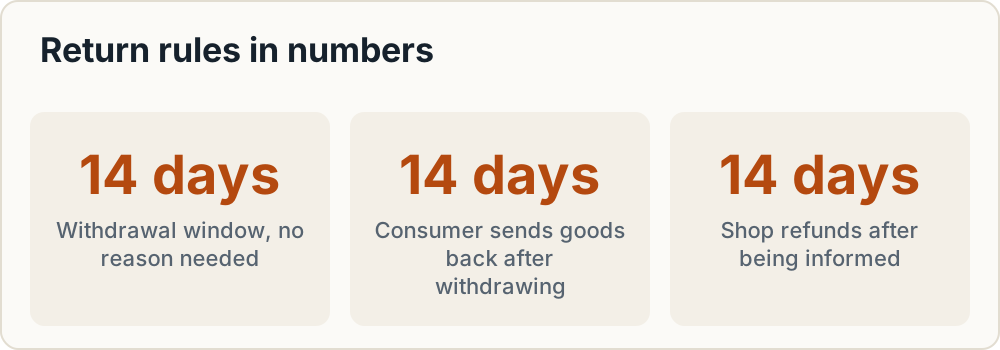
- Withdrawal window: 14 days, no reason needed (Your Europe).
- Sending the goods back: without undue delay, and no later than 14 days after the consumer tells you they are withdrawing (Art. 14(1)).
- Cost: the consumer bears only the direct cost of returning the goods, unless the trader agreed to bear it or failed to inform the consumer that they must pay (Art. 14(1)).
National law says the same thing. Poland's Consumer Rights Act sets it out in Art. 34(2). In the Czech Civil Code it is § 1832(3): the trader pays the return costs if it did not tell the consumer in advance, as § 1820(1)(j) requires.
The shop's side
- Refund deadline: within 14 days of being informed of the withdrawal, using the same payment method the customer used (Art. 13).
- Holding the refund: you may withhold it until you get the goods back or the customer proves they sent them, whichever comes first. This does not apply if you offered to collect the goods yourself.
- Outbound delivery: you refund the original delivery charge, but only up to the cheapest standard delivery you offered. You need not refund the extra cost of a more expensive option the customer chose, such as express (Art. 13; Czech § 1832).
Edge cases
- Bulky goods: the Directive and Czech § 1835 make the trader collect goods at its own expense in one situation: an off-premises contract where the goods were delivered to the consumer's home and cannot normally be returned by post. Ordinary webshop sales are distance contracts, not off-premises contracts, so this rule does not transfer to them automatically. If you sell furniture or other items too large for parcel networks, ask a lawyer how return costs are handled in each destination country.
- Defective goods: a faulty item is a legal guarantee claim, not a withdrawal. Returning defective products is the seller's responsibility (Your Europe). Process and record these returns separately from withdrawals. The EU compliance checklist for an online shop covers the guarantee side.
From 19 June 2026: the withdrawal function
Directive (EU) 2023/2673 requires online shops to offer a withdrawal function from 19 June 2026. According to iubenda's summary, it has four parts:
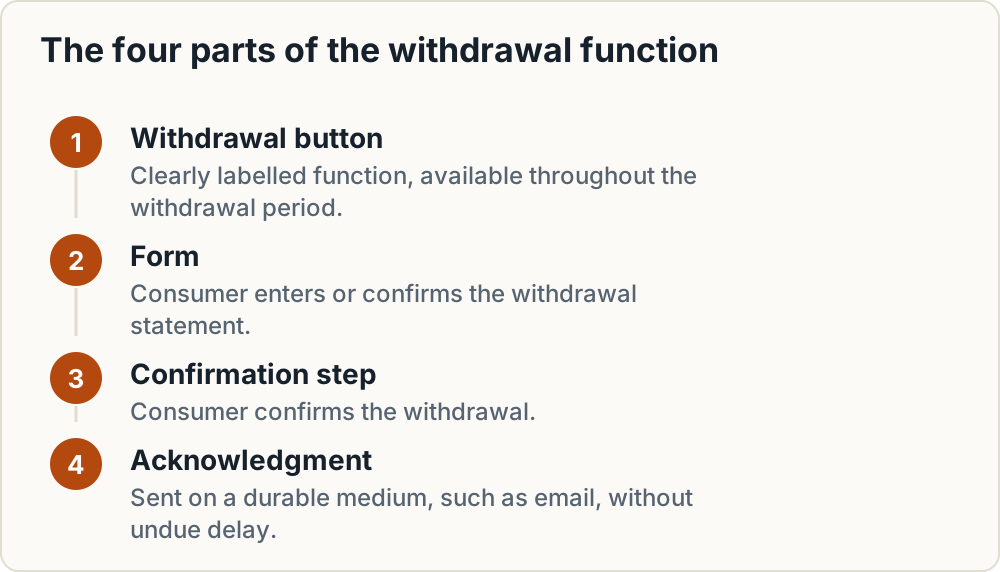
- A clearly labelled button or function, with wording such as "withdraw from contract here", available throughout the withdrawal period.
- A form where the consumer enters or confirms the withdrawal statement.
- A confirmation step.
- An acknowledgment of receipt, sent on a durable medium (for example email) without undue delay.
It applies to online distance contracts with consumers wherever a withdrawal right exists. That includes ordinary goods, not only financial services. The same summary says fines can reach 4% of annual turnover, or a minimum of EUR 2 million where turnover data is not available. These figures come from iubenda, not from the Directive text, so check them against the Directive and your national act.
We have not confirmed how far Czechia, Poland, Slovakia, Hungary and Romania have transposed this requirement. Check your national implementing act and each destination country's act, or ask your shop platform whether its withdrawal button meets local wording rules.
Three ways to set up cross-border returns: decision table
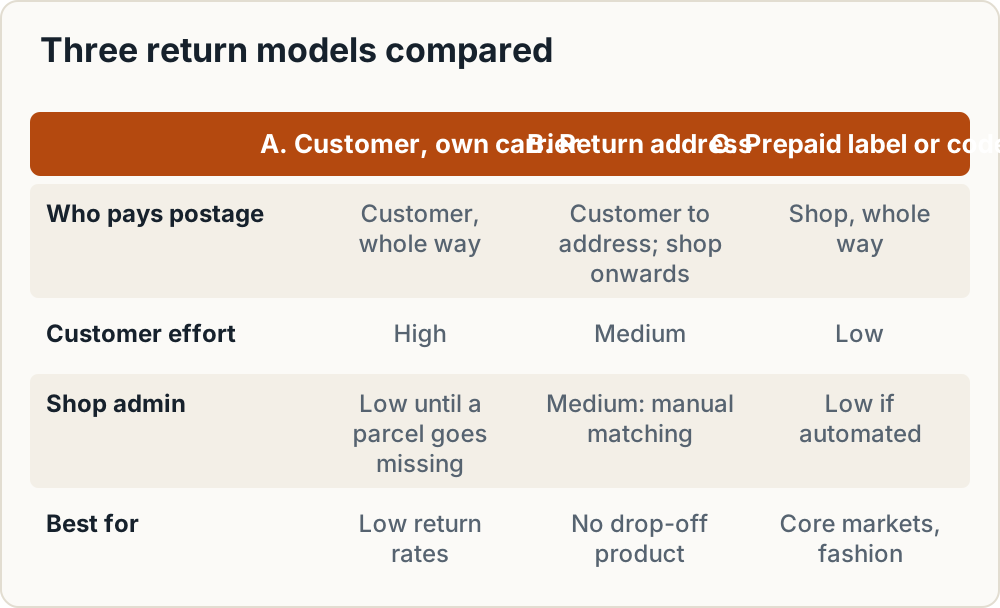
Every practical setup falls into one of three models. You can pick a different model for each destination country.
| Model | Who pays return postage | Customer effort | Shop admin | Best for | Main risk |
|---|---|---|---|---|---|
| A. Customer pays, own carrier | Customer, whole way | High: finds a carrier, pays, packs, addresses the parcel | Low until a parcel goes missing | Low return rates, low-margin goods, rarely served countries | Disputes over proof of dispatch; untracked parcels; lost sales from friction |
| B. Return code to a national return address | Customer to the in-country address; shop from that address onwards | Medium: domestic postage, writes a code on the parcel | Medium: manual matching of returns to orders | Countries where your carrier has no drop-off return product | Address may accept only certain carriers; slow matching |
| C. Prepaid label or drop-off code | Shop, whole way | Low: code or label by email, drop off at a point or locker | Low if automated through the API or portal | Core markets, fashion, higher-margin goods | Return cost must be built into the margin; may encourage more returns |
Model C is a voluntary choice. When you offer it, you have "agreed to bear" the return cost under Art. 14(1), so your terms must say so. Your terms also need to state the conditions, for example "free returns via Packeta drop-off points in CZ, SK, HU and RO only".
Packeta (Zásilkovna) cross-border returns in practice
Packeta is widely used by small shops in CZ, SK, HU and RO, and its return products follow models B and C above. For forward-delivery rates and coverage, see Packeta vs InPost vs GLS vs DPD.
Drop-off returns (Model C): CZ, SK, HU, RO
In Czechia, Slovakia, Hungary and Romania, the customer takes the parcel to a Packeta drop-off point. Packeta offers three ways to issue the return:
| Option | How it works | IT work needed |
|---|---|---|
| API | Your shop system generates a return code or label and sends it to the customer | Yes |
| Returns portal | The customer enters the original parcel number and receives a drop-off code and return label by email | None |
| Universal return code | Generated once in the Packeta Client Section and shared with customers | None |
Key conditions:
- The portal works only for parcels originally delivered by Packeta.
- In these drop-off countries, the shop covers the return shipping cost.
- The customer does not need a printer. They give the drop-off code to staff at the point.
- Z-BOX returns use a 9-digit code entered on the keypad. Packeta's pages disagree on where this works: packeta.sk lists all four countries, while zasilkovna.cz lists only Czechia and Slovakia. Confirm with Packeta before you mention Z-BOX returns to Hungarian or Romanian customers.
- Returns created through the API or portal are matched to the original shipment automatically, and each return gets a tracking number.
Return addresses (Model B): the rest of Packeta's network
For other countries, Packeta uses return addresses. The current list is Belgium, Bulgaria, Estonia, France, Croatia, Italy, Cyprus, Lithuania, Latvia, Germany, the Netherlands, Poland, Portugal, Austria, Greece, Slovenia, Spain and Switzerland. The process:
- The shop gives the customer a return code.
- The customer writes the code on the parcel and sends it, at their own cost, to Packeta's return address in their country.
- Packeta carries the parcel from that address to the shop and bills the shop at its contract prices. The rate was not shown on the public pages we checked; look in your contract or Client Section.
- The shop matches the return to the order manually.
Before you publish return instructions for a country, ask Packeta which carriers the return address accepts, and name that carrier in your instructions.
Poland: returns through InPost lockers
Polish customers can return Packeta parcels through InPost Parcel Lockers. Packeta launched this option on 23 February 2022. The steps are:
- The customer fills in the form at szybkiezwroty.pl and selects "Packeta Group".
- They enter the return code your shop gave them.
- They receive a code by email and SMS, write it on the parcel and drop the parcel at any InPost locker.
- The parcel goes to Packeta's depot in Cieszyn and then on to your shop.
The Packeta page does not say who pays for the locker leg, so do not advertise this route as free until Packeta confirms the terms of your contract. The page's figure of more than 16,000 lockers dates from 2022. For forward-delivery lockers, see the parcel locker delivery setup.
Example: a Czech shop sells to a customer in Kraków. The customer withdraws and gets the return code by email. They register it at szybkiezwroty.pl and drop the parcel at a nearby InPost locker. The parcel travels through Cieszyn to the shop, which pays the Packeta leg at its contract rate. The shop records that rate, plus any cost for the Polish leg, in the worksheet below.
Other carriers: GLS, InPost and platform integrations
GLS ShopReturnService. Customers create a return label in a portal branded for the shop and drop the parcel at a GLS ParcelShop. The return is free for the private sender and billed to the shop. The 2020 GLS announcement listed Czechia, Poland, Slovakia and Hungary among the covered countries. Romania was not on that list. The list dates from October 2020, so check the current coverage with GLS before relying on it.
InPost. The sources we reviewed do not show a separate InPost cross-border return product. Polish locker returns for Packeta parcels go through the szybkiezwroty.pl route described above.
Platform integrations. Some shop platforms include return labels in their returns module. IdoSell, for example, supports UPS and DHL Express for EU cross-border returns and InPost Kurier for domestic Polish returns only.
For rates and transit times to the south-east, see shipping CZ/PL to Romania and Hungary and the shipping setup for a small CEE webshop.
Per-return cost worksheet
We have not verified any carrier prices, so this worksheet has no numbers in it. Fill it in with your own contract rates, one column per destination country.
| Line | What to enter | Applies under | CZ→PL | CZ→SK | CZ→HU |
|---|---|---|---|---|---|
| 1. Outbound shipping refunded | Cheapest standard delivery price you offered | All models | |||
| 2. Return leg paid by shop | Full return label or drop-off price (Model C), or return address to shop (Model B) | B, C | |||
| 3. Handling and inspection | Minutes per return × hourly staff cost | All | |||
| 4. Value lost | Share of returns not resellable × average cost of goods | All | |||
| 5. Payment fee not recovered | Fee on the original payment that your gateway keeps after a refund | All | |||
| 6. Repackaging | Materials for re-shipping the item | All | |||
| Total per return (T) | Sum of lines 1–6 |
For line 5, check your payment provider's refund terms. The article on payment gateway payouts and disputes explains where to find them.
Running it at three return rates
The return rates below are examples, not benchmarks. Monthly return cost = orders × return rate × T.
| Monthly orders to the country | Returns at 5% | Returns at 10% | Returns at 20% |
|---|---|---|---|
| 200 | 10 × T | 20 × T | 40 × T |
| 400 | 20 × T | 40 × T | 80 × T |
| 1,000 | 50 × T | 100 × T | 200 × T |
Our working assumption: under Model C the shop pays a full return leg for every returned order. Under Model B it pays only the leg from the return address to the shop. Under Model A, line 2 is zero, but you still pay lines 1 and 3–6.
If the Model C total at your realistic return rate is more than your margin can carry, use Model B for that country. Alternatively, raise the price threshold for free returns. The free shipping threshold worksheet uses the same logic for outbound costs.
Checklist: set up and document returns before the first cross-border sale
- Terms and withdrawal information: state the 14-day period, who pays the return, and the return process or address for each destination country. This closes the "failed to inform" gap.
- Withdrawal function: make sure your shop has the button, form, confirmation step and email acknowledgment required from 19 June 2026. Check the wording against the national implementing act.
- Model per country: choose A, B or C and write it into the terms. If you choose C, state that the shop pays and any conditions.
- Carrier acceptance: confirm which carriers each return address accepts, and name them in the customer instructions.
- Test return: send one real return per destination country before you promote sales there.
- Refund process: refund within 14 days of the withdrawal notice. Document when you hold a refund until the goods arrive or the customer shows proof of dispatch. Refund outbound delivery only up to the cheapest standard option.
- Defective goods: handle these as guarantee claims at your own cost, separately from withdrawals.
- Matching: assign someone to match return-address parcels to orders, because Packeta does not do this automatically for return addresses.
- Non-EU customers: either block non-EU returns or agree a documented process with your carrier and a customs agent.
- Packaging: count the packaging on items you re-ship under your EPR reporting. See packaging EPR in CEE.
Frequently asked questions
Does the 14-day withdrawal period start at order or at delivery?
For goods, the 14 days run from delivery, not from the order date (Your Europe). After withdrawing, the consumer has another 14 days to send the goods back. Your refund deadline is 14 days from the day you receive the withdrawal notice.
Do I pay customs on a return from Poland to Czechia?
No. Poland and Czechia are both EU member states, so a parcel between them is an intra-EU shipment with no customs duty. The EUR 3 flat duty that applies from 1 July 2026 covers only low-value parcels imported from outside the EU.
Who pays return shipping for a 14-day withdrawal in the EU?
The consumer pays the direct cost of the return, provided the shop told them so before the purchase. The shop pays if it offered free returns or left the cost statement out of its terms. The shop always pays when it is returning defective goods.
How does Packeta handle returns from Germany or Poland?
Germany and Poland use Packeta's return-address model. The customer writes the return code on the parcel and pays to send it to Packeta's address in their country, and the shop pays the leg from there. Polish customers can also register the return at szybkiezwroty.pl and drop the parcel at an InPost locker, which routes it to Packeta's depot in Cieszyn.
Do I need a withdrawal button on my webshop in 2026?
Yes, if you sell online to consumers and they have a withdrawal right. Directive (EU) 2023/2673 requires a clearly labelled withdrawal function from 19 June 2026, with a confirmation step and an acknowledgment on a durable medium. Check the national implementing act in your country and in your destination countries for exact wording rules.
Quick reference
| Topic | Rule or option |
|---|---|
| Withdrawal window | 14 days from delivery, no reason needed |
| Customer sends goods back | Within 14 days of withdrawing |
| Return postage | Customer pays, only if informed in advance; shop pays if it offered or failed to inform |
| Refund deadline | 14 days from the withdrawal notice; may be held until goods or proof of dispatch arrive |
| Outbound delivery refund | Up to the cheapest standard option |
| Defective goods | Seller bears the return cost |
| Customs on CZ/SK/PL/HU/RO returns | None (intra-EU) |
| EUR 3 duty | Non-EU imports up to EUR 150, 1 July 2026 to 1 July 2028 |
| Withdrawal function | EU requirement from 19 June 2026; check national act |
| Packeta drop-off returns (shop pays) | CZ, SK, HU, RO via API, portal or universal code |
| Packeta return addresses (customer pays to address) | DE, PL, AT and 15 other countries; manual matching |
| Poland locker returns | szybkiezwroty.pl → InPost locker → Cieszyn depot |
| GLS ShopReturnService | Shop-billed ParcelShop returns; check current country list |
Sources
What this guide relies on, in the order cited.
- European Commission · commission.europa.eu
- IdoSell blocks return shipments from non-EU countries · idosell.com
- Your Europe · europa.eu
- Art. 14(1) · legislation.gov.uk
- Art. 34(2) · standardyprawa.pl
- § 1832(3) · podnikatel.cz
- Art. 13 · legislation.gov.uk
- iubenda's summary · iubenda.com
- Packeta offers three ways · packeta.sk
- zasilkovna.cz · zasilkovna.cz
- 23 February 2022 · blog.packeta.com
- 2020 GLS announcement · gls-group.com