
On this page
- Short answer: what applies, to whom, and since when
- How the €3 is counted
- What it means for CEE shops competing with Temu and Shein
- If you import stock: which rules apply to you
- The €2 handling fee: what is confirmed and what is not
- Checklist for the next 30 days
- What comes after July 2028
- Frequently asked questions
This guide explains how the rules work in practice. It is not legal or tax advice; check the linked official sources or ask an adviser for your specific case.
Since 1 July 2026, the EU has charged a flat €3 customs duty per item on B2C distance sales of goods worth €150 or less shipped from outside the EU. If you sell stock that is already in the EU, or you import stock in bulk business-to-business, the duty mostly affects your competitors, not you. If you dropship from China or ship direct from a non-EU supplier to your customers, you are probably the one paying it.
This guide is for small shops based in or selling into Czechia, Slovakia, Poland, Hungary and Romania. It covers how the duty is counted, what it actually changes against Temu and Shein, how it applies to the main ways shops import goods, and the separate €2 handling fee that is still waiting for a confirmed start date.
Short answer: what applies, to whom, and since when
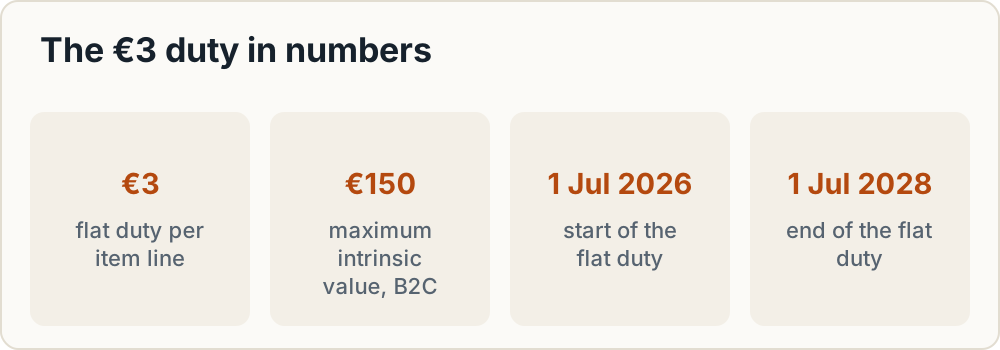
- What: The customs duty exemption for consignments up to €150 ended on 30 June 2026. From 1 July 2026, a temporary flat duty of €3 per item applies to low-value consignments imported from outside the EU, according to Access2Markets. The Council agreed the measure in December 2025.
- Legal basis and duration: The legal basis is Council Regulation (EU) 2026/382. The flat duty runs until 1 July 2028. After that, normal customs duties apply according to the type of goods (European Commission guidance).
- Scope: It covers B2C distance sales with an intrinsic value of €150 or less. It applies regardless of VAT regime (IOSS, special arrangements or standard import VAT) and regardless of declaration type (H1, H6, H7) (Access2Markets).
- VAT: Import VAT still applies. The €3 is added on top of it (Eurofiscalis).
- Coming next: The Commission has adopted a separate EU handling fee of €2 per item. Its application date is not yet confirmed. See the handling fee section below.
How the €3 is counted
Per item line, not per unit or per parcel
The duty is charged per "item". An item is one or more goods in the same consignment that share the same tariff classification and description and, where the customs dataset requires it, the same origin. The Commission's own example: five T-shirts in one parcel cost €3 in total, while one T-shirt and one watch cost €6 (Commission guidance).
In practice, the cost depends on how many different tariff lines a parcel holds, not on how many pieces it holds or how much it is worth.
Declaration type changes the count
How finely goods are grouped depends on the customs declaration used (Access2Markets):
| Declaration type | Typical use | Grouping level | Effect |
|---|---|---|---|
| H7 | Low-value consignment declaration | 6-digit HS code | Broadest grouping |
| H6 | Postal consignments | 8-digit CN code | Medium |
| H1 | Standard import declaration | 10-digit TARIC code | Finest grouping, so potentially more items |
Access2Markets gives this example: three goods with the same HS code but different TARIC codes can cost €3 under H6 or H7 and €9 under H1. You often do not choose the declaration type yourself. Your courier or broker usually does, so ask them.
Exclusion for preferential origin
Goods that qualify under a preferential trade agreement or Customs Union measures are excluded, but only if VAT is not collected through IOSS and the goods are declared in H1 (Commission guidance). This could matter for goods from Turkey, which is in a customs union with the EU, or from countries with EU trade agreements. The conditions are narrow, so check with your customs broker before relying on this exclusion.
Who pays
The declarant pays the duty. That is usually the seller, importer, IOSS holder or indirect representative. The Commission says the consumer pays only in very residual cases (Commission guidance). So the duty is not, as a rule, a charge collected from customers at the door. It is a cost for whoever puts the goods into free circulation, and that business decides how to price it.
What it means for CEE shops competing with Temu and Shein
The scale
According to the European Parliament, 4.6 billion low-value items (under €150) were imported into the EU in 2024. That is about 12 million a day, and 91% of e-commerce shipments under €150 came from China.
The arithmetic per order
The duty is a fixed amount per item line, so its weight depends entirely on order value. The prices below are illustrative and are not taken from any platform. The "Duty + €2 fee" column adds the €2 handling fee, which has no confirmed start date yet.
| Example order (illustrative) | Order value | Item lines | €3 duty | Duty as % of value | Duty + €2 fee (once applied) | As % of value |
|---|---|---|---|---|---|---|
| One phone accessory | €2 | 1 | €3 | 150% | €5 | 250% |
| One T-shirt | €15 | 1 | €3 | 20% | €5 | 33% |
| Five identical T-shirts | €75 | 1 | €3 | 4% | €5 | 7% |
| One jacket | €60 | 1 | €3 | 5% | €5 | 8% |
| Accessory + T-shirt + jacket | €77 | 3 | €9 | 12% | €15 | 19% |
Import VAT is charged separately in every case and is not included above.
An honest assessment
The duty raises landed cost most on very cheap single-item orders and on mixed baskets with many tariff lines. On mid-priced goods, or on orders of several identical units, it adds a few percent. That alone is unlikely to close a large price gap. How platforms absorb or pass on the cost is their commercial decision, and we do not forecast price changes here.
The more structural change is about liability. Under the EU customs reform, the Commission's customs reform page says non-EU online platforms and sellers become responsible for customs formalities and duty payments as importers for distance sales, including product compliance duties. Over time, this brings non-EU sellers closer to the obligations EU shops already carry, such as product safety and packaging rules. See our guides to GPSR fields on Allegro, Kaufland and eMAG and Packaging EPR in Poland, Czech Republic, Romania, Slovakia and Hungary.
Where local shops can compete
Price alone is still a hard fight. A local shop has structural advantages in these areas:
- Delivery speed and returns: next-day domestic delivery and a simple local return address.
- Local payment methods: BLIK, bank transfer and cash on delivery. See payment methods to offer in Poland, Czechia and CEE and cash on delivery fees and refusal risk in Eastern Europe.
- Visibility where buyers compare: clean product feeds on Heureka, Zboží.cz, Árukereső and Compari. See price-comparison feed requirements for Heureka, Zboží.cz, Árukereső and Compari.
Romania's separate 25 lei fee
Romania adds a national layer. On 18 November 2025 the Romanian Parliament adopted a logistics fee of 25 lei per B2C parcel valued under €150 arriving from outside the EU (KPMG). It has applied since 1 January 2026. Postal and courier operators collect it, declare it and pay it to ANAF (Digi24).
A Commission spokesperson told Profit.ro in June 2026 that national handling taxes can apply alongside the €3 duty but must stop once the EU handling fee applies, at the latest in November 2026. We have not found confirmation that Romania has repealed its fee. If you ship non-EU parcels to Romanian customers, check the current status with ANAF or your courier.
If you import stock: which rules apply to you
The €3 duty targets distance sales to consumers. Whether it applies to you depends on how you bring goods in.
| Your model | In scope of €3 duty? | What applies | Who likely bears the cost |
|---|---|---|---|
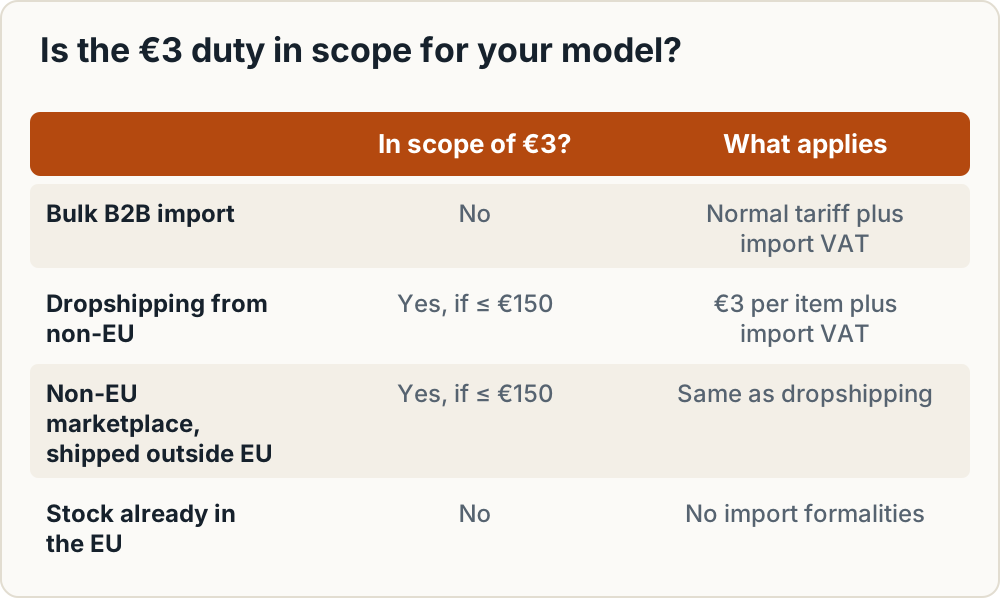
| (a) Bulk B2B import of stock to your EU warehouse | No, per Access2Markets | Normal customs tariff for the goods plus import VAT | You, as importer, at normal rates |
| (b) Dropshipping or direct shipping from a non-EU supplier to your EU customer | Yes, if ≤ €150 | €3 per item, plus import VAT, plus the €2 fee once it applies | The declarant. Often your shop as seller, depending on your contracts with the supplier and courier |
| (c) Selling into the EU through your storefront on a non-EU marketplace, shipped from outside the EU | Yes, if ≤ €150 | Same as (b) | You or the platform, depending on the platform's terms |
| (d) Stock already in the EU, shipped domestically or cross-border within the EU | No | No import formalities on the retail parcel | Not applicable |
(a) Bulk B2B imports
Access2Markets states that the duty applies only to goods supplied to an end consumer. B2B sales fall outside the temporary duty, and normal tariff rules and import VAT apply instead. Look up the duty rate for your goods in TARIC. Some secondary guides do not cover the B2B case at all, so confirm the treatment of your specific shipments with your customs broker, especially small sample orders.
(b) and (c) Dropshipping and direct shipping
Take a CEE shop that accepts the customer's order and has a Chinese supplier ship it directly. That is a distance sale of imported goods, and your shop is the seller. Whoever acts as declarant pays the duty. That may be you, your IOSS intermediary, or a courier acting as indirect representative who then bills you. IOSS registration does not remove the duty. Build €3 per tariff line into your product margins now, and €5 for when the handling fee applies.
(d) Holding stock inside the EU
Once inventory sits in an EU warehouse, retail parcels no longer count as third-country imports. Eurofiscalis suggests this as a practical step. The trade-off: you pay normal import duty and import VAT on the bulk shipment upfront, and you take on stock risk, storage costs and cash-flow pressure.
Clean up product identifiers now
Access2Markets states that product identifier declarations become mandatory on 1 November 2026. Tariff codes also determine how many "items" a parcel contains. Add correct HS and CN codes to your product master data and share them with suppliers and couriers.
The €2 handling fee: what is confirmed and what is not
Confirmed by official sources: The Commission's customs reform page says a Union handling fee on small parcels is to be introduced by 1 November 2026, with the amount set by delegated act. The Commission's document register publishes Delegated Regulation C(2026) 6694 final, dated 21 September 2026. It sets the fee at €2 per item under Article 20(2) of Regulation (EU) 2026/2108, the new Union Customs Code.
Reported by secondary sources: According to The International Desk, the fee:
- uses the same item concept as the duty;
- applies to distance sales, including orders above €150;
- is owed by the person liable for the import customs debt, in practice usually the declarant, and not by the consumer;
- is subject to a 30-day objection period for the European Parliament and Council, and applies ten days after publication in the Official Journal.
When this article was written, we had not found an Official Journal publication confirming the application date. Treat the €2 fee as adopted, with the start date still to be confirmed. For planning, model your costs both with and without it.
Checklist for the next 30 days
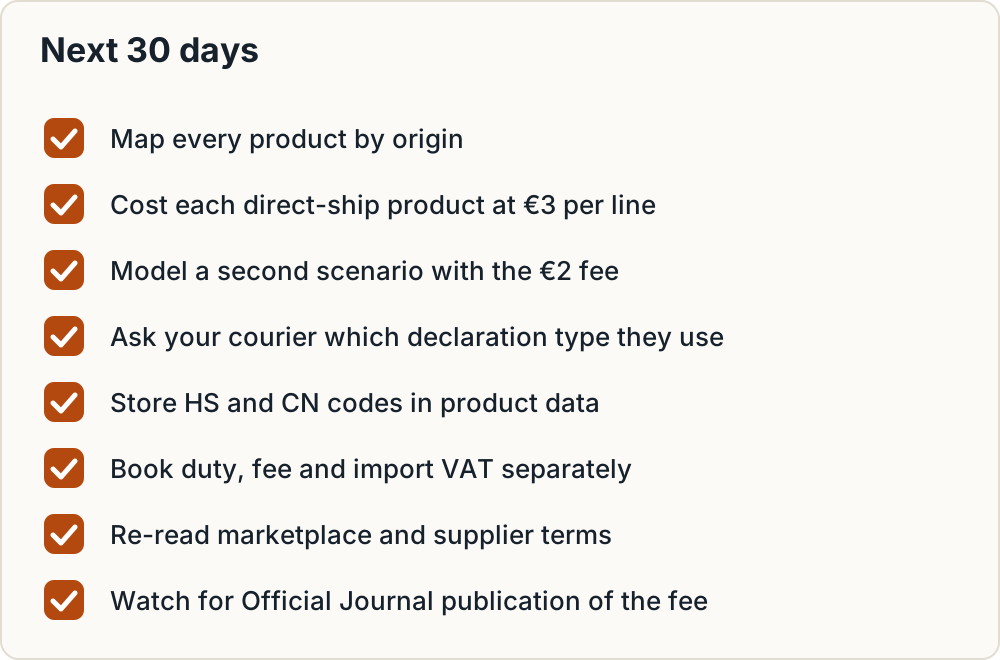
- Map every product by origin: EU stock, non-EU stock imported in bulk, or shipped direct from a non-EU supplier.
- Cost each direct-ship product: count its tariff lines and add €3 per line. In a second scenario, add €2 per line for the handling fee. Then decide whether to reprice, move stock into the EU, or drop the product.
- Ask your courier, broker or fulfilment partner who files the declaration, which type (H1, H6 or H7) they use, and how they will bill the duty to you.
- Check HS and CN codes in TARIC and store them in your product data before identifiers become mandatory on 1 November 2026.
- Book costs separately: keep customs duty, handling fee and import VAT as separate lines in your accounts.
- Re-read your marketplace and supplier terms to see who is liable for duty on distance sales.
- If you ship to Romania, check whether the 25 lei logistics fee still applies once the EU handling fee starts.
- Watch for the Official Journal publication of the handling fee and update your prices once the date is confirmed.
What comes after July 2028
The temporary flat duty ends on 1 July 2028. After that, normal customs tariffs apply to low-value goods according to their classification. Access2Markets notes that this depends on the EU Customs Data Hub being operational.
The Commission's reform timeline for the Data Hub is:
| Year | Data Hub milestone |
|---|---|
| 2028 | Access for e-commerce operators |
| 2031 | Voluntary use for all businesses |
| 2034 | Mandatory for all importers |
Once normal tariffs apply, the duty on a direct-shipped item will depend on its tariff rate. For some goods it could be more than €3, for others less. Accurate tariff codes will matter even more.
Frequently asked questions
Does the €3 duty apply to every parcel from outside the EU?
No. It applies to B2C distance sales of goods with an intrinsic value of €150 or less. According to Access2Markets, B2B sales are outside the temporary duty. Goods above €150 were already subject to normal customs duties.
Is the €3 charged per parcel, per product or per item line?
Per item line. Goods with the same tariff classification and description (and, where required, origin) count as one item. Five identical T-shirts cost €3. A T-shirt and a watch cost €6.
Do I pay the €3 duty if I import stock in bulk for my warehouse?
According to Access2Markets, B2B imports are outside the temporary duty. Normal tariff rates and import VAT apply instead. Confirm the treatment of your shipments with your customs broker.
Does IOSS registration exempt me from the €3 duty?
No. The duty applies under any VAT regime: IOSS, special arrangements or standard import VAT. IOSS simplifies VAT collection but does not affect the customs duty.
Who pays the duty, the seller or the customer?
The declarant: usually the seller, importer, IOSS holder or indirect representative. The Commission says consumers pay only in very residual cases.
Is the €2 handling fee in force yet, and does it stack with the €3 duty?
The Commission adopted a delegated regulation on 21 September 2026 setting the fee at €2 per item. Its application date depends on publication in the Official Journal and was not confirmed when this article was written. Once it applies, it comes on top of the €3 duty, making €5 per item line for low-value distance sales.
Does Romania's 25 lei parcel fee still apply?
It has applied since 1 January 2026 and runs alongside the €3 duty. According to a Commission spokesperson, national handling taxes must stop once the EU handling fee applies. Check the current status with ANAF or your courier before pricing Romanian orders.
How long does the €3 duty last?
Until 1 July 2028 under Council Regulation (EU) 2026/382. After that, normal customs tariffs are expected to apply according to the type of goods, provided the EU Customs Data Hub is operational.
If you have a confirmed application date for the handling fee or an update on Romania's fee, contact the editorial team.
Sources
What this guide relies on, in the order cited.
- Access2Markets · trade.ec.europa.eu
- agreed the measure in December 2025 · consilium.europa.eu
- European Commission guidance · taxation-customs.ec.europa.eu
- Eurofiscalis · eurofiscalis.com
- European Parliament · europarl.europa.eu
- customs reform page · taxation-customs.ec.europa.eu
- KPMG · kpmg.com
- Digi24 · digi24.ro
- Profit.ro · profit.ro
- Delegated Regulation C(2026) 6694 final · ec.europa.eu
- The International Desk · theinternationaldesk.co.uk