
On this page
- Short answer: who has to register in Hungary
- The legal basis in plain terms
- Step-by-step: from first Hungarian order to compliant
- Which streams hit a typical webshop
- 2026 fees: what it costs per kilogram
- Quarterly reporting and payment calendar
- What happens if you do not register or report
- Choosing an authorised representative: what to ask
- Common mistakes
- Frequently asked questions
- Summary checklist
This guide explains how the rules work in practice. It is not legal or tax advice; check the linked official sources or ask an adviser for your specific case.
If your shop is based outside Hungary and ships products to Hungarian consumers, Hungarian law treats you as a producer. You have to work through a Hungarian authorised representative and register before you start selling there. In practice that means four things: a representative with a Hungarian tax number, registration in the state OKIR system, a service contract with MOHU, and a declaration every quarter, with fees charged per kilogram for packaging, electronics and batteries.
This guide sets out the steps in order. It keeps what the decree says separate from what service providers add, and it marks the points we could not verify.
Short answer: who has to register in Hungary
Hungary's extended producer responsibility (EPR) system is set by Government Decree 80/2023 (III.14.). It has applied in its current form since 1 July 2023. The obliged party is the "producer", meaning the first domestic supplier of a "circular product". According to PKF Hungary, foreign companies selling to Hungarian end users as an e-commerce service have been in scope since 1 July 2023.
The covered product streams include packaging, single-use and other plastic products, electrical and electronic equipment (EEE), batteries and accumulators, motor vehicles, tyres, office and commercial printing paper, cooking oils and fats, textile products and wooden furniture (PKF Hungary). For most webshops, the streams that matter are packaging, EEE and batteries. If you sell clothing or furniture, check the textile and furniture streams as well.
Volume threshold: we found no kilogram threshold in the decree. Providers such as Gramta say the obligation applies from the first shipment and that there is no de-minimis exemption. That is the common reading. If your Hungarian volumes are tiny, confirm it with MOHU or your representative before deciding anything.
Hungary's rules work differently from those of its neighbours. For a side-by-side view, see our comparison of packaging EPR in Poland, Czech Republic, Romania, Slovakia and Hungary.
The legal basis in plain terms
These are the provisions of Decree 80/2023 in the Nemzeti Jogszabálytár that matter most to a foreign webshop:
| Provision | What it means for you |
|---|---|
| Section 10(2) | A producer established abroad that places circular products on the Hungarian market by e-commerce must meet its obligations through an authorised representative. |
| Section 10(3) | The authorised representative is responsible for fulfilling the producer's obligations under the decree. |
| Section 23(1) | You must request registration with the national waste management authority before you start activity with circular products. |
| Section 26(5) | You must keep records for at least 5 years. |
| Section 27(1) | You must report data from your records every quarter, by the 20th day of the month after the quarter ends. |
Two bodies are involved. The waste management authority (OHH) enforces the rules and runs registration through OKIR, the national environmental information system. MOHU is the state concession company that collects the EPR fee and invoices producers (Lovat).
Step-by-step: from first Hungarian order to compliant
The usual order is shown below. "Legal" means the step comes from the decree. "Practice" means it is how providers describe the process.
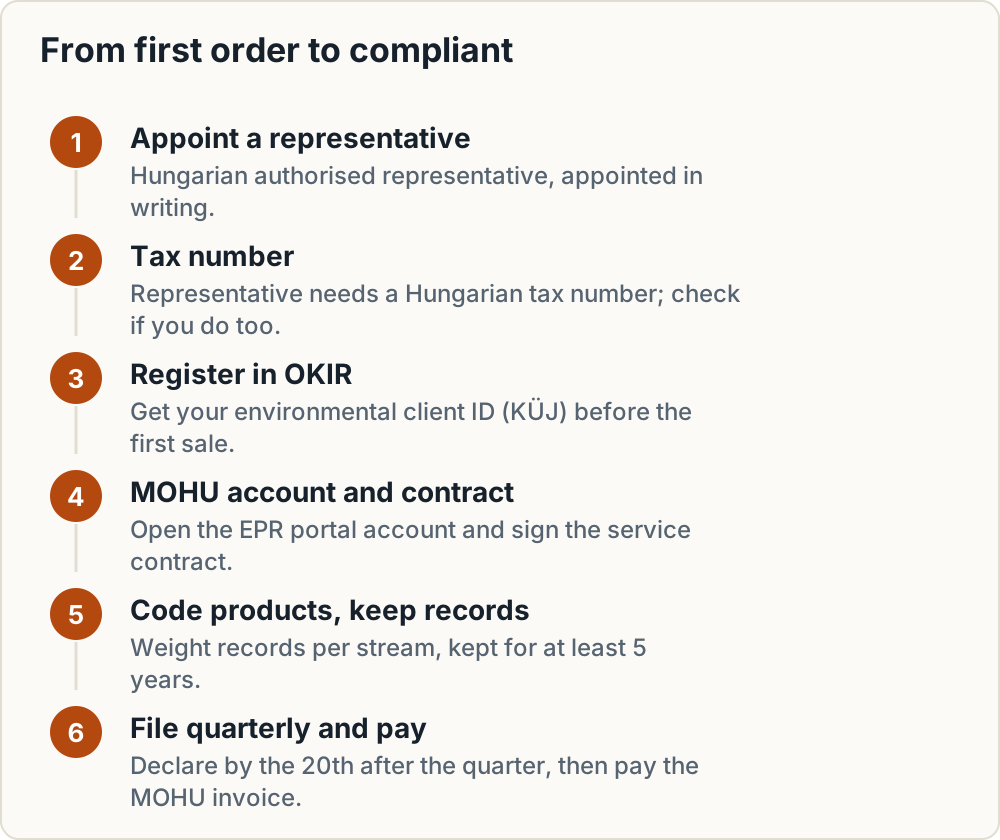
- Appoint a Hungarian authorised representative in writing. (Legal)
- Make sure a Hungarian tax number is in place for the representative, and for you if your representative requires it. (Legal for the representative; route for your own company not verified)
- Register in OKIR and receive your environmental client ID (KÜJ) before the first sale. (Legal: registration before activity; KÜJ mechanics: practice)
- Open a MOHU EPR portal account and sign the MOHU service contract. (Practice, as described by providers)
- Code your products and set up weight records per stream. (Legal: record-keeping; coding details: practice)
- File a declaration every quarter and pay the MOHU invoice. (Legal: quarterly reporting; payment timing: provider-reported)
Step 1: Hungarian tax number and authorised representative
According to the decree text (also available in the consolidated Jogtár version), the representative:
- can be a natural or legal person,
- must be established in Hungary,
- must hold a Hungarian tax number, and
- must be appointed in writing.
If the representative is a company, the registration needs its name, registered office, contact details, tax number and company registration number.
Under Section 10(3), the representative is responsible for fulfilling your obligations under the decree. In practice, the representative can only report what you give it. Your contract should therefore say who is responsible if the weights or material data you supply turn out to be wrong, and who pays any resulting fines.
We could not verify from official tax authority (NAV) material how a foreign company gets its own Hungarian tax number for EPR purposes. In practice, the representative or a Hungarian tax adviser usually handles this. Ask them early whether you need one and how long it takes. VAT registration and fiscal representation follow separate rules and are a different question.
Step 2: OKIR registration and the environmental client ID (KÜJ)
OKIR is where registration and reporting take place. According to Gramta, filings go through the OKIR client portal at kapu.okir.hu.
EPR Hungary, a provider, describes the process like this:
- You sign a power of attorney by hand and stamp it with the company stamp.
- The representative submits it, and the authority usually approves it within about 3 working days. This timing is the provider's claim, not a legal deadline.
- The authority issues your environmental client ID (KÜJ).
- An online form is completed with your tax number, the material streams you place on the market and the date your Hungarian sales start. According to the same provider, no declaration can be submitted until this enrolment is in place.
Section 23(1) requires registration before your first sale. If you already ship to Hungary without registering, raise this with your representative straight away.
Step 3: MOHU portal account and service contract
The MOHU registration is separate from OKIR. According to Lovat, you open an account in MOHU's EPR portal, sign the MOHU service contract and receive a MOHU producer ID. For the portal, foreign companies commonly provide a company register extract and a bank document showing the company name and address (EPR Hungary).
Some providers, including Lovat, mention a one-off enrolment fee. We found no amount in official sources, so ask MOHU or your representative for the current figure.
Step 4: Product coding and records
Providers say each product type needs an 8-digit KF code. They also say records must keep transport packaging separate from the product's own packaging, using separate codes. Treat this as provider-reported and check it against the Annex 4 data fields in the decree text. Whatever structure you use, keep the records for at least 5 years (Section 26(5)).
A simple setup for a small shop:
- one spreadsheet row per SKU, with product weight, its own packaging weight and the stream code;
- one row per shipping material (carton size, mailer bag, void fill) with its unit weight;
- an export of Hungarian orders per quarter that you multiply against both.
Which streams hit a typical webshop
Packaging. This means the parcel cartons, mailer bags and void fill that reach Hungarian customers, plus tape if it is counted as packaging. Use the actual weight of what goes to Hungary, not estimates for your whole business. Material type matters because plastic, cardboard and composite packaging are charged at different rates.
Electronics (EEE). You report the product itself by weight, under its EEE category. Classify every SKU, because the rates vary a lot. A screen costs almost three times as much per kilogram as a large appliance.
Batteries. This covers batteries sold on their own and batteries built into products you sell. A shop selling small electronics may therefore report in all three streams: the device, its battery and the shipping box.
2026 fees: what it costs per kilogram
The 2026 rates are set by Decree 33/2025 (XI.28.) EM, published in Magyar Közlöny 142/2025. They apply from 1 January 2026 and are unchanged from the level in force since 1 October 2025 (Transpack). The 1 October 2025 change raised textile packaging from 67 to 148 HUF/kg, glass from 77 to 107, vehicle batteries from 238 to 390 and lamps from 306 to 419. Plastic, paper and metal packaging rates did not change (Accace).
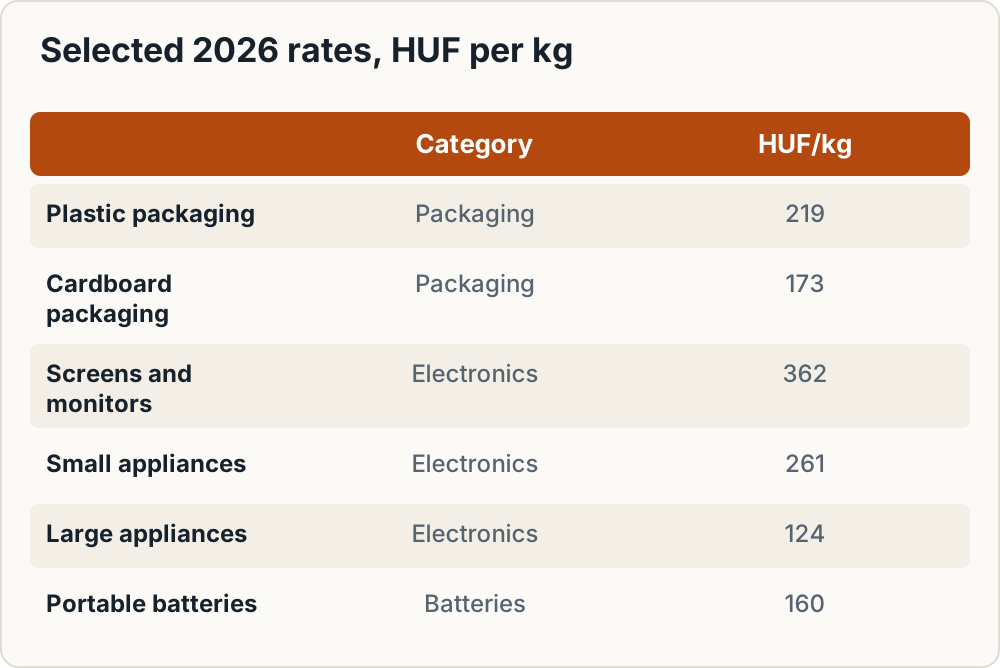
| Packaging | HUF/kg |
|---|---|
| Plastic | 219 |
| Composite | 191 |
| Metal and aluminium | 186 |
| Paper and cardboard | 173 |
| Textile | 148 |
| Other | 129 |
| Glass | 107 |
| Wood | 22 |
| Electrical and electronic equipment | HUF/kg |
|---|---|
| LED and gas discharge lamps | 419 |
| Screens and monitors | 362 |
| Small appliances | 261 |
| Large appliances | 124 |
| Heat exchange equipment | 116 |
| Photovoltaic panels | 63 |
| Batteries | HUF/kg |
|---|---|
| Vehicle (SLI) | 390 |
| Industrial | 239 |
| Light means of transport | 239 |
| Electric vehicle | 239 |
| Portable | 160 |
These figures come from trade-press tables. Check the decree text for any later amendment before you budget. The rates are set by the state under the concession model, so you cannot negotiate them with MOHU or a representative.
Worked example (illustrative arithmetic only). Suppose a shop ships these quantities to Hungary in one quarter:
- 500 kg of cardboard boxes × 173 = HUF 86,500
- 40 kg of plastic mailer bags × 219 = HUF 8,760
- 120 kg of small appliances × 261 = HUF 31,320
The total is HUF 126,580 for the quarter in EPR fees. Representative fees come on top.
Quarterly reporting and payment calendar
You must file a declaration by the 20th of the month after each quarter (Section 27(1)). MOHU then invoices you based on the declared data. According to Lovat, MOHU issues the invoice on the declaration day and payment is due 15 days later, which gives these dates:
| Quarter | Declaration due | Payment due (per Lovat) |
|---|---|---|
| Q1 (Jan–Mar) | 20 April | 5 May |
| Q2 (Apr–Jun) | 20 July | 4 August |
| Q3 (Jul–Sep) | 20 October | 4 November |
| Q4 (Oct–Dec) | 20 January | 4 February |
Your representative needs your weights before the 20th. Representatives may set an earlier cut-off. For example, EPR Hungary asks clients for their data by the 10th. Put your representative's cut-off in your calendar.
What happens if you do not register or report
- Fine of half the unpaid fee. If you fail to report data or report it incorrectly, the fine is half of the unpaid EPR fee, and it is payable together with the fee. LeitnerLeitner gives this example: 10,000 kg unreported at 219 HUF/kg means HUF 2,190,000 in fees plus HUF 1,095,000 in fines.
- Highest rate by default. If you cannot prove what material your packaging is made of, the highest rate applies, which is currently 219 HUF/kg for plastic (LeitnerLeitner).
- Fines per infringement. Lovat reports that from 1 April 2025 the OHH can fine breaches up to HUF 200,000 per infringement. This is a secondary source, so confirm it with your representative.
- Sales suspension. If a producer still does not register after being fined for non-registration, the authority can suspend the placing of its products on the market until registration and payment are done (Marosavat).
- Marketplace delisting. Providers say marketplaces must suspend sellers who do not comply. We did not verify the legal basis for this, so treat delisting as a practical risk rather than a confirmed rule. For the product compliance data platforms already require, see our guide to GPSR fields on Allegro, Kaufland and eMAG.
Choosing an authorised representative: what to ask
We do not rank providers because we have no verified fee comparison. These questions will help you compare quotes:
- Does the quote cover registration only, or ongoing quarterly reporting too? Who files, and by which date must you send your weights?
- The decree makes the representative responsible for your obligations. How does the contract split liability if the data you supply turns out to be wrong?
- Will MOHU invoice you directly or go through the representative? In which currency, and with what mark-up, if any?
- Can you verify the representative's Hungarian registration and tax number?
- Will they handle your own tax number if one is needed, and the MOHU portal setup, including any one-off fee?
- Do they cover every stream you sell (packaging, EEE, batteries, textiles) or only packaging?
Common mistakes
- Assuming another country's EPR number covers Hungary. A German, Polish or Czech registration does not carry over. Each country has its own system.
- Reporting packaging only. Electronics and batteries are separate streams, and several of their rates are higher than cardboard.
- Giving a vague sales start date at registration. The start date is one of the registration data fields, so get it right from the start.
- Collecting data late. Deadlines are usually missed because order exports and packaging weights are gathered at the last minute.
For the official view, MOHU publishes an EPR FAQ in Hungarian and an information notice for producers. Both are useful further reading.
Frequently asked questions
Do I need EPR registration in Hungary if I only sell a few parcels a month?
Probably yes. We found no kilogram threshold in the decree, and providers state that the obligation applies from the first shipment to a Hungarian consumer. If your volumes are very small, ask MOHU or a representative to confirm before you decide.
Do I need a Hungarian VAT number or only a tax number for EPR?
The decree requires your authorised representative to hold a Hungarian tax number. Whether your own company also needs one for EPR, and how to get it, should be confirmed with the representative or a Hungarian tax adviser. VAT registration is a separate question with its own rules.
Can I register in OKIR myself without a Hungarian representative?
Not if you are established abroad and sell into Hungary by e-commerce. Section 10(2) of Decree 80/2023 requires such producers to meet their obligations through an authorised representative established in Hungary. Section 10(3) makes that representative responsible for fulfilling your obligations, so agree in the contract how responsibility for the data you supply is handled.
Does my German, Polish or Czech EPR registration cover Hungary?
No. Each country runs its own EPR system, so Hungary needs its own registration, representative and declarations.
What is the difference between OKIR and the MOHU portal?
OKIR is the state system run by the waste management authority, where you register, get your KÜJ and file declarations. The MOHU portal belongs to the concession company that invoices the EPR fee. According to providers, you need both, with a separate MOHU service contract and producer ID.
What happens if I sell on a marketplace and am not registered?
You risk fines and back fees from the Hungarian authority, and the authority can eventually suspend your products from the market. Providers also report that marketplaces delist non-compliant sellers. Register before you list products for Hungarian delivery.
Summary checklist
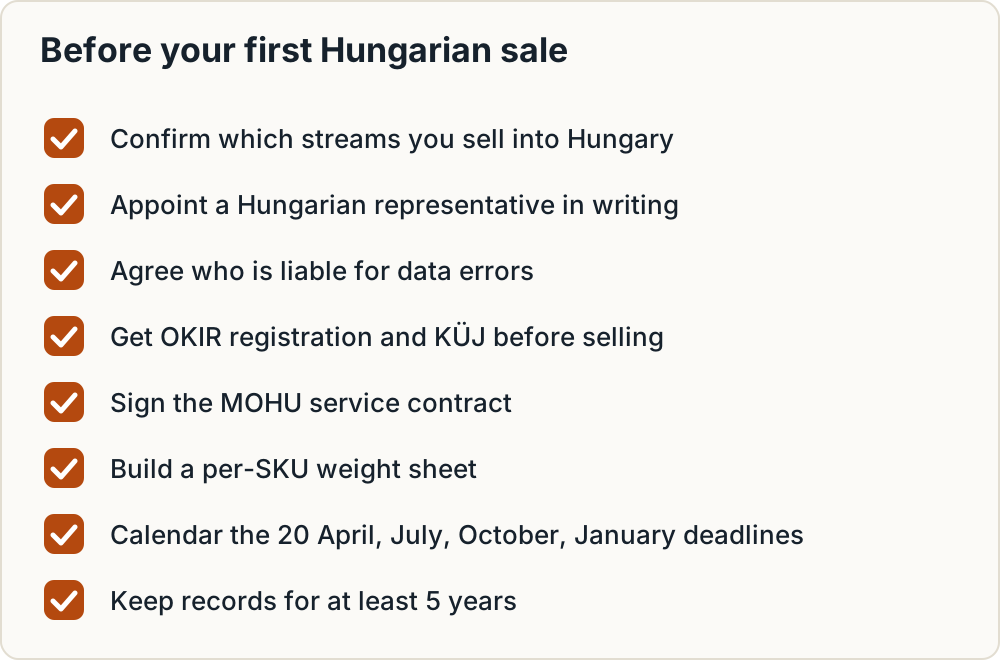
- Confirm which streams you sell into Hungary: packaging, EEE, batteries, textiles or furniture.
- Appoint a Hungarian authorised representative in writing, and check its tax number and registration.
- Agree in the contract who is liable for errors in the data you supply.
- Ask the representative about your own tax number and the MOHU one-off fee.
- Complete OKIR registration and get your KÜJ before the first Hungarian sale.
- Open the MOHU portal account, sign the service contract and note your MOHU producer ID.
- Build a per-SKU weight sheet that separates product, own packaging and shipping packaging.
- Budget using the 2026 rates, for example 173 HUF/kg for cardboard and 219 HUF/kg for plastic.
- Put the declaration deadlines (20 April, 20 July, 20 October, 20 January) and the representative's earlier cut-off in your calendar.
- Keep all records for at least 5 years.
For any corrections, contact the editorial team. Our sourcing standards are set out in our editorial policy.
Sources
What this guide relies on, in the order cited.
- PKF Hungary · pkf.hu
- Gramta · gramta.com
- Decree 80/2023 in the Nemzeti Jogszabálytár · njt.jog.gov.hu
- Lovat · vatcompliance.co
- consolidated Jogtár version · net.jogtar.hu
- EPR Hungary · eprhungary.com
- Transpack · transpack.hu
- Accace · accace.com
- LeitnerLeitner · leitnerleitner.hu
- Marosavat · marosavat.com
- EPR FAQ in Hungarian · mohu.hu
- information notice for producers · mohu.hu