On this page
- The rule in one paragraph (and who it covers)
- What counts as the "lowest price of the last 30 days"
- Worked example: price history and what to display
- Country-by-country comparison table
- New products with no 30-day history
- Discount codes, coupons and loyalty prices
- Platform-by-platform implementation checklist
- Enforcement and penalties: what has actually happened
- Frequently asked questions
- Quick-reference recap
This guide explains how the rules work in practice. It is not legal or tax advice; check the linked official sources or ask an adviser for your specific case.
If you announce a discount to consumers, you must also show the lowest price you charged for that product in the 30 days before the discount started. Any "-20%" badge must be calculated from that 30-day low, not from your list price or RRP. This Omnibus Directive lowest-price rule applies to every webshop selling to consumers in Czechia, Slovakia, Poland, Hungary and Romania. Each country wrote it into its own law with small differences: how new products are handled, perishables, who enforces and how much fines can be. This page covers the EU rule, a worked price-history example, a five-country comparison table, coupon and new-product edge cases, and a checklist you can apply in any shop platform.
The rule in one paragraph (and who it covers)
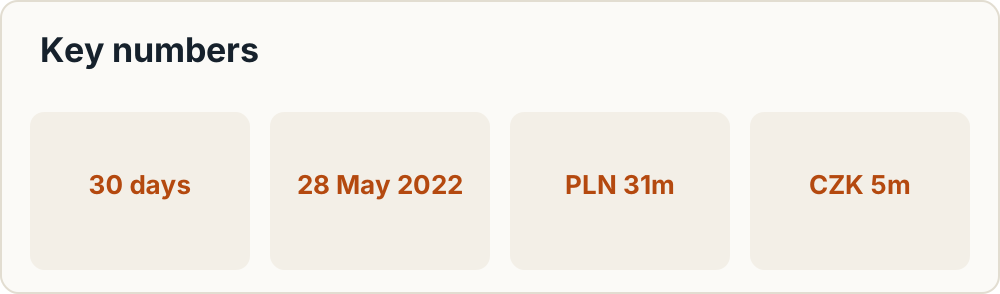
Article 6a of the Price Indication Directive 98/6/EC was added by the Omnibus Directive (EU) 2019/2161. It requires every announcement of a price reduction to state the prior price: the lowest price the trader applied in the 30 days before the reduction. The European Commission says the rules apply from 28 May 2022, with specific provisions for perishable goods, newly launched products and progressive reductions. The Commission also adopted a guidance notice on 17 December 2021. That notice explains how the Commission reads the rule, but it is not law itself.
Some countries applied the rule later than 28 May 2022. Poland applied it from the start of 2023 and Czechia from 6 January 2023 (sources in the table below). National authorities do the enforcing, and they work from their own statutes rather than from the directive.
Scope in short:
- Covered: sales to consumers (B2C), online and offline, whenever you announce a reduction on a product. That includes crossed-out prices, "sale" badges, percentages and campaign banners.
- Not covered: pure B2B sales, and price drops you simply make without presenting them as a reduction.
- Grey zone: coupon codes, loyalty prices and personalised prices (see the coupon section).
What counts as the "lowest price of the last 30 days"
The reference is the lowest price you actually charged consumers in the 30 days before the reduction starts. It is not:
- the manufacturer's RRP,
- your "regular" list price,
- the price on the day before the sale, if it was lower at some point during the window.
If an earlier promotion falls inside the 30-day window, its price counts. A flash sale three weeks ago at 850 makes 850 your prior price for a new sale today.
Percentages must use the 30-day low (CJEU, Aldi Süd)
In Case C-330/23 (Aldi Süd, 26 September 2024), the Court of Justice ruled that a reduction announced in an advertisement, including one expressed as a percentage, must be calculated from the lowest price applied in the 30 days before the reduction. Showing the 30-day low in small print next to a "-30%" worked out from a higher price is not enough. The headline claim has to be calculated from the prior price.
Progressive reductions
If a single campaign cuts the price in steps (for example -10%, then -20%, then -30%), the Czech and Slovak statutes and the Romanian rules described in the press take the reference from the period before the first reduction. Without this, each step would lower the reference for the next one.
Worked example: price history and what to display
The prices below are illustrative. They show how the window behaves for one SKU.
| Days | Price (CZK) | What happened |
|---|---|---|
| 1–19 | 1,000 | Regular price |
| 20–22 | 850 | Three-day flash sale |
| 23–45 | 1,000 | Back to regular |
| 46 | 900 | Planned "Black Friday" price, badge "-10%" |
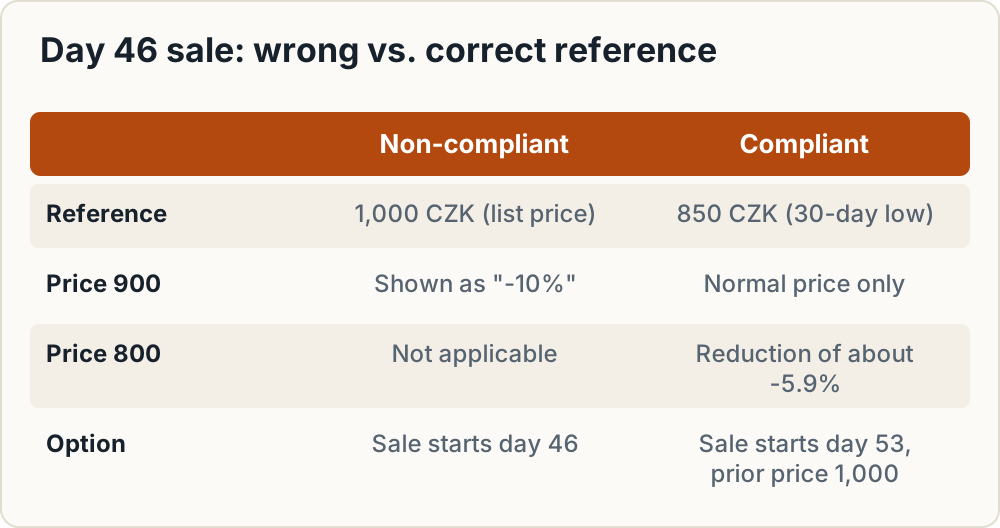
Window for a sale starting on day 46: days 16 to 45. The flash sale on days 20–22 falls inside it, so the prior price is 850 CZK, not 1,000.
What that means:
- "-10% from 1,000" on day 46 is not compliant. The reference must be 850.
- 900 is above 850, so on day 46 the shop cannot present 900 as a reduction at all. It can only show 900 as a normal price.
- A lawful discount on day 46 needs a price below 850. At 800 CZK the claim is a reduction from 850, about -5.9% (50 ÷ 850).
- If you want to advertise "900, -10%", move the sale. Keep the price at 1,000 until day 52 and start the sale on day 53. Its window is days 23–52, the flash sale has dropped out, and the prior price is 1,000. Selling at 900 as a normal price from day 46 does not work, because 900 would then become the new 30-day low.
The "raise then cut" trap
| Days | Price (CZK) |
|---|---|
| 1–31 | 1,000 |
| 32–45 | 1,200 (raised 14 days before the sale) |
| 46 | 960, badge "-20%" |
The window for day 46 (days 16–45) still contains 16 days at 1,000 (days 16–31). The prior price is 1,000, so 960 is a -4% reduction. The "-20%" badge, calculated from 1,200, breaks the rule. Raising the price shortly before a sale does not reset the 30-day low. It only makes the claimed percentage misleading.
How to word the label
The Polish consumer authority UOKiK expects a plain label such as "lowest price in the 30 days before the reduction". According to HLC's summary of the UOKiK guidance, vague labels such as "reference price" or "Omnibus price" are not acceptable, and a crossed-out price on its own is not enough. A neutral format that works in any language:
Now 800 CZK. Lowest price in the 30 days before the discount: 850 CZK (-5.9%). Offer ends 1 December.
Country-by-country comparison table
This table covers the five CEE markets. Items marked "check the statute" could not be confirmed against the official text. Read the national text before relying on them.
| Czechia | Slovakia | Poland | Hungary | Romania | |
|---|---|---|---|---|---|
| Statute | Act 634/1992 Coll. on consumer protection, § 12a | Act 108/2024 Coll., § 7 in the consolidated text (check numbering on Slov-Lex) | Act of 9 May 2014 on informing about prices of goods and services, art. 4 | Joint decree 4/2009 (I. 30.) NFGM-SZMM on price indication | Government Decision amending HG 947/2000 on price indication |
| Applies from | 6 January 2023 | Act 108/2024 in force 1 July 2024 (earlier rules under the previous consumer act) | Start of 2023 | 28 May 2022 | Approval reported 25 May 2022; check the date in force in Monitorul Oficial |
| Reference price | Lowest price at which the seller offered and sold the product in the 30 days before | Lowest price at which goods were sold or provided in the 30 days before | Lowest price in the 30 days before the reduction, shown next to the reduced price | Lowest price in the period before the promotion (the government office summary refers to the preceding month) | Lowest price in the last 30 days |
| New product (<30 days) | Since first offered | Since start of sale | Since the product was first offered | Not covered by the source; check the statute | Lowest price since launch |
| Progressive reductions | 30 days before the first reduction | Price before the first reduction | Check the statute | Check the statute | Price before the first reduction (per press reports) |
| Perishables | Exempt for goods that deteriorate rapidly or have a short shelf life (§ 12a(2)) | Rapidly deteriorating goods exempt | Price before the first reduction | Not covered by the source; check the statute | Reference window of 10 days before the reduction |
| Regulator | ČOI (Czech Trade Inspection Authority) | Slovak Trade Inspection (SOI), per § 26(8) of the consolidated text | UOKiK; local trade inspectors (WIIH) | Government offices (consumer protection departments) | ANPC |
| Fines | Up to CZK 5,000,000 (offence under § 24(5)(k)) | Check the statute | See the enforcement section; check the Act for inspector fine levels | Check the statute | Sources conflict; check the published text |
Country notes
- Czechia. The perishables exemption is legally uncertain. ePravo reports that one appeals body accepted an interpretation based on "use by" dates under Regulation 1169/2011. Do not assume all food qualifies. For blanket discounts ("everything -20%"), the reference price must appear on each product.
- Slovakia. The prior price must be stated in every announcement of a price reduction. Before July 2024 the rule sat in the previous consumer protection act. Older guidance may cite that act.
- Poland. Polish enforcement has the most detail available: written UOKiK guidance and reported decisions against large platforms.
- Hungary. The government office summary says both the earlier price and the promotional price must appear on each product, even in a general campaign such as "20% off all tops". The rule applies to e-commerce.
- Romania. The sources available are press reports on the draft and on the government's approval. Treat the 30-day and 10-day periods as the reported rule, and confirm the final text and fine ranges in Monitorul Oficial. Our guide to ecommerce platforms in Romania covers the platform side.
New products with no 30-day history
For a product listed less than 30 days ago, the reference period is the time since it was first offered. That is how the Czech, Slovak and Polish rules work, and how the Romanian rule is described in the press. Never backfill an invented "regular price" for days when the product was not on sale.
A launch offer is a different case. According to the HLC summary of UOKiK guidance, you may announce a future price for a new item (for example "PLN 10 now, PLN 15 from 1 June"), provided you present it differently from an ordinary discount. The summary does not prescribe a format. The cautious approach is to avoid crossed-out prices and percentage-off badges on such offers.
Track variants separately
Each size, colour or bundle that has its own price needs its own history. In the January 2026 Polish case reported by Spidersweb, Temu was faulted for showing the lowest-price information inconsistently, including across variants and between listing and product pages. Store the price history per SKU/variant, not per parent product.
Discount codes, coupons and loyalty prices
Coupon codes in Poland. Per the HLC summary, when a code on the shop's own site or app announces a reduction on specific products (for example "-20% on boots with code XYZ"), you must show the 30-day lowest price next to the products covered. A general cart-level code that does not advertise a price for any product is less clear. The cautious approach is to show the 30-day low on the affected products anyway.
Coupon codes in CZ, SK, HU and RO. We found no regulator statement on coupons for these four countries. Do not assume they follow Poland, and do not assume they exempt coupons. If a code is advertised in a banner as "-25% on all shoes", treat that as an announced price reduction.
Loyalty and personalised prices. The Commission's 2021 guidance notice (linked from the Commission's Price Indication Directive page) covers these cases. Read the notice itself before you build a members-only price display. Secondary summaries vary on exactly what it allows.
Banner percentages. Whatever the mechanism, a "-30%" claim must be calculated from the 30-day low (CJEU C-330/23).
Platform-by-platform implementation checklist
Platform-neutral steps
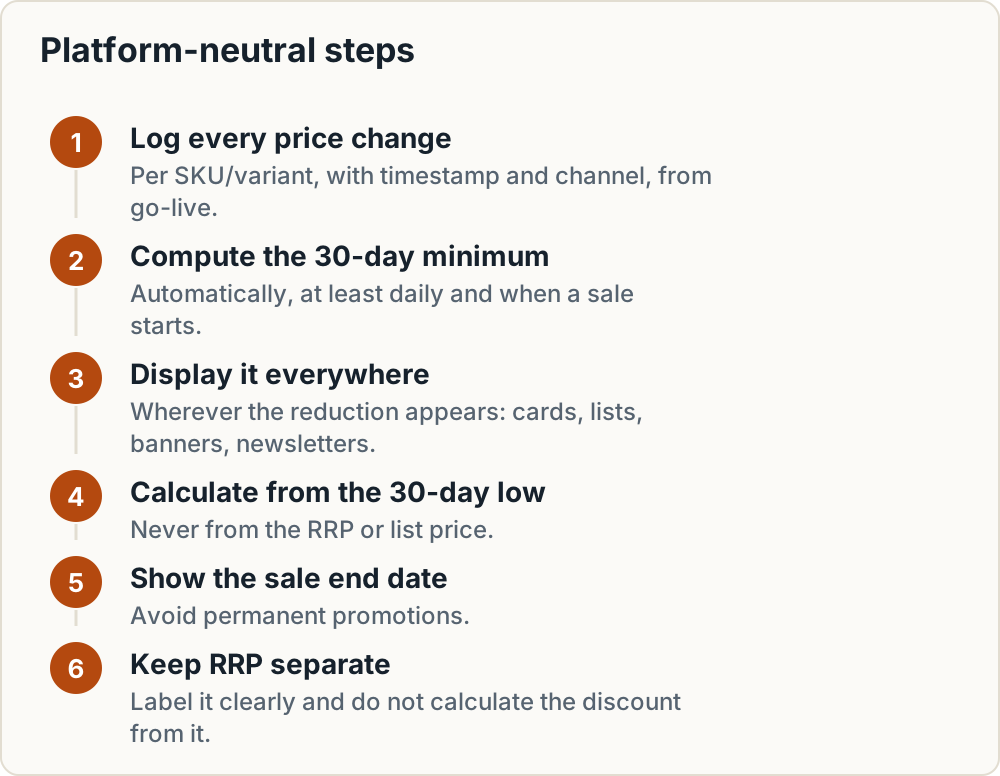
- Log every price change per SKU/variant with a timestamp and the channel where it applied. Start from the day you go live. Do not reconstruct history you cannot prove.
- Compute the 30-day minimum for every discounted SKU automatically, at least daily and again when a sale starts.
- Display it everywhere the reduction appears. Shoper's guidance covers product cards, product lists, product previews and promotional modules such as new items and bestsellers. Also cover search suggestions, related-product blocks, newsletters, banners and social ads wherever they show a sale price.
- Calculate percentages from the 30-day low, never from the RRP or the list price.
- Show the sale end date, and avoid "permanent" promotions that never return to the regular price.
- Keep RRP separate. If you still show a manufacturer's RRP, label it clearly as RRP. Keep it visually distinct from the mandatory 30-day price, and do not calculate the discount from it.
Platform notes
| Platform | What we could confirm | What to check |
|---|---|---|
| Shoper | Shoper's own article (updated 12 August 2026) recommends automatic price-history calculation. Manual edits are meant only for serious errors and apply to main products, not variants | Whether the automatic value appears in every template block you use |
| Shoptet | No native feature confirmed in our research | Shoptet help docs and your template: does it store per-variant price history and show it on listings? See our Shoptet setup guide and legal pages |
| Shopify | Third-party apps for the 30-day low exist in the App Store; no native feature confirmed | Whether the app logs history from install only, handles variants and markets, and updates theme listing cards |
| WooCommerce | No feature confirmed | Plugins in the WordPress directory: per-variation history, cache handling, display in loops and widgets |
| Gomag | No feature confirmed | Gomag documentation or support |
For a wider feature comparison, see Shoptet vs Shopify vs WooCommerce for CEE.
Feeds and marketplaces
The sale price and any compare-at price in your Google Merchant Center, Heureka or Ceneo feeds must match the claim on the product page. A feed that still sends the old RRP as the "original" price repeats the misleading claim in another channel. Price mismatches between feed and page also lead to disapprovals. See Google Merchant Center disapproved products and our comparison of product feed tools for WooCommerce, Shoptet and Shopify.
Pre-launch test before each campaign
- Pick 10 discounted SKUs, including at least two variants and one product added in the last 30 days.
- For each, compare the product page, the category card, the search suggestion, the feed, the banner and the campaign email.
- Check by hand that the 30-day low matches your price log and that the percentage is calculated from it.
- Save dated screenshots. They are your evidence if an inspector asks.
Enforcement and penalties: what has actually happened
Poland. In January 2026, Spidersweb reported that UOKiK fined Zalando about PLN 31 million and Temu about PLN 6 million for failing to present the lowest price from the 30 days before promotions properly. Zalando was also reported to have calculated discounts from regular or initial prices rather than the 30-day low. It said it would appeal. The figures come from a news report, so check UOKiK's own announcement for the official amounts and status.
Czechia. Breaching § 12a is an offence carrying fines of up to CZK 5,000,000. ČOI is the supervising authority.
Other countries. We could not confirm fine levels for Slovakia, Hungary or Romania from the official texts. Romanian press reports give conflicting ranges.
Frequently asked questions
Does the 30-day rule apply to "free shipping" or "buy one, get one free" offers?
The rule covers announced reductions of a product's price. Free shipping does not change the product price shown, so it falls outside the plain wording. Multi-buy offers can amount to a price reduction per item, so check how your national authority treats them before presenting them as a discount.
Can I show the 30-day lowest price only on the product page, not on category listings?
Not safely. The prior price has to accompany the announcement of the reduction, so wherever a sale price or badge appears, the 30-day low should appear too. Shoper's guidance covers product lists, previews and promotional modules as well as product cards.
What if I sell on a marketplace such as Allegro or eMAG rather than my own shop?
The obligation sits with the trader announcing the reduction, which is you for your own offers. If the marketplace shows a reference or prior price next to your offer, check that it matches your real price history across channels.
Do I need to keep the price history after the sale ends?
The statutes we reviewed do not set a retention period for price logs. You still need the history to calculate the next 30-day window and to prove compliance in an inspection, so keep timestamped logs and campaign screenshots for at least as long as an authority could open proceedings.
Is the rule the same if I sell cross-border into all five countries from one shop?
The EU rule is the same everywhere, but the national statutes and regulators of the countries whose consumers you target can apply. Use the strictest common approach: a 30-day low per variant, shown everywhere, percentages calculated from it. Then check perishables and coupon handling country by country.
Quick-reference recap
| Question | Answer |
|---|---|
| What must be shown? | The lowest price charged to consumers in the 30 days before the reduction, next to the sale price |
| What is the percentage calculated from? | That 30-day low (CJEU C-330/23) |
| Product listed under 30 days | Lowest price since first offered (CZ, SK, PL; RO per reports) |
| Progressive reductions | Reference taken before the first step (CZ, SK; RO per reports) |
| Perishables | CZ and SK exempt; PL uses price before first reduction; RO reportedly 10 days |
| Coupons | PL: show the 30-day low on products a code targets; elsewhere unconfirmed |
| Label | Plain words, e.g. "Lowest price in the 30 days before the discount" |
| Largest known fines | PL: Zalando about PLN 31m, Temu about PLN 6m (reported Jan 2026); CZ: up to CZK 5m |
What to do this week
- Turn on (or install) per-variant price logging, and confirm it records every change with a date.
- Check every live sale badge: recalculate the percentage from the 30-day low and fix any badge calculated from RRP or list price.
- Replace vague labels with plain wording in each language you sell in.
- Align feed sale and compare-at prices with the page claim.
- Run the 10-SKU test before your next campaign and save the screenshots.
- Check the rows marked "check the statute" in the table against the national text for each market you sell into.
Then work through the rest of the EU compliance checklist for an online shop, including the EU 14-day withdrawal right for webshops.
Sources
What this guide relies on, in the order cited.
- apply from 28 May 2022 · commission.europa.eu
- calculated from the lowest price applied in the 30 days before the reduction · curia.europa.eu
- HLC's summary of the UOKiK guidance · hlc.com
- § 12a · zakonyprolidi.cz
- § 7 in the consolidated text · zakonypreludi.sk
- 6 January 2023 · pravniprostor.cz
- Start of 2023 · prawo.pl
- 28 May 2022 · kormanyhivatalok.hu
- reported 25 May 2022 · alba24.ro
- Lowest price since launch · e-juridic.manager.ro
- Up to CZK 5,000,000 · epravo.cz
- Spidersweb · spidersweb.pl
- product cards, product lists, product previews and promotional modules such as new items and bestsellers · shoper.pl