
On this page
- Short answer: does an e-shop need eKasa in 2026?
- What changed on 1 January 2026
- Revenue registration: which e-shop payment flows are covered
- The cashless payment duty from 1 May 2026
- Penalties
- Setting up if you do need eKasa
- Self-audit checklist for an e-shop owner
- Related Slovak obligations that are not eKasa
- Frequently asked questions
- Quick reference
This guide explains how the rules work in practice. It is not legal or tax advice; check the linked official sources or ask an adviser for your specific case.
A Slovak online shop paid only by bank transfer, online card gateway or cash on delivery collected by a courier generally does not have to issue eKasa receipts. eKasa starts to apply when you or your staff take money at a place you control, such as a showroom, warehouse pickup counter, pop-up or market stall. Since 1 January 2026 these rules come from Act 384/2025 Z. z., which replaced Act 289/2008 Z. z. The new Act has two separate duties: registering revenue in eKasa and, from 1 May 2026, letting customers pay cashless at those same sales points. This page covers both, gives a decision table for common e-shop payment flows and ends with a self-audit checklist. It also flags what no official 2026 guideline for e-shops has confirmed yet.
Short answer: does an e-shop need eKasa in 2026?
For most small online shops, no. Use this as a first filter:
- Pure online model (prepayment by transfer, gateway card payment, cash on delivery collected by a carrier): generally no eKasa receipt.
- Any place where your own people receive cash, card or QR payments from customers: eKasa almost certainly applies to that revenue.
- Older articles that cite Act 289/2008 describe the repealed law. Their logic often still holds, but paragraph numbers and some details have changed.
- Two duties, not one. Registering revenue and offering a cashless option are separate obligations. The second applies only to sellers who already have to register revenue.
What changed on 1 January 2026
Act 384/2025 Z. z. on revenue recording came into force on 1 January 2026. The changes that matter most to small shops:
| Change | What it means in practice | Source |
|---|---|---|
| New Act replaces 289/2008 | Cite § numbers from Act 384/2025, not the old Act | Nine Digit summary |
| Registration "without undue delay" after receiving payment; offline fallback | If the online connection fails, data is stored and must be sent within 96 hours of the first attempt (§ 3(1)) | Act 384/2025, print version |
| Electronic receipts | A receipt may be sent or made available electronically if the buyer agrees (§ 8(1)) | Act 384/2025, 1 Jan 2026 version |
| Cashless payment duty | Purchases above EUR 1 must be payable cashless, from 1 May 2026 (§ 15) | Financial Administration |
| Notice at sales points | A notice about revenue recording must be displayed at each sales point (§ 3(4)) and kept there until 31 Dec 2026 (§ 19(11)) | Financial Administration support portal |
| New register type | A software online register (which can run as a cloud service) joins the ORP and the Virtual Register | Podnikajte.sk |
| QR payments in eKasa | QR payment is built into the eKasa system and needs no extra hardware | Nine Digit summary |
The old annex that listed which services were covered has also been removed, so more types of service now fall under the registration duty (Nine Digit). This matters more for service businesses than for goods e-shops. If you also sell services in person (installation, repairs, workshops), check the current statutory text with your accountant.
Revenue registration: which e-shop payment flows are covered
Two definitions in § 2 of Act 384/2025 decide most e-shop cases. A sales point ("predajné miesto") is the place where revenue is received. Revenue ("tržba") is a payment received for goods or services at the sales point, in cash or by other means of payment (Act 384/2025, slov-lex).
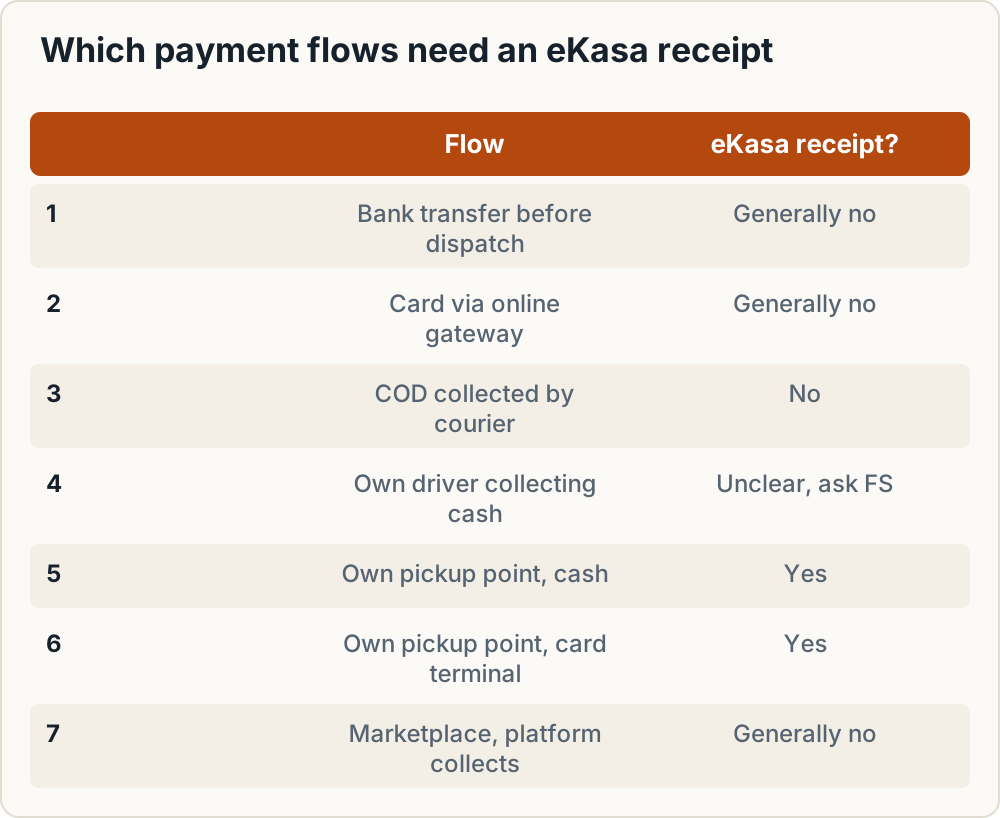
So the test is where and by whom the money is received, not whether you sell online. Three further rules narrow it down:
- Cash on delivery is exempt. § 3(2) excludes goods sold on cash on delivery ("na dobierku") from the registration duty, along with other items such as vending machine sales (Act 384/2025, slov-lex).
- Territory. Registration is mandatory for revenue received on Slovak territory. Registering revenue received abroad is voluntary, and foreign sales follow that country's rules (Financial Administration support portal).
- Older guidance on e-shops. Guideline 2/ERP/2021/MP was issued under the old Act. It said eKasa is not needed for bank transfers or online card payments made before delivery, or where a courier or other third party collects the cash. It said eKasa is needed for pickup where the buyer pays at the sales point by card or other means (Podnikajte.sk summary). A 2026 accountant summary reaches the same conclusion under the new Act (Danovy-poradca.sk).
Not yet confirmed officially: We have not found an official Financial Administration guideline on e-shops issued under Act 384/2025. The 2021 guideline fits the 2026 definition of revenue, but it was written for the repealed law. For any borderline flow, get written confirmation from the Financial Administration or your accountant.
Decision table: payment flow vs eKasa
| Flow | eKasa receipt needed? | Basis | What to check |
|---|---|---|---|
| Bank transfer before dispatch | Generally no | Payment is not received at a sales point; 2/ERP/2021/MP | That nobody also takes cash for these orders at handover |
| Card or wallet via online gateway | Generally no | Same as above | Gateway payout reports match orders |
| Cash on delivery collected by a courier or Slovenská pošta | No | § 3(2) COD exemption; a third party collects | Carrier contract: the carrier collects and pays out to you |
| Own driver or employee collecting cash at the door | Unclear, ask FS or an accountant | Your own person receives the cash; the COD exemption wording may still apply | Get a written view before relying on the exemption |
| Your own pickup point, full prepayment online | Generally no | No payment received on site | Staff do not accept top-ups or extras on site |
| Your own pickup point, paid in cash | Yes | Revenue received at your sales point | Register, receipt, notice, cashless option from 1 May 2026 |
| Your own pickup point, paid by card on a physical terminal | Yes | 2/ERP/2021/MP; card payment is revenue under § 2 | Terminal and eKasa both set up at the counter |
| Your own pickup point, paid by QR code | Yes, in our reading | A non-cash payment received at the sales point counts as revenue under § 2 | Confirm with FS or an accountant; use eKasa QR |
| Third-party parcel locker or pickup network with prepayment | Generally no | No payment received at your sales point | See parcel locker delivery setup |
| Locker or kiosk you own that accepts payment | Unclear, ask FS or an accountant | No source covers this case | Do not assume the vending machine exemption applies |
| Marketplace sale, platform collects payment | Generally no for the online sale | The platform receives the payment online | Payments really run through the platform, e.g. selling on Kaufland in Slovakia |
| Physical shop plus webshop | Yes for shop revenue; online flows as above | The shop is a sales point | Keep in-store and online revenue clearly separate |
| Foreign EU seller shipping to SK, no Slovak premises | No Slovak eKasa duty for online sales | The duty covers revenue received on SK territory | Any Slovak warehouse pickup, pop-up or event stall changes this |
The "generally no" rows rely on 2/ERP/2021/MP. It was issued under the old law but fits the 2026 definition of revenue.
The cashless payment duty from 1 May 2026
§ 15 of Act 384/2025 requires sellers to let the buyer pay cashless for purchases above EUR 1 (Act 384/2025, slov-lex). Parliament moved the start from 1 March to 1 May 2026. The duty applies to merchants who record sales. The law does not prescribe a method, so one cashless option is enough, and cash remains valid (Financial Administration press release).
Practical points:
- Accepted options. A card terminal, a phone working as a terminal, or a QR code paid through the customer's banking app. One of these is enough.
- Exception. § 15 does not apply when no internet signal is available.
- Bank fees. Until the end of 2027, banks may not charge fees for payment notifications sent through the Financial Administration's technical solution. QR payment notifications work with VÚB, Tatra banka, ČSOB and Slovenská sporiteľňa, which together cover about 80% of the market (Financial Administration).
- Scope. A payment provider's summary says the duty targets physical points of sale (24-pay).
Pickup counters: Your website gateway does not cover sales at your pickup counter. If customers can pay in cash there, the counter itself needs a terminal or QR option.
Penalties
The sanctions are in § 17. The ranges below come from the text in force from 1 January 2026 (Act 384/2025, print version). The Act has already been amended, so check the current consolidated text on slov-lex.
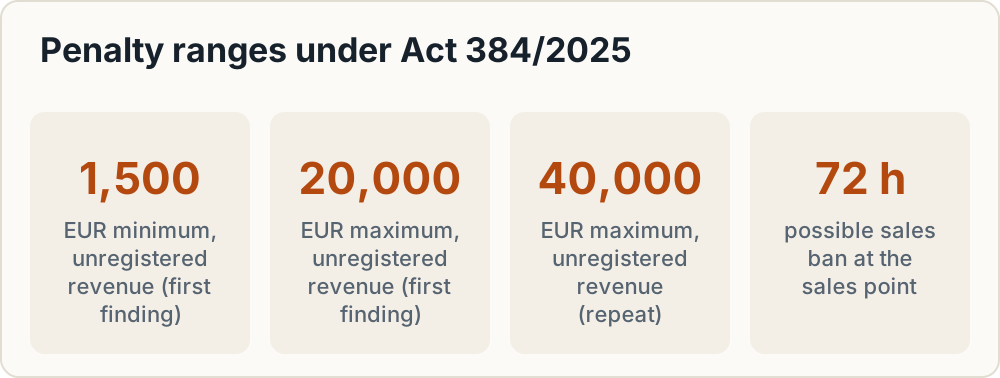
| Breach | First finding | Repeat finding |
|---|---|---|
| Revenue not registered | EUR 1,500 – 20,000 | EUR 3,000 – 40,000 |
| Receipt not issued | EUR 150 – 6,500 | EUR 300 – 13,000 |
| No cashless option (from 1 May 2026) | Warning only | EUR 500 – 15,000 |
For repeated serious breaches, such as unregistered revenue, the authority can also ban sales at the sales point concerned for up to 72 hours (§ 17(7)). For an e-shop with a pickup counter, the main risk is a cash or card handover with no receipt.
Setting up if you do need eKasa
The 2026 Act recognises three register types (Podnikajte.sk):
- Online cash register (ORP): a certified device from a vendor.
- Software online register: new in 2026. The register software and protected data storage can run in a remote (cloud) environment.
- Virtual Register (VRP): the Financial Administration's free option, which runs on your own device. Check the Financial Administration's VRP documentation for printing options, catalogue limits and QR support before you rely on it.
QR payment is built into eKasa and linked to the Financial Administration's payment notification service. It lets a small pickup counter meet the cashless duty without extra hardware.
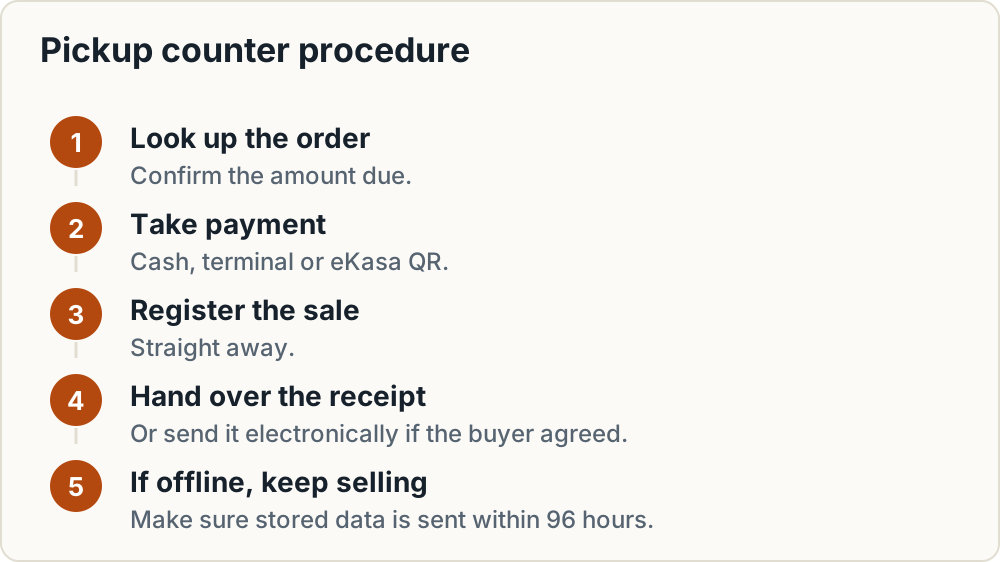
A simple counter procedure:
- Look up the order and confirm the amount due.
- Take payment (cash, terminal or eKasa QR).
- Register the sale straight away.
- Hand over the receipt, or send it electronically if the buyer has agreed.
- If the register goes offline, keep selling, but make sure the stored data is sent within 96 hours.
Self-audit checklist for an e-shop owner
- List every place where you or an employee physically receive money: office, warehouse, showroom, fairs, markets, home deliveries by your own staff.
- Map each checkout and pickup payment method to the decision table above.
- For each "yes" row, choose a register type (ORP, software register or VRP) and set it up.
- Add a cashless option at each of those sales points: terminal, phone-as-terminal or eKasa QR.
- Display the revenue-recording notice at each sales point now. It must stay up until 31 Dec 2026.
- Read your courier and COD contracts: who collects the cash and who pays it out to you. See cash on delivery in Eastern Europe.
- Confirm that marketplace orders are paid only through the platform.
- Non-Slovak sellers: confirm you have no Slovak sales point, such as a warehouse that allows pickup with payment, or a pop-up.
- Record the date of the check and your accountant's confirmation for any "unclear" rows.
Related Slovak obligations that are not eKasa
eKasa covers only revenue received at a sales point. Other rules apply separately: VAT on cross-border sales (see OSS VAT registration for a webshop), invoicing, consumer withdrawal rights and packaging EPR. For the full list, use our EU compliance checklist for an online shop. For checkout options, see payment methods to offer in CEE and the WooCommerce setup for Czechia and Slovakia.
Frequently asked questions
Does the cashless payment duty from 1 May 2026 apply to my website checkout?
The § 15 duty applies to sellers who register revenue in eKasa, and revenue means payments received at a sales point. A purely online checkout paid by gateway or transfer is not an eKasa flow, so the duty generally does not affect it. It matters wherever you take payments in person.
Can I use the free Virtual Register (VRP) instead of buying a device?
In many cases, yes. The Financial Administration's Virtual Register is free and runs on your own device, so it suits low-volume pickup counters. Check the current VRP documentation for printing, catalogue limits and QR payment support first.
Can I email the receipt instead of printing it?
Yes. Under § 8(1) of Act 384/2025 you can send or make the receipt available electronically, but only if the buyer agrees. Without that agreement, hand over a paper receipt.
Are articles written under Act 289/2008 still useful?
Their reasoning on e-shops, especially guideline 2/ERP/2021/MP, still fits the 2026 definition of revenue. Paragraph numbers, register types, the notice and the cashless duty are new, though. Treat older articles as background and check the details against Act 384/2025.
What happens if my register loses its internet connection?
The register stores the data and you keep issuing receipts. Under § 3(1), the data must reach the eKasa system within 96 hours of the first attempt to send it. The cashless duty also does not apply while no internet signal is available.
Quick reference
- Law: Act 384/2025 Z. z., in force since 1 Jan 2026, replacing Act 289/2008.
- Pure online sales (transfer, gateway, courier COD): generally no eKasa. COD is exempt under § 3(2).
- In-person payment at your premises (cash, card, QR): eKasa applies.
- Cashless duty: from 1 May 2026, purchases over EUR 1, one method is enough. First breach brings a warning, then EUR 500 – 15,000.
- Unregistered revenue: EUR 1,500 – 20,000 first time, EUR 3,000 – 40,000 repeat, plus a possible sales ban of up to 72 hours.
- Notice at sales points: display it now. It must stay up until 31 Dec 2026.
- Foreign sellers: only revenue received on Slovak territory is covered.
- Unclear cases (own drivers, your own payment lockers): get written confirmation from the Financial Administration or an accountant.
Sources
What this guide relies on, in the order cited.
- replaced Act 289/2008 Z. z. · ekasa.ninedigit.sk
- Act 384/2025, print version · zakonypreludi.sk
- Act 384/2025, 1 Jan 2026 version · static.slov-lex.sk
- Financial Administration · financnasprava.sk
- Financial Administration support portal · podpora.financnasprava.sk
- Podnikajte.sk · podnikajte.sk
- Act 384/2025, slov-lex · static.slov-lex.sk
- Financial Administration support portal · podpora.financnasprava.sk
- Podnikajte.sk summary · podnikajte.sk
- Danovy-poradca.sk · danovy-poradca.sk
- 24-pay · 24-pay.sk