
On this page
- Short answer: what changed for webshop B2C invoices in 2026
- Who is in scope: three kinds of webshop
- B2B vs B2C: how RO e-Factura treats each order
- The CNP case and the 13 zeros
- The 5 working days rule with a worked example
- Decision table: what to do for each order type
- What your invoicing tool must do: checklist
- Frequently asked questions
- Next steps
This guide explains how the rules work in practice. It is not legal or tax advice; check the linked official sources or ask an adviser for your specific case.
Since mid-2026, a Romanian webshop generally no longer has to send its B2C invoices to ANAF. There are exceptions: a private customer who is in the optional e-Factura register, and any customer who gives a company tax ID. B2B invoices must still be transmitted within 5 working days. This guide covers RO e-Factura for webshop B2C and B2B orders after Law 88/2026: how to classify each order, how the 13-zero code works and what your invoicing tool needs to do.
Short answer: what changed for webshop B2C invoices in 2026
| Point | Current position (as reported) |
|---|---|
| Scope | Shops established in Romania, plus foreign shops with a Romanian VAT number, for supplies with place of supply in Romania |
| B2C invoices | From June–July 2026, generally not transmitted, unless the buyer is in the optional register |
| Deadline | 5 working days since 1 January 2026 |
| CNP customers | Treated as B2C. A CNP is not a business tax ID |
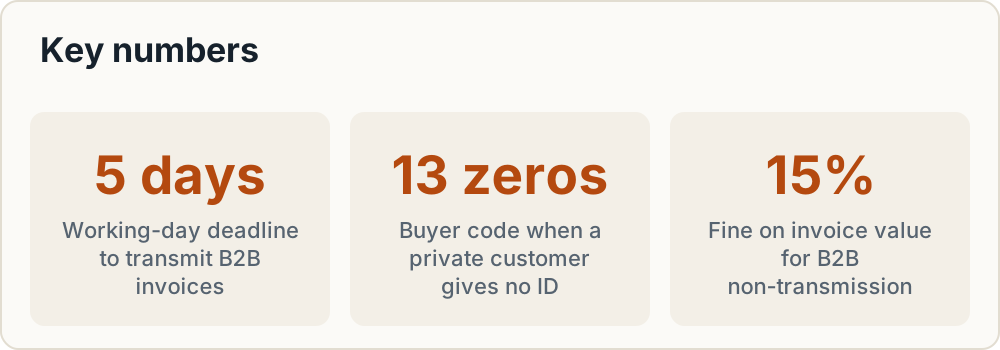
| Penalties | B2B non-transmission: 15% of invoice value. Late transmission: RON 1,000–10,000 depending on taxpayer size |
Mandatory B2C e-invoicing started on 1 January 2025 for Romanian-established suppliers. Fiscal receipts that meet the conditions for a simplified invoice were exempt, according to Capital.ro's summary of ANAF material. Many Romanian guides still describe that regime. They are out of date.
The change came with Law No. 88/2026, published in Monitorul Oficial no. 459 on 29 May 2026. It approves GEO 128/2024 and amends GEO 120/2021, which is the legal basis of RO e-Factura (Capital.ro). Infobuz reports that ANAF Order 1,021/2026, published on 3 September 2026, sets out how the changes are implemented.
Dates differ between sources. LookupTax and Infobuz give 1 June 2026 for the narrower supplier scope, including sellers identified only by CNP. Fiscal Solutions and Comarch give 1 July 2026 for the B2C reporting exemption. Before you rely on either date for invoices issued in June 2026, check it against the text of Law 88/2026 and the current ANAF RO e-Factura guide.
Who is in scope: three kinds of webshop
Whether the system applies depends on where the shop is established and whether it holds a Romanian VAT number. What the shop sells does not change this.
1. Shop established in Romania (SRL, PFA with CUI)
Invoices for supplies with place of supply in Romania are in scope. This includes invoices issued to non-established persons that are registered for VAT in Romania (Contabilul.manager.ro). Since Law 88/2026, B2B invoices are the core obligation.
A sole trader identified only by a CNP is a special case, covered below. What decides it is how the seller is identified for tax purposes, not the legal form. A PFA is not automatically exempt (Infobuz).
2. Foreign shop with a Romanian VAT number
Secondary sources report that a foreign business with a Romanian VAT number must send its invoices through RO e-Factura when the place of supply is in Romania (Beancount.io). Guidance from ANAF Brașov reportedly dates the B2B obligation for non-established VAT registrants from 1 January 2024. We could not extract the text of that PDF, so read it yourself or ask your Romanian fiscal representative to confirm.
3. Foreign shop selling to Romanian consumers via OSS only
The obligation is tied to Romanian establishment or Romanian VAT registration. Our reading is that a shop with neither, which declares Romanian B2C VAT through OSS, is not a RO e-Factura user. This is our inference. None of the sources we reviewed says so directly. Confirm it with an accountant before you rely on it. The registration side is covered in our guide to OSS VAT registration for a webshop.
B2B vs B2C: how RO e-Factura treats each order
B2B. The customer gives a Romanian CUI or VAT code. The invoice goes to ANAF as RO_CIUS XML within 5 working days. Failing to transmit can be fined at 15% of the invoice value (Capital.ro, 1stopVAT).
B2C. Under the amended rules, a supply is B2C when the customer gives no tax ID or identifies by CNP (Fiscal Solutions, Comarch).
Three edge cases matter for a webshop:
- Company ID at checkout. If a retail customer gives a company tax ID, an e-invoice is required (1stopVAT). A "company purchase" checkbox with a CUI field turns the order into B2B.
- Fiscal receipts. Simplified invoices in the form of fiscal receipts are outside the transmission rule (Contabilul.manager.ro). If your shop issues full invoices rather than fiscal receipts, this exception does not apply.
- Intra-EU supplies. If the buyer gives another member state's VAT code for an intra-Community supply, the invoice is excepted (same source).
The CNP case and the 13 zeros
Buyer side: 13 zeros when no ID is given
If a private customer gives no tax code, ANAF's wording requires "un cod alcătuit din 13 cifre de zero", a code made of 13 zeros, as quoted by Capital.ro. On the invoice this is 0000000000000 in the buyer identification field. Comarch confirms the substitute code and advises businesses to update their billing software. Do not leave the field blank.
A customer who gives a CNP is still a B2C customer. Do not route the CNP field through your shop's business tax ID logic.
A CNP is personal data. Ask for it only when you actually need it.
Seller side: CNP-identified suppliers are now optional
Under Law 88/2026, the mandatory scope no longer covers persons identified only by CNP, copyright-income earners, farmers under the special VAT regime or foreign cultural institutes. They may opt in (LookupTax). To withdraw from the optional register, a supplier files form 081 with section V completed. Withdrawal takes effect on the first day of the following month (Infobuz, Comarch).
Buyer in the optional register
If a natural person is registered in the RO e-Factura system, the transaction is treated as B2B and reporting is mandatory (1stopVAT). This is the main case where an order looks like B2C but must still be transmitted.
The 5 working days rule with a worked example
Since 1 January 2026, invoices must be transmitted within 5 working days, not calendar days. The rule was introduced by GEO 89/2025, which amends GEO 120/2021 (Contabilul.manager.ro). Days are counted under Regulation 1182/71. The issue date does not count, and weekends and public holidays are excluded.
Example 1: a normal week
Invoice issued Friday 16 October 2026.
| Working day | Date |
|---|---|
| 1 | Monday 19 October |
| 2 | Tuesday 20 October |
| 3 | Wednesday 21 October |
| 4 | Thursday 22 October |
| 5 | Friday 23 October (last day) |
Example 2: across public holidays
Invoice issued Friday 27 November 2026. In 2026, St Andrew's Day (30 November) falls on a Monday and National Day (1 December) on a Tuesday. Both are legal days off (Capital.ro holiday calendar).
| Working day | Date |
|---|---|
| — | Sat 28, Sun 29 Nov (weekend), Mon 30 Nov, Tue 1 Dec (holidays) |
| 1 | Wednesday 2 December |
| 2 | Thursday 3 December |
| 3 | Friday 4 December |
| 4 | Monday 7 December |
| 5 | Tuesday 8 December (last day) |
If you counted calendar days, the deadline would be 2 December. If you counted working days but forgot the holidays, it would be 4 December. The simplest policy is to transmit each invoice to ANAF on the day you issue it. Then you only need to count days when ANAF rejects a file or the system is down.
Penalties for late B2B transmission
| Taxpayer category | Fine for late transmission |
|---|---|
| Large taxpayers | RON 5,000–10,000 |
| Medium taxpayers | RON 2,500–5,000 |
| Other taxpayers | RON 1,000–2,500 |
Sources: Capital.ro, Fiscal Solutions. The fine for not transmitting a B2B invoice at all is reported as 15% of the invoice value. The 2026 change removed the transmission duty for most B2C invoices, so these fines now matter mainly for B2B orders and optional-register buyers.
Decision table: what to do for each order type
| Customer at checkout | Buyer ID field | Transmit to ANAF? | Deadline | Source |
|---|---|---|---|---|
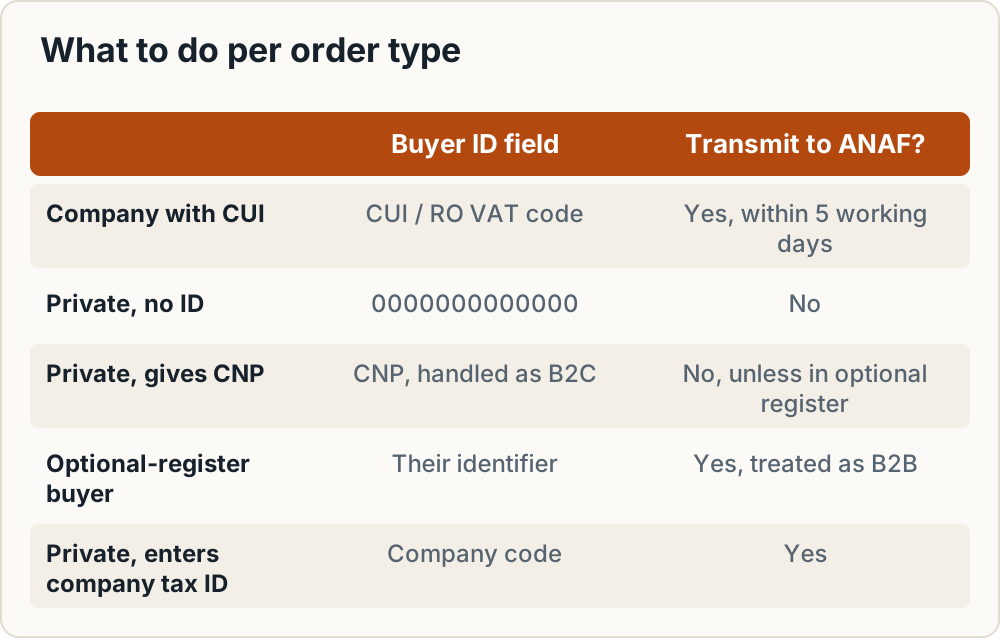
| Romanian company with CUI | CUI / RO VAT code | Yes, RO_CIUS XML | 5 working days | Capital.ro |
| Private person, no ID given | 0000000000000 |
No (from June–July 2026) | — | Fiscal Solutions |
| Private person giving a CNP | CNP, handled as B2C | No, unless in optional register | — | Comarch |
| Person in the optional register | Their identifier | Yes, treated as B2B | 5 working days | 1stopVAT |
| Private person entering a company tax ID | Company code | Yes | 5 working days | 1stopVAT |
| EU business with a non-Romanian VAT ID (intra-Community supply) | Their EU VAT code | No | — | Contabilul.manager.ro |
| Marketplace order (e.g. eMAG) | Depends on marketplace setup | Not verified | — | Check marketplace terms |
We have not verified how marketplace orders interact with RO e-Factura. Who issues the invoice, and under which ID, depends on the marketplace model. See our guide to selling on eMAG as a foreign seller. For comparison with a fully mandatory B2B system, read KSeF for your online shop in Poland.
What your invoicing tool must do: checklist
You can hand this list to a developer or SaaS vendor:
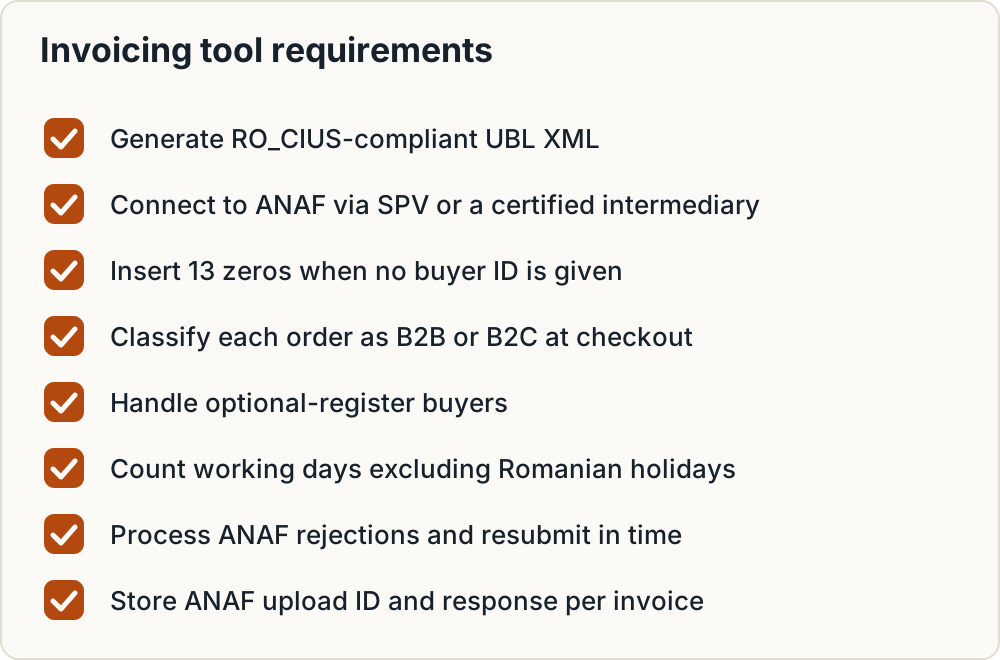
- Generate RO_CIUS-compliant UBL XML for every invoice that is transmitted.
- Connect to ANAF through SPV with OAuth authorisation, or through a certified intermediary. Know whose credentials are used and when the tokens expire.
- Insert 13 zeros automatically when a private customer gives no ID. Never send an empty field.
- Classify each order at checkout. A CUI or company tax ID switches the order to the B2B flow. A CNP or no ID keeps it in B2C.
- Handle optional-register buyers. The register is reported to be published on ANAF's site. Ask whether your vendor checks it, and confirm with ANAF whether a lookup is available. Until then, give B2B-type customers a way to say they are registered.
- Count working days, excluding Romanian public holidays, and alert before the fifth day.
- Process ANAF responses. Read rejection messages, fix the data and resubmit within the deadline.
- Store the ANAF upload ID and response with each invoice, and archive invoices for the period the law requires.
- Issue credit notes and refunds as e-Factura documents for B2B orders.
- Keep a changelog showing when the post-Law 88/2026 B2C logic went live.
Three questions to ask your vendor:
- Does the tool apply the post-Law 88/2026 B2C rules, including the optional-register exception?
- Does it support a non-established company with a Romanian VAT number?
- If ANAF's system is down near a deadline, does the tool retry automatically, and who monitors it?
Check your tool after the update. If it still transmits every B2C invoice under the 2025 logic, you are sending CNP data you no longer need to send. If it stopped transmitting for all private customers, it misses optional-register buyers, who must still be reported.
Frequently asked questions
Do I have to send B2C invoices to ANAF in 2026?
Mostly no, from June–July 2026. Romanian suppliers generally no longer transmit invoices to private customers who give no tax ID or only a CNP. The exception is a buyer in the optional e-Factura register: that sale counts as B2B and must be reported.
Does a PFA customer count as B2C?
It depends on how the PFA is identified for tax purposes, not on its legal form. A PFA that gives a CUI at checkout is a B2B customer. A person in the optional e-Factura register is also handled as B2B.
What is the penalty for not sending a B2B invoice?
Failing to transmit a B2B invoice is reported to carry a fine of 15% of the invoice value. Late transmission is fined from RON 1,000–2,500 for smaller taxpayers up to RON 5,000–10,000 for large taxpayers.
How does someone join or leave the optional register?
To leave, a supplier files ANAF form 081 with section V completed. Withdrawal takes effect on the first day of the following month, so update the customer's status from that date, not from the filing date. For the procedure to join, check the current ANAF guidance.
Which invoicing tools support RO e-Factura?
We have not tested individual tools. Compare any candidate against the checklist above. Focus on the post-2026 B2C logic, support for non-resident VAT registrants and working-day deadline tracking.
Next steps
- Find your case among the three scope types above. If you rely on the OSS-only reading, ask an accountant to confirm it in writing.
- Check your checkout. You need a separate CUI field, an optional CNP field, and an automatic 13-zero default for private customers.
- Ask your invoicing vendor for the date the Law 88/2026 logic went live. Test one B2B order and one B2C order.
- Set a policy to transmit on the day of issue. Add Romanian public holidays to your deadline alerts.
- Read the current ANAF RO e-Factura guide. If you hold a Romanian VAT number, settle the June vs July 2026 dates with a Romanian accountant.
- Work through the rest of your obligations with our EU compliance checklist for an online shop.
Sources
What this guide relies on, in the order cited.
- according to Capital.ro's summary of ANAF material · capital.ro
- Infobuz · infobuz.ro
- LookupTax · lookuptax.com
- Fiscal Solutions · fiscal-requirements.com
- Comarch · comarch.com
- text of Law 88/2026 · static.anaf.ro
- ANAF RO e-Factura guide · static.anaf.ro
- Contabilul.manager.ro · contabilul.manager.ro
- Beancount.io · beancount.io
- that PDF · static.anaf.ro
- 1stopVAT · 1stopvat.com
- Capital.ro holiday calendar · capital.ro